1
.
6
1
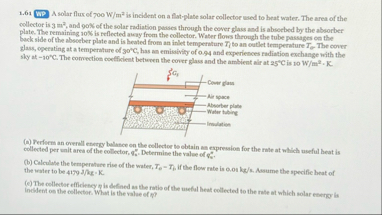
WD A solar flux of
7
0
0
W
m
2
is incident on a flat
-
plate solar collector used to heat water. The area of the collector is
3
m
2
,
and
9
0
%
of the solar radiation passes through the cover glass and is absorbed by the absorber plate. The remaining
1
0
%
ts reflected nery from the collector. Water flows through the tube passages on the back side of the absoeber plate and is heated from an inlet temperature
T
1
to an outlet temperature
T
0
.
The cover glass, operating at a temperature of
3
0
°
C
,
has an emissivity of
0
.
9
4
and experiences radiation exchange with the sky at
-
3
0
°
C
.
The correction coefficient between the cover glass and the ambient alr at
2
5
°
C
is
1
0
W
m
2
*
K
.
(
a
)
Ferform an overall energy bulance on the collector to obtain an expression for the rate at which useful heat is collected per wait area of the collector,
q
2
2
.
Determine the value of
q
2
2
.
(
b
)
Calculate the temperature rise of the water,
T
0
-
T
7
,
if the flow rate is
0
.
0
1
talk. Assume the specific hrat of Die waler to be
4
1
7
9
.
3
k
g
*
K
.
(
c
)
The cellettor efficiency is defined as the ratio of the useful heat collected to the rate at which solar exercy is indilent on the cellector. What is the value of
4
?6160 Av mht 0 te i ec dbo wt Tel
3 doth topes ce dy tr
me a Bs i le 0
ta nro 0 emp pene ER
To Ceri cs es eo ode cb
TT hte lt est
Sem fee tT ei eit
tm oh re
Question:
1
.
6
1
WD A solar flux of
7
0
0
W
m
2
is incident on a flat
-
plate solar collector used to heat water. The area of the collector is
3
m
2
,
and
9
0
%
of the solar radiation passes through the cover glass and is absorbed by the absorber plate. The remaining
1
0
%
ts reflected nery from the collector. Water flows through the tube passages on the back side of the absoeber plate and is heated from an inlet temperature
T
1
to an outlet temperature
T
0
.
The cover glass, operating at a temperature of
3
0
°
C
,
has an emissivity of
0
.
9
4
and experiences radiation exchange with the sky at
-
3
0
°
C
.
The correction coefficient between the cover glass and the ambient alr at
2
5
°
C
is
1
0
W
m
2
*
K
.
(
a
)
Ferform an overall energy bulance on the collector to obtain an expression for the rate at which useful heat is collected per wait area of the collector,
q
2
2
.
Determine the value of
q
2
2
.
(
b
)
Calculate the temperature rise of the water,
T
0
-
T
7
,
if the flow rate is
0
.
0
1
talk. Assume the specific hrat of Die waler to be
4
1
7
9
.
3
k
g
*
K
.
(
c
)
The cellettor efficiency is defined as the ratio of the useful heat collected to the rate at which solar exercy is indilent on the cellector. What is the value of
4
?6160 Av mht 0 te i ec dbo wt Tel
3 doth topes ce dy tr
me a Bs i le 0
ta nro 0 emp pene ER
To Ceri cs es eo ode cb
TT hte lt est
Sem fee tT ei eit
tm oh re
This is AI generated Response.
Asked by: Veera manikanta
Created at: 2025-08-22 22:43:05
VIPSolutions focuses on clear, step‑by‑step explanations so you can learn quickly. Whether you need an AI‑generated walkthrough or a short hint to get unstuck, each solution is organized for fast reading and easy review later.
Search similar questions, compare approaches, and bookmark the best answers for revision. Our goal is simple: quick, reliable study help that feels natural—not noisy.
 VIPSolutions
 6160 Av mht 0 te i ec dbo wt Tel
3 doth topes ce dy tr
me a Bs i le 0
ta nro 0 emp pene ER
To Ceri cs es eo ode cb
TT hte lt est
Sem fee tT ei eit
tm oh re