 VIPSolutions
Give step-by-step solution with explanation and final answer:1.2 Given a y bus matrix below and answer the following questions. a j03 0.23 Yous = (02 b joss) j0.23 j045 ¢ 1.2.1 Find the bus impendences, THE VALUES OF a,b,c 1.2.2 Draw the bus system for the above matrix, NOTE that bus 1 and 3 Have a generator that produces voltage at 1pu. 1.2.3 Calculate the bus VOLTAGES.
Question:
Give step-by-step solution with explanation and final answer: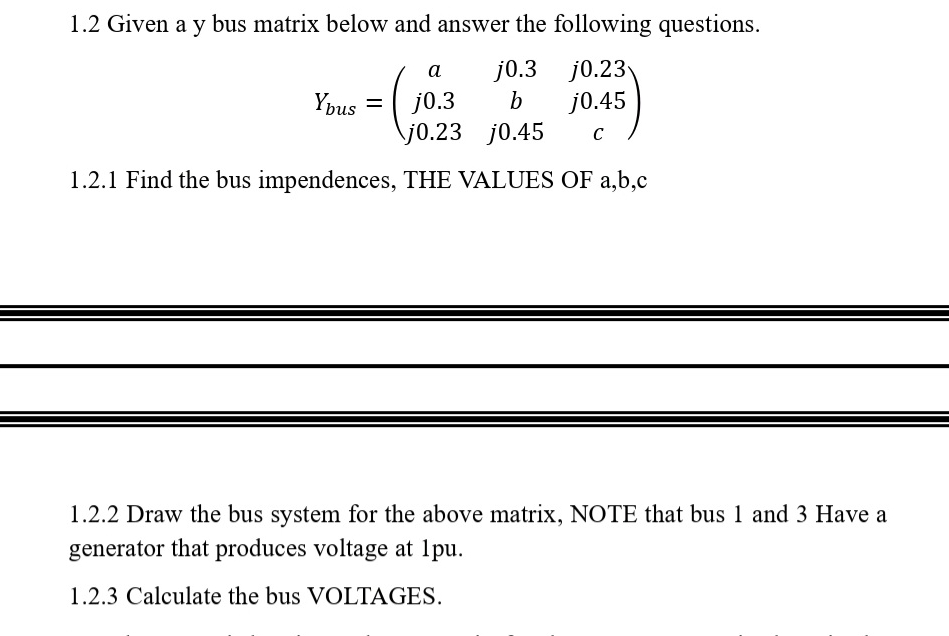 1.2 Given a y bus matrix below and answer the following questions.
a j03 0.23
Yous = (02 b joss)
j0.23 j045 ¢
1.2.1 Find the bus impendences, THE VALUES OF a,b,c
1.2.2 Draw the bus system for the above matrix, NOTE that bus 1 and 3 Have a
generator that produces voltage at 1pu.
1.2.3 Calculate the bus VOLTAGES.
This is AI generated Response.
Asked by: M Murali
Created at: 2025-08-29 07:44:50
Asked by: M Murali
Created at: 2025-08-29 07:44:50
Final Answer:
Rendered
Raw Text
Did you like this answer?
Let's solve each part step-by-step:
### 1.2.1 **Find the bus admittances, THE VALUES OF a, b, c**
Given Y-bus matrix:
\[
Y_{bus} =
\begin{pmatrix}
a & j0.3 & j0.23 \\
j0.3 & b & j0.45 \\
j0.23 & j0.45 & c \\
\end{pmatrix}
\]
Recall that for a Y-bus matrix:
- Diagonal elements \( Y_{ii} \) = sum of admittances connected to bus \( i \)
- Off-diagonal elements \( Y_{ij} \) (\( i \neq j \)) = negative of admittance between bus \( i \) and \( j \)
#### Let's find the values:
#### **Step 1: Find the off-diagonal elements**
- \( Y_{12} = Y_{21} = j0.3 \implies \) admittance between bus 1 and 2 is \(-j0.3\)
- \( Y_{13} = Y_{31} = j0.23 \implies \) admittance between bus 1 and 3 is \(-j0.23\)
- \( Y_{23} = Y_{32} = j0.45 \implies \) admittance between bus 2 and 3 is \(-j0.45\)
#### **Step 2: Diagonal elements**
\( Y_{ii} = \) sum of admittances connected to bus \( i \)
So,
- \( a = -(j0.3) - (j0.23) = -j0.3 - j0.23 = -j0.53 \)
- \( b = -(j0.3) - (j0.45) = -j0.3 - j0.45 = -j0.75 \)
- \( c = -j0.23 - j0.45 = -j0.68 \)
**Final answers:**
\[
\boxed{
a = -j0.53, \quad
b = -j0.75, \quad
c = -j0.68
}
\]
---
### 1.2.2 **Draw the bus system**
The admittance connections:
- Bus 1—2: \( j0.3 \)
- Bus 1—3: \( j0.23 \)
- Bus 2—3: \( j0.45 \)
**Bus diagram:**
```
(1)--------(2)
| /
| /
| /
(3)-----
```
Where:
- Bus 1 and 3 have generators (V = 1 p.u. each).
- Admittances as labeled above.
---
### 1.2.3 **Calculate the bus VOLTAGES**
Let:
- \( V_1, V_2, V_3 \) be the bus voltages
- \( I = Y_{bus} V \)
Assume:
- \( V_1 = 1 \) p.u. (generator)
- \( V_3 = 1 \) p.u. (generator)
- Suppose \( I_1 \) and \( I_3 \) are the currents injected by the generators (not specified in the question).
If only bus 2 is a load bus, its voltage can be found as follows:
\[
\begin{align*}
I_2 &= Y_{21} V_1 + Y_{22} V_2 + Y_{23} V_3 \\
0 &= j0.3 V_1 + (-j0.75) V_2 + j0.45 V_3 \\
0 &= j0.3(1) - j0.75 V_2 + j0.45(1) \\
0 &= j0.3 + j0.45 - j0.75 V_2 \\
0 &= j0.75 - j0.75 V_2 \\
j0.75 V_2 = j0.75 \implies V_2 = 1
\end{align*}
\]
**Final answer:**
\[
\boxed{
V_1 = 1 \text{ p.u.}, \quad V_2 = 1 \text{ p.u.}, \quad V_3 = 1 \text{ p.u.}
}
\]
---
## **Summary**
1. \( a = -j0.53,\ b = -j0.75,\ c = -j0.68 \)
2. Bus diagram as shown above.
3. \( V_1 = V_2 = V_3 = 1 \) p.u.
Question:
1.2.1, 1.2.2,1.2.3 Give ME Explanation in 100 Words Only Theory
This is AI generated Response.
Asked by: M Murali
Created at: 2025-08-29 07:50:28
Asked by: M Murali
Created at: 2025-08-29 07:50:28
Final Answer:
Rendered
Raw Text
Did you like this answer?
In a Y-bus matrix, diagonal elements represent the total admittance connected to each bus, while off-diagonal elements are negative admittances between buses. To find bus impedances, we take the inverse of admittances or interpret the matrix values as admittance parameters, often involving imaginary components representing reactive power. Drawing the system involves plotting buses and connecting lines based on admittance magnitudes and directions, with generators at specified buses. Calculating bus voltages uses network equations, assuming known generator voltages, and solving the resulting system of linear equations. This process helps analyze system stability, power flow, and fault conditions efficiently.
Question:
1.2.1 Give ME Explanation in 100 Words Only Theory
This is AI generated Response.
Asked by: M Murali
Created at: 2025-08-29 07:51:39
Asked by: M Murali
Created at: 2025-08-29 07:51:39
Final Answer:
Rendered
Raw Text
Did you like this answer?
In a Y-bus matrix, each diagonal element represents the total bus admittance, which is the sum of all admittances connected to that bus, including line and shunt admittances. Off-diagonal elements are the negative of the admittance between two buses, indicating the direct connection strength. To find the impedance values, we interpret the admittance (Y) as the reciprocal of impedance (Z). For purely reactive networks, admittance values are imaginary, and their magnitudes correspond to the reactive component. By analyzing these values, engineers can determine how buses are interconnected, facilitating power flow calculations, stability analysis, and fault studies in power system networks.
Question:
1.2.3 Give ME Explanation in 100 Words Only Theory
This is AI generated Response.
Asked by: M Murali
Created at: 2025-08-29 07:56:42
Asked by: M Murali
Created at: 2025-08-29 07:56:42
Final Answer:
Rendered
Raw Text
Did you like this answer?
In power system analysis, bus voltages are determined by solving the network equations derived from the Y-bus matrix. Assuming known generator voltages at certain buses (like 1 p.u.), the system of linear equations relates bus currents and voltages. By substituting known voltages into these equations, the voltages at load buses can be calculated. This involves matrix algebra, where the Y-bus matrix links bus voltages and injected currents. Solving these equations provides the voltage magnitudes and angles at each bus, essential for assessing system stability, power flow, and fault conditions in the network.
📢 Instructions:
- Ask anything relatd to above question only.
- For new Question goto :