 VIPSolutions
give answer in 2 step with explanation at the end of each step and final answer at the end:ER hg wali 0 720-2020 va ses he emt ee hs ee ett Cnr 1 0 ot cn = i re or Bt mtd ie prt i hn m5, [treet rr Frc = rng re et ps1 ety = Am fet pedir ROR fiver eat 2 Pt prin et rt pe mbTiee he pet te hee md ee. td on dtp TT sa hn mbt i i bpd PE a ror wee hey pm A A Cp 5 Comber mm om mC ee i etn, fe J I ——— A edt i Al ee ie ptt tan in Edler reper
Question:
give answer in 2 step with explanation at the end of each step and final answer at the end: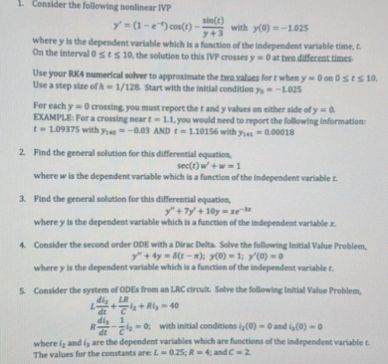 ER hg wali 0
720-2020 va ses
he emt ee hs ee ett
Cnr 1 0 ot cn = i
re or Bt mtd ie prt i hn m5,
[treet rr
Frc = rng re et ps1 ety =
Am fet pedir ROR
fiver eat
2 Pt prin et rt pe
mbTiee
he pet te hee md ee.
td on dtp
TT sa
hn mbt i i bpd
PE
a ror wee
hey pm A A Cp
5 Comber mm om mC ee i etn,
fe
J I ———
A edt i Al ee ie ptt tan
in Edler reper
This is AI generated Response.
Asked by: Pagal
Created at: 2025-09-04 03:59:02
Asked by: Pagal
Created at: 2025-09-04 03:59:02
Final Answer:
Rendered
Raw Text
Did you like this answer?
Sure! I'll tackle **Question 2** step-by-step, as requested:
---
### **2. Find the general solution for this differential equation.**
\[
\frac{dy}{dt} = \sec^2 (t)
\]
where \( y \) is the dependent variable and \( t \) is the independent variable.
---
#### **Step 1: Recognize the Type of Equation**
This is a **first-order ordinary differential equation (ODE)** and is *separable*. We can write:
\[
\frac{dy}{dt} = \sec^2 (t)
\]
To solve, integrate both sides with respect to \( t \):
\[
\int \frac{dy}{dt} dt = \int \sec^2 (t) dt
\]
**Explanation:**
We're using the property that the derivative of \( \tan(t) \) is \( \sec^2(t) \), and integrating both sides with respect to the independent variable \( t \).
---
#### **Step 2: Integrate Both Sides**
\[
y(t) = \int \sec^2 (t) dt = \tan(t) + C
\]
where \( C \) is the constant of integration.
**Explanation:**
This follows directly from the standard integral:
\[
\int \sec^2 (t) dt = \tan(t) + C
\]
---
### **Final Answer:**
\[
\boxed{y(t) = \tan(t) + C}
\]
where \( C \) is an arbitrary constant.
Question:
1
This is AI generated Response.
Asked by: Pagal
Created at: 2025-09-04 03:59:34
Asked by: Pagal
Created at: 2025-09-04 03:59:34
Final Answer:
Rendered
Raw Text
Did you like this answer?
Sure! Let's analyze the question step-by-step:
---
### **Step 1: Recognize the type of differential equation**
The given differential equation is:
\[
\frac{dy}{dt} = \sec^2 (t)
\]
**Explanation:**
This is a first-order differential equation where the derivative of \( y \) with respect to \( t \) is given explicitly. Since the right side depends only on \( t \), it is directly integrable with respect to \( t \).
---
### **Step 2: Integrate to find the general solution**
Integrate both sides with respect to \( t \):
\[
y(t) = \int \sec^2(t) dt + C
\]
Using the standard integral:
\[
\int \sec^2(t) dt = \tan(t) + C'
\]
where \( C' \) is an arbitrary constant (which can be renamed as \( C \)).
**Explanation:**
The integral of \( \sec^2(t) \) is a well-known result, \( \tan(t) + C \).
---
### **Final answer:**
\[
\boxed{y(t) = \tan(t) + C}
\]
where \( C \) is an arbitrary constant of integration.
📢 Instructions:
- Ask anything relatd to above question only.
- For new Question goto :