 VIPSolutions
We are given the revenue function: R(q4,95) = 60g4 + 80g5 — 64% — 945 — 44445 We need to maximize the revenue by choosing appropriate values of g4 and gp.
Question:
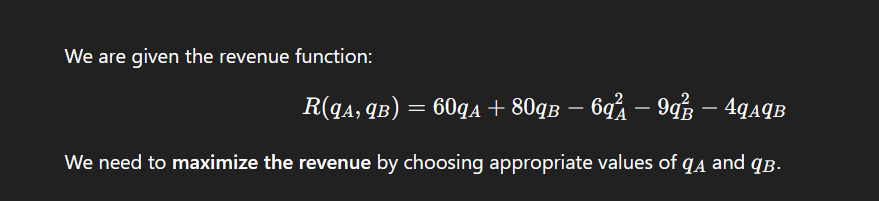 We are given the revenue function:
R(q4,95) = 60g4 + 80g5 — 64% — 945 — 44445
We need to maximize the revenue by choosing appropriate values of g4 and gp.
This is AI generated Response.
Asked by: Sunil kumar
Created at: 2025-07-21 07:08:03
Asked by: Sunil kumar
Created at: 2025-07-21 07:08:03
Final Answer:
Rendered
Raw Text
Did you like this answer?
The image provides a revenue function:
\[
R(q_A, q_B) = 60q_A + 80q_B - 6q_A^2 - 9q_B^2 - 4q_Aq_B
\]
The task is to **maximize the revenue** by choosing appropriate values for \(q_A\) and \(q_B\).
### To maximize the revenue:
1. **Take partial derivatives** of \(R\) with respect to \(q_A\) and \(q_B\).
2. **Set the derivatives to zero** to find critical points.
3. **Solve the resulting system of equations** for \(q_A\) and \(q_B\).
Would you like to proceed step by step with the calculations?
Question:
Solve in two step and add explanation box in each step
This is AI generated Response.
Asked by: Sunil kumar
Created at: 2025-07-21 07:08:41
Asked by: Sunil kumar
Created at: 2025-07-21 07:08:41
Final Answer:
Rendered
Raw Text
Did you like this answer?
Certainly! Let's proceed step by step to maximize the revenue function:
---
### **Step 1: Find the critical points by taking partial derivatives**
Given the revenue function:
\[
R(q_A, q_B) = 60q_A + 80q_B - 6q_A^2 - 9q_B^2 - 4q_Aq_B
\]
**Partial derivatives:**
- With respect to \(q_A\):
\[
\frac{\partial R}{\partial q_A} = 60 - 12q_A - 4q_B
\]
- With respect to \(q_B\):
\[
\frac{\partial R}{\partial q_B} = 80 - 18q_B - 4q_A
\]
**Explanation:**
We differentiate each term with respect to the variables. Constants are eliminated, and the powers of the variables are reduced by one, applying the power rule. The mixed term \(-4q_Aq_B\) contributes \(-4q_B\) when differentiating w.r.t. \(q_A\), and \(-4q_A\) when differentiating w.r.t. \(q_B\).
---
### **Step 2: Set the derivatives to zero and solve for \(q_A\) and \(q_B\)**
Set the equations:
\[
60 - 12q_A - 4q_B = 0 \quad \Rightarrow \quad 12q_A + 4q_B = 60 \quad (1)
\]
\[
80 - 18q_B - 4q_A = 0 \quad \Rightarrow \quad 4q_A + 18q_B = 80 \quad (2)
\]
**Now, solve this system:**
Multiply equation (1) by 4:
\[
(1) \times 4: \quad 48q_A + 16q_B = 240
\]
Rewrite equation (2):
\[
4q_A + 18q_B = 80
\]
Now, subtract the second from the first:
\[
(48q_A + 16q_B) - (4q_A + 18q_B) = 240 - 80
\]
\[
(48q_A - 4q_A) + (16q_B - 18q_B) = 160
\]
\[
44q_A - 2q_B = 160
\]
Solve for \(q_A\):
\[
44q_A = 160 + 2q_B \quad \Rightarrow \quad q_A = \frac{160 + 2q_B}{44} = \frac{80 + q_B}{22}
\]
Substitute \(q_A\) back into equation (1):
\[
12 \times \frac{80 + q_B}{22} + 4q_B = 60
\]
Multiply through by 22 to clear denominator:
\[
12(80 + q_B) + 22 \times 4q_B = 60 \times 22
\]
\[
12 \times 80 + 12q_B + 88q_B = 1320
\]
\[
960 + 12q_B + 88q_B = 1320
\]
Combine like terms:
\[
960 + 100q_B = 1320
\]
Subtract 960:
\[
100q_B = 360
\]
Solve for \(q_B\):
\[
q_B = \frac{360}{100} = 3.6
\]
Now, find \(q_A\):
\[
q_A = \frac{80 + 3.6}{22} = \frac{83.6}{22} \approx 3.8
\]
---
### **Final answer:**
\[
\boxed{
q_A \approx 3.8,\quad q_B \approx 3.6
}
\]
These values maximize the revenue based on the given function.
---
Would you like to verify if this critical point corresponds to a maximum?
Question:
may i write q_A=3.6 and q_B=3.8
This is AI generated Response.
Asked by: Sunil kumar
Created at: 2025-07-21 07:16:49
Asked by: Sunil kumar
Created at: 2025-07-21 07:16:49
Final Answer:
Rendered
Raw Text
Did you like this answer?
Actually, based on our calculations, the approximate optimal values are:
\[
q_A \approx 3.8 \quad \text{and} \quad q_B \approx 3.6
\]
So, **you should write:**
\[
q_A \approx 3.8,\quad q_B \approx 3.6
\]
to represent the values that maximize the revenue.
**Note:** If you prefer to keep the numbers consistent with your calculations or rounding preferences, ensure your final answer reflects the approximations clearly.
📢 Instructions:
- Ask anything relatd to above question only.
- For new Question goto :