 VIPSolutions
vw @ y out" | gen she g for the : ding?” 4 fink § am Fil LP Cs o—l 440 kN 3 Tm - sm Ld 5 2m EON A . == i Tay Lo mt free 2m A I [™ Ny | rey Xx; I ) 2025/08/05 15:35
Question:
 vw @
y out" | gen she
g for the
: ding?”
4 fink
§ am
Fil
LP
Cs o—l
440 kN
3 Tm
- sm
Ld 5
2m EON
A . ==
i
Tay
Lo mt
free
2m
A
I
[™
Ny
| rey Xx;
I
) 2025/08/05 15:35
This is AI generated Response.
Asked by: gorle prasanth
Created at: 2025-08-05 15:40:27
Asked by: gorle prasanth
Created at: 2025-08-05 15:40:27
Final Answer:
Rendered
Raw Text
Did you like this answer?
Let's analyze the given problem:
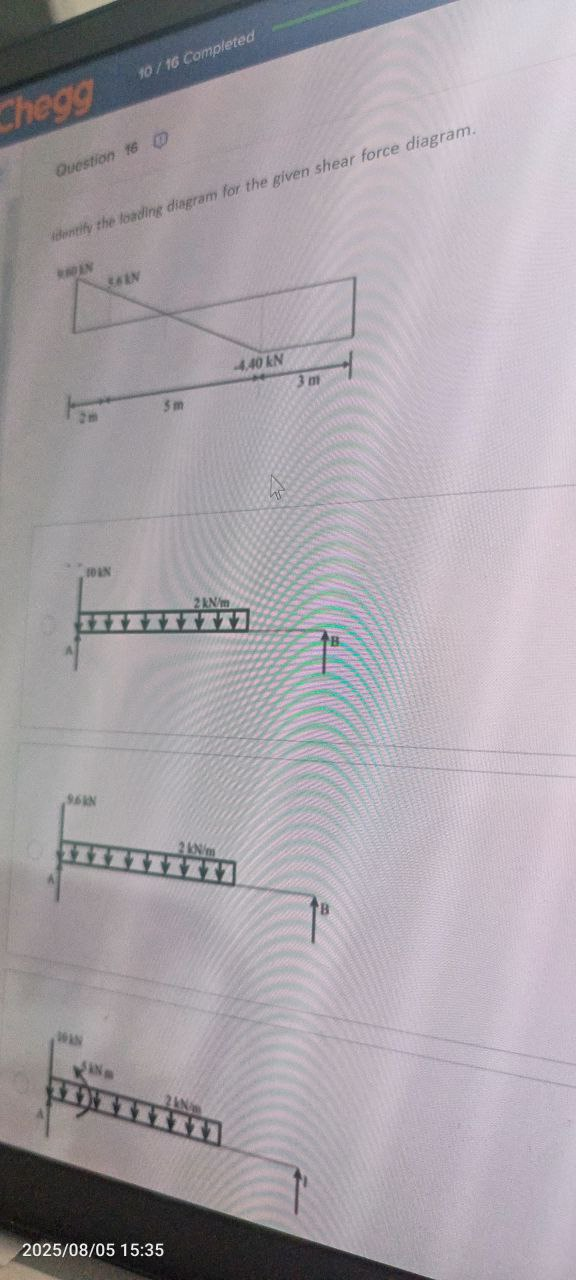
### Shear Force Diagram (Top Image):
- Starts at **+10 kN** at the left end.
- Decreases linearly to **0 kN** at 5 m.
- Continues to decrease linearly to **-4 kN** at 8 m.
### Loading Diagram Analysis:
- **A linear change in the shear force diagram** indicates a **uniformly distributed load (UDL)** on the beam.
- **A sudden jump in the shear force** would indicate a point load (which we do not see here).
### Matching with Options:
Looking at the three loading diagram options:
#### First Option:
- 10 kN point load at A, followed by a UDL of 2 kN/m. This would result in a sudden drop (jump) in the shear force diagram, which we do **not** see in the provided SFD.
#### Second Option:
- Only a UDL of 2 kN/m over the length AB. The shear force should **start at a value and decrease linearly**, but the starting value should match the area under the load up to that point.
#### Third Option:
- A UDL of 2 kN/m and a moment at A. The moment would affect the **bending moment diagram**, but not the shear force diagram directly.
### Calculating the Shear at Each Point:
If we only have a UDL:
- Shear at left end = Reaction at A.
- Shear decreases linearly due to the UDL.
Given that the shear force starts at +10 kN and ends at -4 kN after 8 m:
- Change in shear = -4 - 10 = -14 kN over 8 m.
- UDL = Change in shear / Length = 14/8 = 1.75 kN/m (very close to 2 kN/m, possibly rounded).
### **Conclusion:**
The **second option** (middle diagram) is most consistent with the given shear force diagram, as it represents a UDL of 2 kN/m over the entire span, which matches the linear decrease in the shear force diagram.
---
**Final Answer:**
**The correct loading diagram for the given shear force diagram is the second (middle) option.**
📢 Instructions:
- Ask anything relatd to above question only.
- For new Question goto :