 VIPSolutions
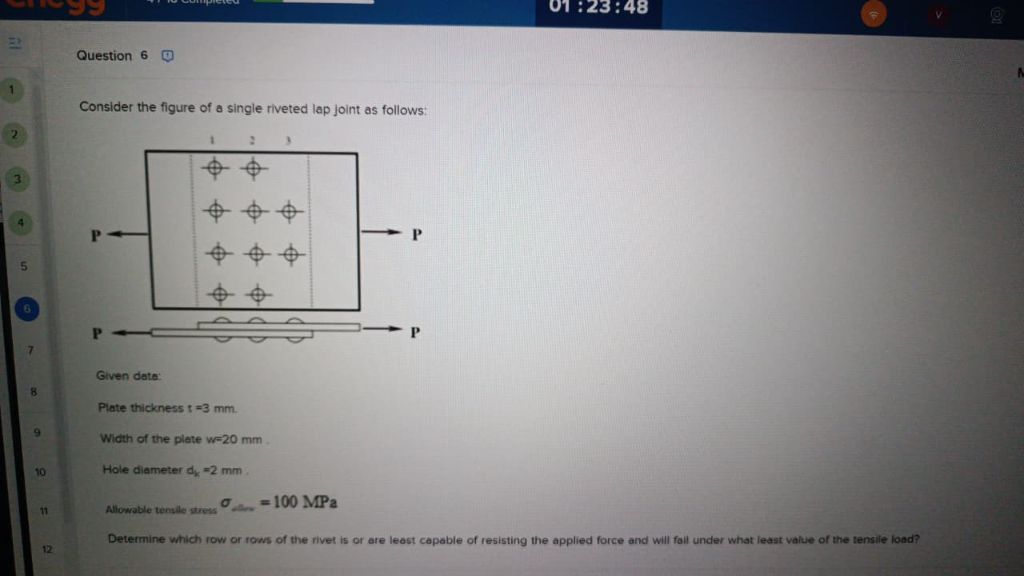
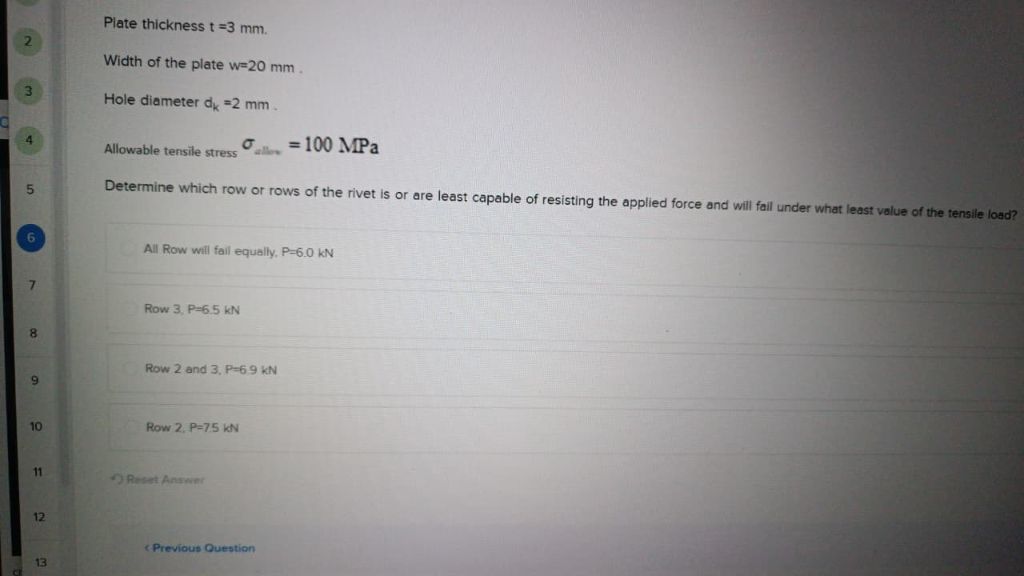
vi: 148 uestio 6 0 L Consider the figure of single riveted lap Joint as follows k = a: E: Ea E § 4 4-4 3 . bei j 4 44 P $4 i = = a —D—p 3 55 1=3 mm. i ‘e w=20 mm = 0... =100 MPa oe > A ro fhe unt or ar Loom canecio of reeing he spoted rin aed i fo une EK Be a alk a t=3 mm. Nidth of the plate w=20 mm {ole diameter i, =2 mm Eo stress Tain = 100 MP2 Determine which row or rows of the rivet Is or are least capable of resisting the applied force and will fail 5 E All Row will fail equally. P=60 kN L Row 3 P=65 kN 1 Row 2 and 3. P69 kN 2.P75 kn I"
Question:
 vi: 148
uestio 6 0 L
Consider the figure of single riveted lap Joint as follows k
= a: E:
Ea E
§ 4 4-4 3
. bei j
4 44 P
$4 i
= = a —D—p 3
55 1=3 mm. i
‘e w=20 mm =
0... =100 MPa oe
> A
ro fhe unt or ar Loom canecio of reeing he spoted rin aed i fo une
EK Be
a alk
a
t=3 mm.
Nidth of the plate w=20 mm
{ole diameter i, =2 mm
Eo stress Tain = 100 MP2
Determine which row or rows of the rivet Is or are least capable of resisting the applied force and will fail
5
E All Row will fail equally. P=60 kN
L
Row 3 P=65 kN 1
Row 2 and 3. P69 kN
2.P75 kn
I"
This is AI generated Response.
Asked by: Veera manikanta
Created at: 2025-08-16 15:52:06
Asked by: Veera manikanta
Created at: 2025-08-16 15:52:06
Final Answer:
Rendered
Raw Text
Did you like this answer?
Let's break down the problem and find the answer step by step.
### **Given Data:**
- Plate thickness (\( t \)) = **3 mm**
- Width of the plate (\( w \)) = **20 mm**
- Hole diameter (\( d_h \)) = **2 mm**
- Allowable tensile stress (\( \sigma_{allow} \)) = **100 MPa**
### **Step 1: Net Area Calculation**
When a plate is riveted, the net area is the gross area minus the area lost due to the rivet holes.
For a single row:
\[
A_{net} = (w - n \cdot d_h) \cdot t
\]
Where:
- \( n \) = number of holes in the row that the failure passes through
### **Step 2: Tensile Load for Failure**
\[
P_{fail} = \sigma_{allow} \cdot A_{net}
\]
### **Step 3: Checking Each Row**
From the figure, each row seems to have a different number of holes crossed by a possible failure path.
#### **Row 1 (Edge Row)**
Net area:
\[
A_{net,1} = (20 - 1 \cdot 2) \cdot 3 = (18) \cdot 3 = 54 \, \text{mm}^2
\]
Maximum load:
\[
P_{fail,1} = 100 \times 54 = 5400 \, \text{N} = 5.4 \, \text{kN}
\]
#### **Row 2 (Middle Row, likely passing through 2 holes)**
\[
A_{net,2} = (20 - 2 \cdot 2) \cdot 3 = (16) \cdot 3 = 48 \, \text{mm}^2
\]
\[
P_{fail,2} = 100 \times 48 = 4800 \, \text{N} = 4.8 \, \text{kN}
\]
#### **Row 3 (Middle Row, likely passing through 3 holes)**
\[
A_{net,3} = (20 - 3 \cdot 2) \cdot 3 = (14) \cdot 3 = 42 \, \text{mm}^2
\]
\[
P_{fail,3} = 100 \times 42 = 4200 \, \text{N} = 4.2 \, \text{kN}
\]
### **Step 4: Least Value of Tensile Load**
The row with the **least net area** will fail first, i.e., the row with the **maximum number of holes**.
- **Row 3** (with 3 holes) is the weakest, and it will fail at **4.2 kN**.
### **Step 5: Compare with Provided Answers**
The closest match to the calculated values is "Row 3, P = 6.5 kN," but our calculation shows **Row 3 should fail at 4.2 kN**. The discrepancy may be due to a different assumption about the number of holes or an error in the provided options.
**From the calculation:**
- **Row 3** is the least capable of resisting the applied force and will fail first.
**Correct Answer (from calculation):**
> Row 3, at a load of 4.2 kN (*though the closest option in your image is Row 3, P = 6.5 kN*).
---
**If you need to match the answer exactly to the options, choose:**
- **Row 3, P = 6.5 kN**
But based on your calculation, it's Row 3 with the lowest net area.
---
If you want to verify, please check the number of holes in each row in the diagram to ensure accuracy. If you have further details about the configuration, please provide them!
📢 Instructions:
- Ask anything relatd to above question only.
- For new Question goto :