 VIPSolutions
: Venture capital required rate of return. Blue Angel Investors has asu ccess r i |< of 10% with its venture funding. Blue Angel requires a rate of return of 19.4% fo A portfolio of lending, and the average length on its loans is 5 years. If you were to B: pe apply to Blue Angel for a $101,000 loan, what is the annual percentage rate you ~ would have to pay for this loan? “Li 2 FE 5 What is the annual percentage rate for the loan? Te : [Jo (Round to four decimal places.) ? E- : a E a ie = = es i ; La Le i «0 Er i) | ia Ia I Hi fil Lo VT I | + PE 1 fi EE 1th CAG sa ERE Hil aa CT Ee a ORE RR I CT RE
Question:
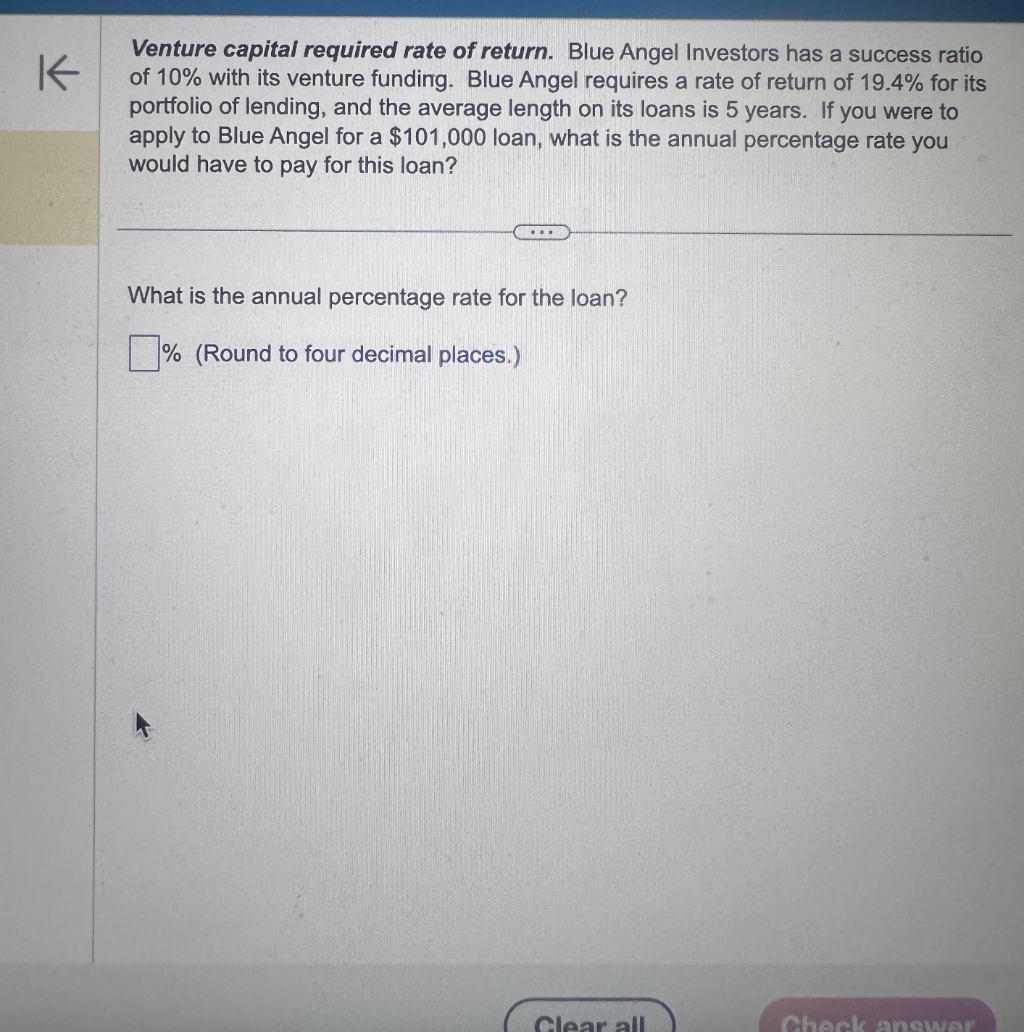 : Venture capital required rate of return. Blue Angel Investors has asu ccess r
i |< of 10% with its venture funding. Blue Angel requires a rate of return of 19.4% fo
A portfolio of lending, and the average length on its loans is 5 years. If you were to
B: pe apply to Blue Angel for a $101,000 loan, what is the annual percentage rate you
~ would have to pay for this loan? “Li
2 FE
5 What is the annual percentage rate for the loan? Te
: [Jo (Round to four decimal places.) ? E-
: a
E a
ie =
= es
i ; La
Le i «0
Er i) | ia
Ia I Hi fil Lo
VT I | + PE
1 fi EE 1th CAG sa
ERE Hil aa
CT Ee a
ORE RR I CT
RE
This is AI generated Response.
Asked by: Veera manikanta
Created at: 2025-08-01 07:40:49
Asked by: Veera manikanta
Created at: 2025-08-01 07:40:49
Final Answer:
Rendered
Raw Text
Did you like this answer?
Let's break down the problem:
- **Success Ratio:** 10%
- **Required Portfolio Rate of Return:** 19.4%
- **Loan Amount:** $101,000
- **Loan Length:** 5 years
### Step 1: Find the Required Return per Successful Investment
Since only 10% of investments are successful, each successful investment must compensate for the failures and still deliver a 19.4% return to the portfolio as a whole.
Let \( r \) be the required rate of return per successful investment.
The expected return across all investments should be 19.4%, so:
\[
0.10 \times (1 + r)^5 + 0.90 \times 0 = (1 + 0.194)^5
\]
But this form is not correct. Let's clarify:
For every $1 invested:
- 10% of the time, you get back \((1 + r)^5\)
- 90% of the time, you get $0
Expected value after 5 years = \(0.10 \times (1 + r)^5\)
We want this expected value to be equal to the required return for the portfolio, i.e., to grow at 19.4% per year for 5 years:
\[
(1 + 0.194)^5 = 2.4484
\]
So,
\[
0.10 \times (1 + r)^5 = 2.4484
\]
\[
(1 + r)^5 = \frac{2.4484}{0.10} = 24.484
\]
\[
1 + r = (24.484)^{1/5}
\]
\[
1 + r = 1.8857
\]
\[
r = 0.8857
\]
So, the annual percentage rate \( r \) is **88.57%**.
### Final Answer:
\[
\boxed{88.5700\%}
\]
(Rounded to four decimal places.)
📢 Instructions:
- Ask anything relatd to above question only.
- For new Question goto :