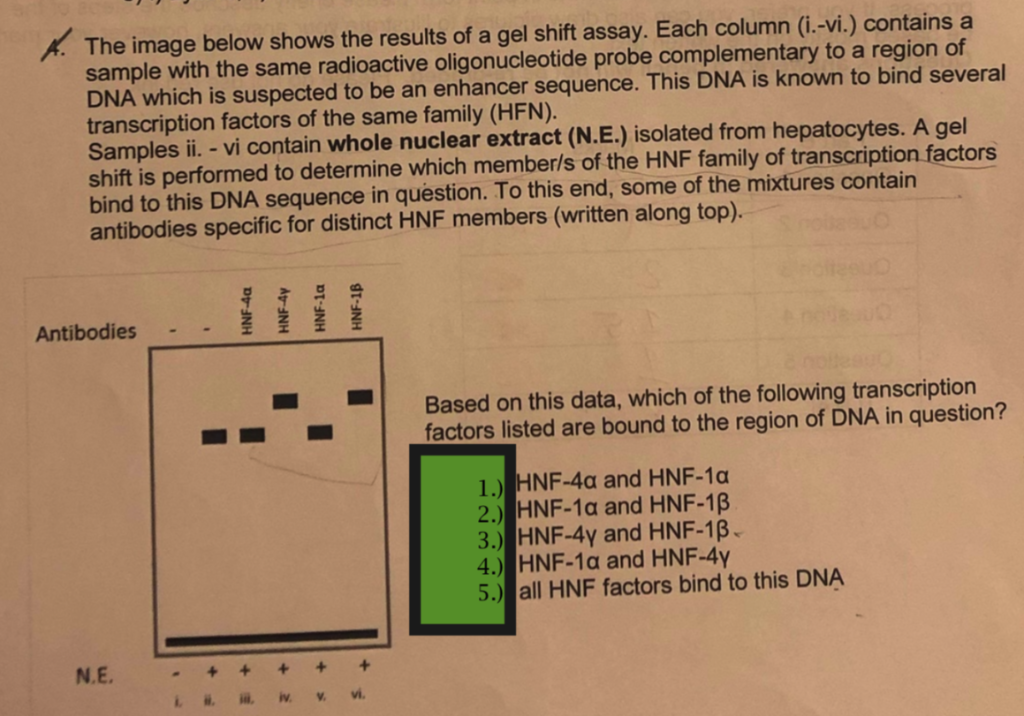
V4 The image below shows the results of a gel shift assay. Each column (i.-vi.) contains a
sample with the same radioactive oligonucleotide probe complementary to a region of
DNA which is suspected to be an enhancer sequence. This DNA is known to bind several
transcription factors of the same family (HFN).
Samples ii. - vi contain whole nuclear extract (N.E.) isolated from hepatocytes. A gel
shift is performed to determine which member/s of the HNF family of transcription factors
bind to this DNA sequence in question. To this end, some of the mixtures contain
antibodies specific for distinct HNF members (written along top).
§ 57322
ee”. 111%
Based on this data, which of the following transcription
factors listed are bound to the region of DNA in question?
NF-4a and HNF-1a
HNF-1a and HNF-1B
HNF-4y and HNF-1B..
HNF-1a and HNF-4y
all HNF factors bind to this DNA
NE. TTT Sh SR SE 4
LA - w v “.
Question:
V4 The image below shows the results of a gel shift assay. Each column (i.-vi.) contains a
sample with the same radioactive oligonucleotide probe complementary to a region of
DNA which is suspected to be an enhancer sequence. This DNA is known to bind several
transcription factors of the same family (HFN).
Samples ii. - vi contain whole nuclear extract (N.E.) isolated from hepatocytes. A gel
shift is performed to determine which member/s of the HNF family of transcription factors
bind to this DNA sequence in question. To this end, some of the mixtures contain
antibodies specific for distinct HNF members (written along top).
§ 57322
ee”. 111%
Based on this data, which of the following transcription
factors listed are bound to the region of DNA in question?
NF-4a and HNF-1a
HNF-1a and HNF-1B
HNF-4y and HNF-1B..
HNF-1a and HNF-4y
all HNF factors bind to this DNA
NE. TTT Sh SR SE 4
LA - w v “.
This is AI generated Response.
Asked by: Nikita Gaikwad
Created at: 2025-06-19 00:53:24
Final Answer:
RenderedRaw Text
Did you like this answer?
Let's break down the gel shift assay results:
- **Lane i (-)**: Contains DNA + nuclear extract (N.E.), no antibody. Shows a shifted band, indicating that a protein from the extract binds the DNA.
- **Lane ii (HNF-4α antibody)**: Shifted band moves to a higher position (supershift), indicating HNF-4α binds the DNA.
- **Lane iii (HNF-4γ antibody)**: No supershift, same as lane i, suggesting HNF-4γ does **not** bind the DNA.
- **Lane iv (HNF-1α antibody)**: Supershift, indicating HNF-1α binds the DNA.
- **Lane v (HNF-1β antibody)**: No supershift, suggesting HNF-1β does **not** bind the DNA.
**Interpretation:**
- Supershift occurs **only** with HNF-4α and HNF-1α antibodies, which means these proteins are binding to the DNA.
**Correct answer:**
> **1.) HNF-4α and HNF-1α**
Question:
explain more
This is AI generated Response.
Asked by: Nikita Gaikwad
Created at: 2025-06-19 00:53:45
Final Answer:
RenderedRaw Text
Did you like this answer?
Certainly! Let's analyze the gel shift (EMSA) data step-by-step to understand which transcription factors bind to the DNA sequence in question.
---
### Overview of the Gel Shift Assay Data:
| Lane | Description | Observation | Interpretation |
|--------|----------------|----------------|----------------|
| i. | DNA + nuclear extract (no antibody) | **Shifted band present** | Proteins in the extract bind the DNA, causing a shift. |
| ii. | DNA + nuclear extract + HNF-4α antibody | **Supershift (further shifted)** | HNF-4α binds the DNA; antibody binding causes a supershift. |
| iii. | DNA + nuclear extract + HNF-4γ antibody | **No supershift** | HNF-4γ does not bind the DNA. |
| iv. | DNA + nuclear extract + HNF-1α antibody | **Supershift** | HNF-1α binds the DNA. |
| v. | DNA + nuclear extract + HNF-1β antibody | **No supershift** | HNF-1β does not bind the DNA. |
---
### What is a supershift?
- When an antibody binds to a DNA-protein complex, it increases the size of the complex, resulting in a **supershift**—a band that migrates slower (higher position) on the gel.
- **Presence of a supershift indicates that the specific protein recognized by the antibody is part of the DNA-protein complex.**
---
### Interpretation:
- **HNF-4α**: The supershift in lane ii indicates HNF-4α binds the DNA.
- **HNF-4γ**: No supershift in lane iii suggests HNF-4γ does not bind.
- **HNF-1α**: The supershift in lane iv indicates HNF-1α binds.
- **HNF-1β**: No supershift in lane v suggests HNF-1β does not bind.
### Conclusion:
- **HNF-4α** and **HNF-1α** are the transcription factors binding to the DNA in this assay.
- The other HNF family members tested (HNF-4γ and HNF-1β) do not bind under these conditions.
---
### Final answer:
**HNF-4α and HNF-1α** are the transcription factors bound to this DNA region.
---
If you'd like, I can help clarify any part of this explanation further!
VIPSolutions focuses on clear, step‑by‑step explanations so you can learn quickly. Whether you need an AI‑generated walkthrough or a short hint to get unstuck, each solution is organized for fast reading and easy review later.
Search similar questions, compare approaches, and bookmark the best answers for revision. Our goal is simple: quick, reliable study help that feels natural—not noisy.
 VIPSolutions
 V4 The image below shows the results of a gel shift assay. Each column (i.-vi.) contains a
sample with the same radioactive oligonucleotide probe complementary to a region of
DNA which is suspected to be an enhancer sequence. This DNA is known to bind several
transcription factors of the same family (HFN).
Samples ii. - vi contain whole nuclear extract (N.E.) isolated from hepatocytes. A gel
shift is performed to determine which member/s of the HNF family of transcription factors
bind to this DNA sequence in question. To this end, some of the mixtures contain
antibodies specific for distinct HNF members (written along top).
§ 57322
ee”. 111%
Based on this data, which of the following transcription
factors listed are bound to the region of DNA in question?
NF-4a and HNF-1a
HNF-1a and HNF-1B
HNF-4y and HNF-1B..
HNF-1a and HNF-4y
all HNF factors bind to this DNA
NE. TTT Sh SR SE 4
LA - w v “.