 VIPSolutions
v Charges are distributed continuously along the path shown in the. alo weess figure, with uniform near charge density p,. The path consists of two semi-infinite straight ine segments parallel to the x-axis, one’ aty = +a and the other at y = -a, both extending from x = 0 to +a» These two segments are connected on the left by a semicircular =| X arc of radius a, centered a the origin O. ees. Find the electric field vector at the origin O due to this charge =) = distribution
Question:
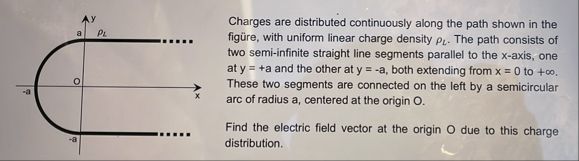 v Charges are distributed continuously along the path shown in the.
alo weess figure, with uniform near charge density p,. The path consists of
two semi-infinite straight ine segments parallel to the x-axis, one’
aty = +a and the other at y = -a, both extending from x = 0 to +a»
These two segments are connected on the left by a semicircular
=| X arc of radius a, centered a the origin O.
ees. Find the electric field vector at the origin O due to this charge
=) = distribution
This is AI generated Response.
Asked by: rohit singh
Created at: 2025-11-10 19:37:13
Asked by: rohit singh
Created at: 2025-11-10 19:37:13
Final Answer:
Rendered
Raw Text
Did you like this answer?
Let's break down the problem and solve for the **electric field at the origin O** due to the described charge distribution.
---
## **Problem Restatement- **Configuration
- Two semi-infinite lines parallel to \(x\)-axis at \(y = +a\) and \(y = -a\), from \(x = \) to \(x \to +\infty\)
- Connected at their left ends (\(x = \)) by a semicircular arc of radius \(a\), centered at \(O\)
- **Charge density:** Uniform, \(\rho_L\)
- **Find:** Electric field at \(O\).
---
## **Step 1: Semicircular Arc Contribution**
For a uniformly charged arc of radius \(a\) subtending angle \(\pi\) (semicircle):
- **Element:** \(dq = \rho_L a d\theta\), where \(\theta\) runs from \(\pi/2\) to \(3\pi/2\).
- **Position:** On the arc, \( \vec{r} = a(\cos\theta\,\hat{i} + \sin\theta\,\hat{j}) \)
- **Electric field due to \(dq\) at \(O\):**
\[
d\vec{E} = \frac{1}{4\pi\epsilon_} \frac{dq}{a^2} (-\cos\theta\,\hat{i} - \sin\theta\,\hat{j})
\]
(negative because direction is from element to \(O\))
Substitute \(dq\):
\[
d\vec{E} = \frac{\rho_L}{4\pi\epsilon_ a} (-\cos\theta\,\hat{i} - \sin\theta\,\hat{j}) d\theta
\]
- **Total arc field:**
\[
\vec{E}_{\text{arc}} = \frac{\rho_L}{4\pi\epsilon_ a} \int_{\pi/2}^{3\pi/2} (-\cos\theta\,\hat{i} - \sin\theta\,\hat{j}) d\theta
\]
Compute components:
- \( \int_{\pi/2}^{3\pi/2} -\cos\theta\,d\theta = -[\sin\theta]_{\pi/2}^{3\pi/2} = -[\sin(3\pi/2) - \sin(\pi/2)] = -[-1 - 1] = 2 \)
- \( \int_{\pi/2}^{3\pi/2} -\sin\theta\,d\theta = [\cos\theta]_{\pi/2}^{3\pi/2} = [\cos(3\pi/2) - \cos(\pi/2)] = [ - ] = \)
So,
\[
\vec{E}_{\text{arc}} = \frac{\rho_L}{4\pi\epsilon_ a} (2\hat{i})
= \frac{\rho_L}{2\pi\epsilon_ a} \hat{i}
\]
---
## **Step 2: Semi-infinite Lines Contribution**
For a **semi-infinite line** starting at \(x=\) and extending to \(x=+\infty\), parallel to x-axis, a perpendicular distance \(a\) from \(O\):
- Each line produces a field at \(O\):
- For line at \(y = +a\): \(dq = \rho_L dx\), position vector: \(x\hat{i} + a\hat{j}\)
- Distance from \(O\): \(r = \sqrt{x^2 + a^2}\)
- Direction from charge to \(O\): \(-x\hat{i} - a\hat{j}\)
\[
d\vec{E}_1 = \frac{1}{4\pi\epsilon_} \frac{\rho_L dx}{(x^2 + a^2)} \frac{-(x\hat{i} + a\hat{j})}{\sqrt{x^2 + a^2}}
\]
\[
d\vec{E}_1 = -\frac{\rho_L}{4\pi\epsilon_} \frac{x\hat{i} + a\hat{j}}{(x^2 + a^2)^{3/2}} dx
\]
Integrate \(x\) from \(\) to \(+\infty\).
\[
\vec{E}_1 = -\frac{\rho_L}{4\pi\epsilon_} \int_^{\infty} \frac{x\hat{i} + a\hat{j}}{(x^2 + a^2)^{3/2}} dx
\]
\(x\hat{i}\) term:
\[
\int_^{\infty} \frac{x}{(x^2 + a^2)^{3/2}} dx = \quad \text{(odd function about } x=\text{, integrated from to }\infty\text{)}
\]
\(a\hat{j}\) term:
\[
\int_^{\infty} \frac{a}{(x^2 + a^2)^{3/2}} dx
\]
Let \(x = a\tan\theta\), \(dx = a\sec^2\theta d\theta\), \(x^2 + a^2 = a^2\sec^2\theta\)
When \(x=\): \(\theta=\), \(x=\infty\): \(\theta \to \pi/2\)
\[
\int_^{\infty} \frac{a}{(x^2 + a^2)^{3/2}} dx = \int_^{\pi/2} \frac{a}{(a^2\sec^2\theta)^{3/2}} a\sec^2\theta d\theta
\]
\[
= \int_^{\pi/2} \frac{a^2\sec^2\theta}{a^3 \sec^3\theta} d\theta = \int_^{\pi/2} \frac{1}{a} \cos\theta d\theta
\]
\[
= \frac{1}{a} [\sin\theta]_^{\pi/2} = \frac{1}{a} (1 - ) = \frac{1}{a}
\]
So,
\[
\vec{E}_1 = -\frac{\rho_L}{4\pi\epsilon_} \left( \cdot\hat{i} + \frac{1}{a}\hat{j} \right) = -\frac{\rho_L}{4\pi\epsilon_ a}\hat{j}
\]
Similarly, for the segment at \(y = -a\), the field at \(O\) is:
\[
\vec{E}_2 = +\frac{\rho_L}{4\pi\epsilon_ a}\hat{j}
\]
So, the two straight segments **cancel out in the y-direction** and add nothing in the x-direction.
---
## **Step 3: Total Field at the Origin**
\[
\boxed{
\vec{E}_{\text{total}} = \frac{\rho_L}{2\pi\epsilon_ a} \hat{i}
}
\]
- **Direction:** Along the positive x-axis
- **Magnitude:** \( \frac{\rho_L}{2\pi\epsilon_ a} \)
---
### **Summary Table**
| Segment | Electric Field at O | Direction |
|------------------|----------------------------|-------------------|
| Semicircular arc | \( \frac{\rho_L}{2\pi\epsilon_ a} \) | \(+\hat{i}\) |
| Upper line | \( -\frac{\rho_L}{4\pi\epsilon_ a} \) | \(-\hat{j}\) |
| Lower line | \( +\frac{\rho_L}{4\pi\epsilon_ a} \) | \(+\hat{j}\) |
| **Total** | \( \frac{\rho_L}{2\pi\epsilon_ a} \) | \(+\hat{i}\) |
---
## **Final Answer**
\[
\boxed{
\vec{E}_O = \frac{\rho_L}{2\pi\epsilon_ a}\, \hat{i}
}
\]
**The electric field at the origin is directed to the right (along the positive x-axis) with the magnitude shown above.**
📢 Instructions:
- Ask anything relatd to above question only.
- For new Question goto :