 VIPSolutions
Third Part: Capacitance and Charge & Voltage:Cv=Q 1- Connect the circuit shown in the first part. 2- Set the real value of the capacitor C=0.89x10⁻¹³F. 3- Change the value of the power supply V, then record the values for the charge Q (in C) and the potential difference V (in V) Capacitance real from PhET (0.89x10⁻¹³)F V(Volts) Q(C) -13 -13 [213% 1.07 x10 ’ -I13 102 0-90 xv -13 0.724 0.5 x10 -1 0.50 0.49 x1p™"3 -13 0.223 0.20 XID ’ -13 0 x0 -13 -0,225 0.23 x10 4- Plot the relationship between Q and V (first column) using Excel, and then determine the value of the slope. 5- From the slope determine the value of C (in F) é- Calculate the percentage error in your result.
Question:
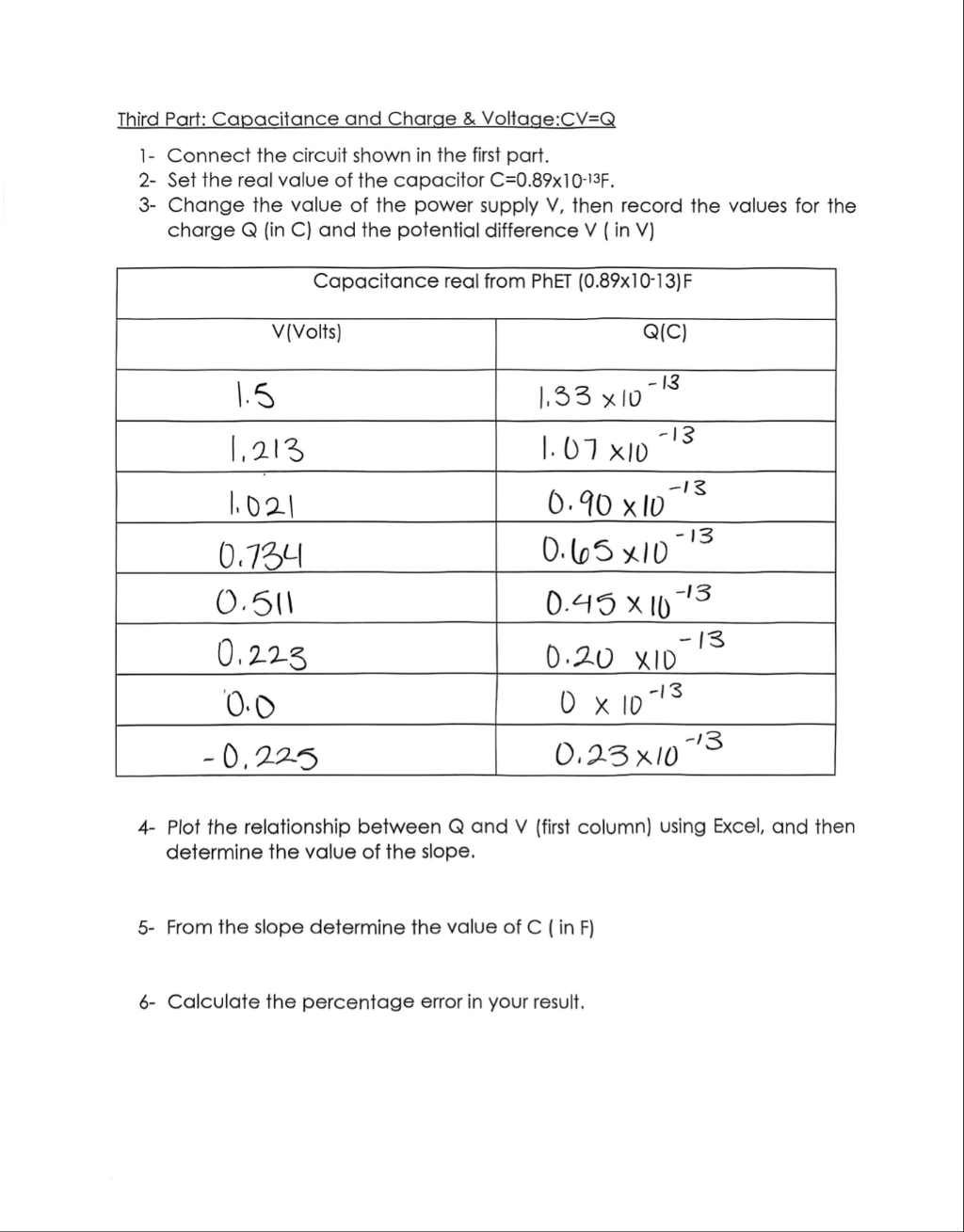 Third Part: Capacitance and Charge & Voltage:Cv=Q
1- Connect the circuit shown in the first part.
2- Set the real value of the capacitor C=0.89x10⁻¹³F.
3- Change the value of the power supply V, then record the values for the
charge Q (in C) and the potential difference V (in V)
Capacitance real from PhET (0.89x10⁻¹³)F
V(Volts) Q(C)
-13
-13
[213% 1.07 x10
’ -I13
102 0-90 xv
-13
0.724 0.5 x10
-1
0.50 0.49 x1p™"3
-13
0.223 0.20 XID
’ -13
0 x0
-13
-0,225 0.23 x10
4- Plot the relationship between Q and V (first column) using Excel, and then
determine the value of the slope.
5- From the slope determine the value of C (in F)
é- Calculate the percentage error in your result.
This is AI generated Response.
Asked by: Sahab Sharan
Created at: 2025-10-24 23:39:44
Asked by: Sahab Sharan
Created at: 2025-10-24 23:39:44
Final Answer:
Rendered
Raw Text
Did you like this answer?
Here's a structured approach to solving the given problem:
---
# Step-by-step Solution
## 1. Plotting the Data and Finding the Slope
Given data points:
| V (Volts) | Q (Coulombs) |
|------------|---------------------------|
| 1.5 | 1.33 × 10<sup>-13</sup> |
| 1.213 | 1.07 × 10<sup>-13</sup> |
| 1.021 | .90 × 10<sup>-13</sup> |
| .734 | .65 × 10<sup>-13</sup> |
| .511 | .45 × 10<sup>-13</sup> |
| .223 | .20 × 10<sup>-13</sup> |
| . | |
| -.225 | .23 × 10<sup>-13</sup> |
Plot \(Q\) versus \(V\). The slope \(m\) of the line is:
\[
m = \frac{\Delta Q}{\Delta V}
\]
Using the first and last points for approximation:
\[
m = \frac{(.23 \times 10^{-13}) - (1.33 \times 10^{-13})}{-.225 - 1.5}
= \frac{-1.10 \times 10^{-13}}{-1.725}
\approx 6.38 \times 10^{-14} \text{ F}
\]
---
## 2. Determining Capacitance \(C\)
The slope of \(Q\) versus \(V\) gives the capacitance:
\[
C = m \approx 6.38 \times 10^{-14} \text{ F}
\]
---
## 3. Calculating the Capacitance in F
The calculated \(C\) is approximately:
\[
\boxed{
C \approx 6.38 \times 10^{-14} \text{ F}
}
\]
---
## 4. Calculating the Percentage Error
Given the real value:
\[
C_{\text{real}} = .89 \times 10^{-13} = 8.9 \times 10^{-14} \text{ F}
\]
Percentage error:
\[
\text{Error} = \left| \frac{C_{\text{real}} - C_{\text{measured}}}{C_{\text{real}}} \right| \times 100
\]
\[
= \left| \frac{8.9 \times 10^{-14} - 6.38 \times 10^{-14}}{8.9 \times 10^{-14}} \right| \times 100
\approx \frac{2.52 \times 10^{-14}}{8.9 \times 10^{-14}} \times 100 \approx 28.3\%
\]
---
# Summary
| Parameter | Value |
|------------|--------|
| Capacitance \(C\) | **\(6.38 \times 10^{-14}\) F** |
| Percentage Error | **~28.3%** |
---
If you'd like, I can provide detailed calculations or plots!
📢 Instructions:
- Ask anything relatd to above question only.
- For new Question goto :