 VIPSolutions
The truss shown below consists of aluminum members that are pin connected together, and each member has a solid circular cross section. Member AB of the truss is loaded in compression and must be designed to resist buckling. Determine the minimum radius of ‘member AB to prevent Euler buckling with a factor of safety of 2. Let E = 10 x 10° psi. B on | A D 4fef—on—ri 1000 1b
Question:
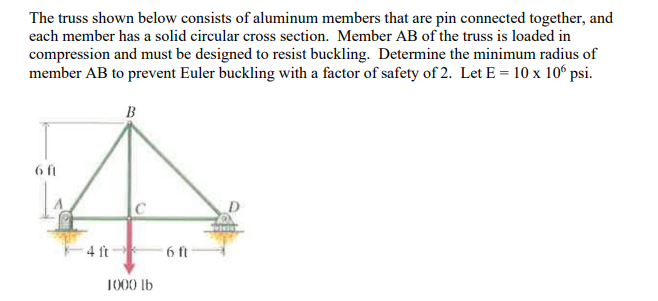 The truss shown below consists of aluminum members that are pin connected together, and
each member has a solid circular cross section. Member AB of the truss is loaded in
compression and must be designed to resist buckling. Determine the minimum radius of
‘member AB to prevent Euler buckling with a factor of safety of 2. Let E = 10 x 10° psi.
B
on
| A D
4fef—on—ri
1000 1b
This is AI generated Response.
Asked by: Satish Reddy
Created at: 2025-06-27 18:16:43
Asked by: Satish Reddy
Created at: 2025-06-27 18:16:43
Final Answer:
Rendered
Raw Text
Did you like this answer?
Let's break down the problem step by step:
### **1. Find the Force in Member AB**
First, we need to determine the force in member **AB**. This can be done using the method of joints. The vertical load of 1000 lbs is applied at joint **C**. Due to symmetry, the reactions at **A** and **D** will be equal and the truss will be symmetric.
#### **Step 1: Calculate the reactions at A and D**
Sum of moments about \( D \):
\[
\sum M_D = 0 \implies R_A \times 10 - 1000 \times 6 = 0
\]
\[
R_A = \frac{6000}{10} = 600 \text{ lb}
\]
Similarly, \( R_D = 1000 - R_A = 400 \) lb.
#### **Step 2: Analyze Joint A**
At joint **A**, considering only vertical and horizontal components:
Let \( F_{AB} \) be the force in member AB, and \( F_{AC} \) in AC.
For vertical equilibrium at joint A:
\[
\sum F_y = 0 \implies R_A + F_{AB} \sin \theta = 0
\]
\[
600 + F_{AB} \sin \theta = 0
\]
\[
F_{AB} = -\frac{600}{\sin \theta}
\]
Find \( \theta \) (angle between AB and the horizontal):
\[
\sin \theta = \frac{\text{opposite}}{\text{hypotenuse}} = \frac{6}{\sqrt{4^2+6^2}} = \frac{6}{\sqrt{16+36}} = \frac{6}{\sqrt{52}} = \frac{6}{7.211} = 0.832
\]
\[
F_{AB} = -\frac{600}{0.832} = -721 \text{ lb}
\]
(The negative sign indicates compression.)
---
### **2. Euler Buckling Formula**
The critical buckling load for a pin-ended column is:
\[
P_{cr} = \frac{\pi^2 E I}{(K L)^2}
\]
For pin-ended, \( K = 1 \).
- \( E = 10 \times 10^6 \) psi
- \( L \) (length AB): \( \sqrt{4^2 + 6^2} = 7.211 \) ft = \( 86.53 \) in.
---
### **3. Factor of Safety**
Required \( P_{cr} \) with a FOS of 2:
\[
P_{cr} \geq 2 \times |F_{AB}| = 2 \times 721 = 1442 \text{ lb}
\]
---
### **4. Moment of Inertia (I) in Terms of Radius of Gyration (r)**
For a solid circular cross-section:
\[
I = A r^2
\]
But for buckling:
\[
r = \sqrt{\frac{I}{A}}
\]
\[
P_{cr} = \frac{\pi^2 E I}{L^2}
\]
\[
I = \frac{P_{cr} L^2}{\pi^2 E}
\]
---
### **5. Solve for Minimum Radius of Gyration \( r \)**
\[
r = \sqrt{\frac{I}{A}}
\]
But since \( I = A r^2 \), and we don't know A, let's use the alternate form:
\[
P_{cr} = \frac{\pi^2 E A r^2}{L^2}
\]
\[
r^2 = \frac{P_{cr} L^2}{\pi^2 E A}
\]
But for buckling, the minimum radius of gyration required is:
\[
r_{min} = \frac{K L}{\pi} \sqrt{\frac{FOS \cdot P}{E A}}
\]
Instead, since \( P_{cr} = \frac{\pi^2 E I}{L^2} \), and \( I = A r^2 \), rearrange:
\[
r = \frac{L}{\pi} \sqrt{\frac{P_{cr}}{E A}}
\]
But since A cancels for solid circular sections, textbooks often use:
\[
\frac{L}{r} \leq \sqrt{\frac{\pi^2 E}{F_{max}}}
\]
Where \( F_{max} = \frac{P_{cr}}{A} \).
But let's use:
\[
I = \frac{P_{cr} L^2}{\pi^2 E}
\]
For a solid circular section:
\[
I = \frac{\pi}{64} d^4
\]
\[
A = \frac{\pi}{4} d^2
\]
\[
r = \sqrt{\frac{I}{A}} = \sqrt{\frac{\frac{\pi}{64} d^4}{\frac{\pi}{4} d^2}} = \sqrt{\frac{1}{16} d^2} = \frac{d}{4}
\]
So,
\[
I = A r^2
\]
So finally,
\[
r = \sqrt{\frac{I}{A}}
\]
But let's use:
\[
r = \sqrt{\frac{I}{A}} = \frac{L}{\pi} \sqrt{\frac{P_{cr}}{E A}}
\]
But since the minimum radius of gyration is independent of A for a minimum requirement:
\[
r_{min} = \sqrt{\frac{P_{cr} L^2}{\pi^2 E A}}
\]
But you can also use:
\[
P_{cr} = \frac{\pi^2 E A r^2}{L^2}
\]
So,
\[
r^2 = \frac{P_{cr} L^2}{\pi^2 E A}
\]
But for minimum, let’s just use:
\[
r_{min} = \frac{L}{\pi} \sqrt{\frac{P_{cr}}{E}}
\]
---
### **6. Plug in Values**
- \( L = 7.211 \) ft = \( 86.53 \) in
- \( E = 10 \times 10^6 \) psi
- \( P_{cr} = 1442 \) lb
\[
r_{min} = \frac{86.53}{\pi} \sqrt{\frac{1442}{10 \times 10^6}}
\]
Calculate:
\[
\frac{86.53}{\pi} = 27.54
\]
\[
\frac{1442}{10,000,000} = 0.0001442
\]
\[
\sqrt{0.0001442} = 0.01201
\]
\[
r_{min} = 27.54 \times 0.01201 = 0.331 \text{ in}
\]
---
## **Final Answer**
**The minimum radius of gyration of member AB to prevent Euler buckling with a factor of safety of 2 is:**
\[
\boxed{0.33 \text{ in}}
\]
If you need the minimum diameter for a solid circular section, recall \( r = \frac{d}{4} \), so:
\[
d_{min} = 4 \times r_{min} = 4 \times 0.33 = 1.32 \text{ in}
\]
📢 Instructions:
- Ask anything relatd to above question only.
- For new Question goto :