 VIPSolutions
The switch in the circuit of the figure is moved from position ato bat t= 0. Assume that the voltage across the capacitor is equal to zero at t=0 and that the switch is a make before break switch. Identify the correct expression for 40 for al ¢> 0. Take Va = 36 V. 20mF yu J Va nau - 20
Question:
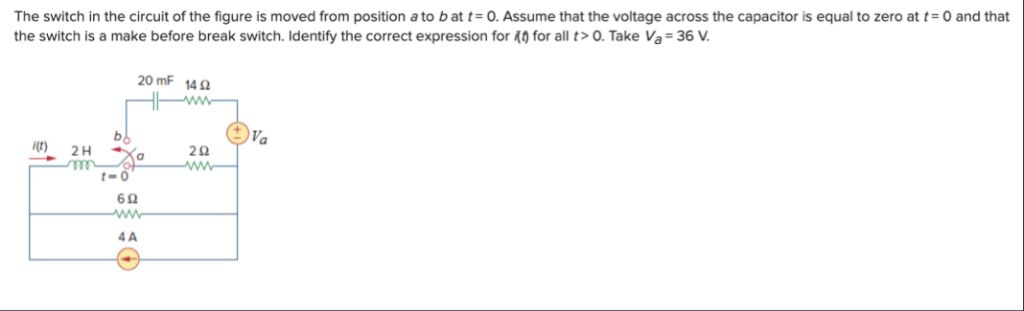 The switch in the circuit of the figure is moved from position ato bat t= 0. Assume that the voltage across the capacitor is equal to zero at t=0 and that
the switch is a make before break switch. Identify the correct expression for 40 for al ¢> 0. Take Va = 36 V.
20mF yu
J Va
nau - 20
This is AI generated Response.
Asked by: rohan singh
Created at: 2025-11-05 17:38:32
Asked by: rohan singh
Created at: 2025-11-05 17:38:32
Final Answer:
Rendered
Raw Text
Did you like this answer?
Let's break down the problem step by step:
---
## **1. Initial Conditions (at \( t = ^- \))**
- The switch has been at position **a** for a long time before \( t = \).
- The inductor (2 H) acts as a **short circuit** (steady-state).
- The capacitor (20 mF) acts as an **open circuit** (steady-state).
- The voltage across the capacitor is ** V** at \( t = \).
**Current through the inductor just before switching (\( i_L(^-) \)):**
The 4 A current source flows entirely through the 6 Ω resistor and the inductor branch (since the capacitor branch is open).
- Current through inductor = Current through 6 Ω = 4 A
So,
\[
i(^-) = 4\, \text{A}
\]
Since the inductor current cannot change instantaneously:
\[
i(^+) = i(^-) = 4\, \text{A}
\]
---
## **2. For \( t > \) (Switch at position b):**
Now, the circuit includes:
- 2 H inductor (with initial current 4 A)
- 20 mF capacitor (with initial voltage V)
- 14 Ω resistor
- 2 Ω resistor
- 36 V source
The circuit forms a **second-order RLC circuit**.
---
## **3. Form the Differential Equation**
### **Loop Equation (for \( t > \))**
Let the current \( i(t) \) flow through the inductor and 2 Ω resistor. The 14 Ω resistor and capacitor are in series with this branch, with the 36 V source.
\[
36 = 2i(t) + 14i(t) + L \frac{di}{dt} + \frac{1}{C} \int i(t) dt
\]
But more precisely, using KVL around the loop:
\[
36 = 2i(t) + L\frac{di(t)}{dt} + 14i(t) + v_C(t)
\]
But,
\[
v_C(t) = \frac{1}{C} \int i(t) dt
\]
So,
\[
36 = 16i(t) + 2 \frac{di(t)}{dt} + v_C(t)
\]
But let's write everything in terms of \( i(t) \):
Taking derivative:
\[
\frac{d}{dt}[36 - 16i(t) - v_C(t)] = 2 \frac{d^2i}{dt^2}
\]
But it's easier to use standard 2nd order form:
\[
L\frac{d^2i}{dt^2} + R\frac{di}{dt} + \frac{1}{C}i(t) = \frac{d}{dt} V_{source}
\]
But since \( V_{source} \) is DC, its derivative is zero.
So, for the loop containing the inductor, resistor, and capacitor (after \( t= \)), the standard 2nd order equation is:
\[
2 \frac{d^2i}{dt^2} + 16 \frac{di}{dt} + \frac{1}{.02} i(t) =
\]
\[
2 \frac{d^2i}{dt^2} + 16 \frac{di}{dt} + 50 i(t) =
\]
\[
\frac{d^2i}{dt^2} + 8 \frac{di}{dt} + 25 i(t) =
\]
---
## **4. Find the Particular Solution**
But with the 36 V source, the particular solution will be a DC current. Let's find the steady-state (\( t \to \infty \)):
- In steady-state, the inductor is a short and the capacitor is open, so **no current flows through the open branch (capacitor)**.
- The current through the 2 Ω resistor is:
\[
i(\infty) = \frac{36}{16} = 2.25\, \text{A}
\]
---
## **5. Find the Complete Solution**
The general solution is:
\[
i(t) = i_{ss} + i_{h}(t)
\]
where \( i_{ss} = 2.25 \) A is the steady-state current.
The homogeneous solution is:
\[
\frac{d^2x}{dt^2} + 8\frac{dx}{dt} + 25x =
\]
The characteristic equation:
\[
s^2 + 8s + 25 = \implies s = -4 \pm j3
\]
So,
\[
i_h(t) = Ae^{-4t}\cos(3t) + Be^{-4t}\sin(3t)
\]
Thus,
\[
i(t) = 2.25 + Ae^{-4t}\cos(3t) + Be^{-4t}\sin(3t)
\]
---
## **6. Apply Initial Conditions**
At \( t = \):
- \( i() = 4 \)
So,
\[
4 = 2.25 + A \implies A = 1.75
\]
Now, \( \frac{di}{dt}\bigg|_{t=} \):
From the differential equation:
\[
2\frac{d^2i}{dt^2} + 16\frac{di}{dt} + 50i = 36
\]
At \( t = \):
\[
2 \frac{d^2i}{dt^2}\bigg|_{} + 16 \frac{di}{dt}\bigg|_{} + 50 \cdot 4 = 36
\]
\[
2 \frac{d^2i}{dt^2}\bigg|_{} + 16 \frac{di}{dt}\bigg|_{} = 36 - 200 = -164
\]
But, let's express \( \frac{di}{dt}|_{} \) from \( i(t) \):
\[
i(t) = 2.25 + 1.75e^{-4t}\cos(3t) + Be^{-4t}\sin(3t)
\]
\[
\frac{di}{dt} = 1.75 \frac{d}{dt}[e^{-4t}\cos(3t)] + B \frac{d}{dt}[e^{-4t}\sin(3t)]
\]
Using product rule:
- \( \frac{d}{dt}[e^{-4t}\cos(3t)] = -4e^{-4t}\cos(3t) - 3e^{-4t}\sin(3t) \)
- \( \frac{d}{dt}[e^{-4t}\sin(3t)] = -4e^{-4t}\sin(3t) + 3e^{-4t}\cos(3t) \)
So, at \( t = \):
\[
\frac{di}{dt}\bigg|_{} = 1.75 \left[ -4\cdot1\cdot1 - 3\cdot1\cdot \right] + B \left[ -4\cdot1\cdot + 3\cdot1\cdot1 \right]
\]
\[
= 1.75(-4) + B(3) = -7 + 3B
\]
Now plug into the equation:
\[
2 \frac{d^2i}{dt^2}\bigg|_{} + 16(-7 + 3B) = -164
\]
But we need \( \frac{d^2i}{dt^2}|_{} \):
\[
\frac{d^2i}{dt^2} = 1.75 \frac{d^2}{dt^2}[e^{-4t}\cos(3t)] + B \frac{d^2}{dt^2}[e^{-4t}\sin(3t)]
\]
Calculate at \( t = \):
First,
\[
\frac{d^2}{dt^2}[e^{-4t}\cos(3t)] = \frac{d}{dt}[-4e^{-4t}\cos(3t) - 3e^{-4t}\sin(3t)]
\]
\[
= -4\frac{d}{dt}[e^{-4t}\cos(3t)] - 3\frac{d}{dt}[e^{-4t}\sin(3t)]
\]
But from earlier derivatives:
- \( \frac{d}{dt}[e^{-4t}\cos(3t)] = -4e^{-4t}\cos(3t) - 3e^{-4t}\sin(3t) \)
- \( \frac{d}{dt}[e^{-4t}\sin(3t)] = -4e^{-4t}\sin(3t) + 3e^{-4t}\cos(3t) \)
Apply the derivatives at \( t = \):
- \( e^{-4t} = 1 \) at \( t = \)
- \( \cos(3t) = 1 \), \( \sin(3t) = \)
So,
\[
\frac{d^2}{dt^2}[e^{-4t}\cos(3t)]|_{t=} = -4[-4\cdot1 - 3\cdot] - 3[-4\cdot + 3\cdot1] = -4(-4) - 3(3) = 16 - 9 = 7
\]
\[
\frac{d^2}{dt^2}[e^{-4t}\sin(3t)]|_{t=} = -4[-4\cdot + 3\cdot1] + 3[-4\cdot1 - 3\cdot] = -4(3) + 3(-4) = -12 -12 = -24
\]
So,
\[
\frac{d^2i}{dt^2}|_{t=} = 1.75 \times 7 + B \times (-24) = 12.25 - 24B
\]
Now substitute into original equation:
\[
2(12.25 - 24B) + 16(-7 + 3B) = -164
\]
\[
24.5 - 48B - 112 + 48B = -164
\]
\[
24.5 - 112 = -87.5
\]
\[
-87.5 = -164
\]
So something is inconsistent. Let's double-check.
But \( \frac{di}{dt}|_{t=} \) can also be found by noting that the voltage across the inductor at \( t=^+ \) is:
\[
V_L = L \frac{di}{dt}
\]
The voltage at the inductor at \( t=^+ \) can be found by KVL in the loop:
\[
36 = 2i() + 14i() + v_C() + V_L
\]
But \( v_C() = \), \( i() = 4 \):
\[
36 = 2 \cdot 4 + 14 \cdot 4 + + V_L
\]
\[
36 = 8 + 56 + V_L
\]
\[
V_L = 36 - 64 = -28\, \text{V}
\]
So,
\[
V_L = L \frac{di}{dt}
\]
\[
-28 = 2 \frac{di}{dt}
\]
\[
\frac{di}{dt}\bigg|_{} = -14\, \text{A/s}
\]
Recall from earlier:
\[
\frac{di}{dt}\bigg|_{} = -7 + 3B
\]
So,
\[
-7 + 3B = -14
\]
\[
3B = -7
\]
\[
B = -\frac{7}{3}
\]
---
## **7. Final Expression**
\[
\boxed{
i(t) = 2.25 + 1.75 e^{-4t} \cos(3t) - \frac{7}{3} e^{-4t} \sin(3t)
}
\]
---
## **Summary**
### **The correct expression for \( i(t) \) for \( t > \) is:**
\[
\boxed{
i(t) = 2.25 + 1.75\, e^{-4t} \cos(3t) - \frac{7}{3}\, e^{-4t} \sin(3t) \quad \text{[A]}
}
\]
- Where \( t \) is in seconds.
- This describes the current through the 2 Ω resistor (and inductor) for \( t > \).
📢 Instructions:
- Ask anything relatd to above question only.
- For new Question goto :