 VIPSolutions
The switch in the circuit of the figure is moved from position ato bat t= 0. Assume that the voltage across the capacitor is equal to zero at t=0 and that the switch is a make before break switch. Identify the correct expression for 40 for al ¢> 0. Take Va = 36 V. 20mF yu J Va nau - 20
Question:
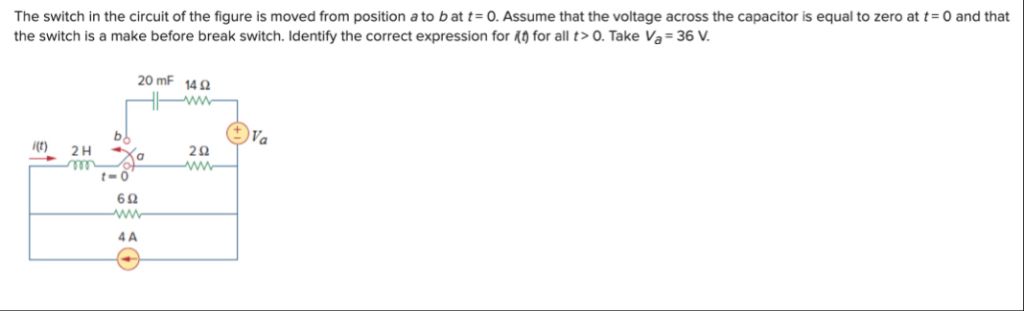 The switch in the circuit of the figure is moved from position ato bat t= 0. Assume that the voltage across the capacitor is equal to zero at t=0 and that
the switch is a make before break switch. Identify the correct expression for 40 for al ¢> 0. Take Va = 36 V.
20mF yu
J Va
nau - 20
This is AI generated Response.
Asked by: rohan singh
Created at: 2025-11-05 17:35:41
Asked by: rohan singh
Created at: 2025-11-05 17:35:41
Final Answer:
Rendered
Raw Text
Did you like this answer?
Let's break down the problem step by step.
---
## **Given:**
- The switch moves from **a** to **b** at \( t = \).
- Capacitor voltage is **** at \( t = \).
- \( V_a = 36\,\text{V} \)
- **Make-before-break** switch.
- Find **\( i(t) \) for \( t > \)**.
---
## **Step 1: Initial Conditions (For \( t < \))**
**Switch at \( a \):**
- Inductor: Acts as short circuit at steady state.
- Capacitor: Acts as open circuit at steady state.
**Current through Inductor (\( i_L(-) \)):**
The inductor is in series with the \( 6\,\Omega \) resistor and parallel to the \( 2\,\Omega \) resistor.
- Total resistance in left loop: \( 2\,\Omega + 6\,\Omega = 8\,\Omega \)
- Source: \( 4\,A \) current source
But since the current source is in parallel with the \( 6\,\Omega \) resistor, **all the current goes through the current source** (the \( 6\,\Omega \) branch is shorted by the current source). So:
\[
i_L(^-) = 4\,\text{A}
\]
---
## **Step 2: For \( t > \) (Switch at \( b \))**
**New Circuit:**
- The inductor, resistor (\( 14\,\Omega \)), and capacitor (\( 20\,\text{mF} \)), and \( V_a \) are in series.
The equivalent circuit for \( t > \):
- Inductor (\( L = 2\,\text{H} \))
- Resistor (\( R = 14\,\Omega \))
- Capacitor (\( C = 20\,\text{mF} = .02\,\text{F} \))
- Voltage source (\( V_a = 36\,\text{V} \))
---
## **Step 3: Writing the Differential Equation**
Apply KVL around the loop for \( t > \):
\[
V_a = L \frac{di}{dt} + Ri + \frac{1}{C} \int i\,dt
\]
Take derivative:
\[
= L\frac{d^2i}{dt^2} + R\frac{di}{dt} + \frac{i}{C}
\]
Plug values:
- \( L = 2 \)
- \( R = 14 \)
- \( C = .02 \)
\[
= 2\frac{d^2i}{dt^2} + 14\frac{di}{dt} + \frac{i}{.02}
\]
\[
= 2\frac{d^2i}{dt^2} + 14\frac{di}{dt} + 50i
\]
Move \( V_a \) to the right:
\[
36 = 2\frac{d^2i}{dt^2} + 14\frac{di}{dt} + 50i
\]
\[
\frac{d^2i}{dt^2} + 7\frac{di}{dt} + 25i = 18
\]
---
## **Step 4: Solving the Differential Equation**
**Homogeneous solution**:
\[
\frac{d^2i}{dt^2} + 7\frac{di}{dt} + 25i =
\]
Characteristic equation:
\[
s^2 + 7s + 25 =
\]
\[
s = \frac{-7 \pm \sqrt{49 - 100}}{2} = \frac{-7 \pm j\sqrt{51}}{2}
\]
\[
s = -3.5 \pm j\cdot 3.57
\]
So, the homogeneous solution:
\[
i_h(t) = e^{-3.5t}(A\cos(3.57t) + B\sin(3.57t))
\]
**Particular solution** (steady-state, for constant input):
Try \( i_p = I_ \):
\[
+ + 25I_ = 18 \implies I_ = .72
\]
**General solution:**
\[
i(t) = .72 + e^{-3.5t}(A\cos(3.57t) + B\sin(3.57t))
\]
---
## **Step 5: Initial Conditions**
- \( i() = i_L(^-) = 4\,\text{A} \)
- Initial capacitor voltage is , so \( v_C() = \).
Inductor's initial derivative (from KVL at \( t = \)):
\[
V_a = L\frac{di}{dt}\Big|_{t=} + Ri() + v_C()
\]
\[
36 = 2\frac{di}{dt}\Big|_{t=} + 14 \times 4 +
\]
\[
36 = 2\frac{di}{dt}\Big|_{t=} + 56
\]
\[
2\frac{di}{dt}\Big|_{t=} = 36 - 56 = -20
\]
\[
\frac{di}{dt}\Big|_{t=} = -10\,\text{A/s}
\]
---
### **Now apply initial conditions to the solution:**
\[
i(t) = .72 + e^{-3.5t}(A\cos(3.57t) + B\sin(3.57t))
\]
#### At \( t = \):
\[
i() = .72 + (A \cdot 1 + B \cdot ) = 4
\implies A = 4 - .72 = 3.28
\]
#### Derivative at \( t = \):
\[
\frac{di}{dt} = e^{-3.5t}\left[ -3.5(A\cos(3.57t) + B\sin(3.57t)) + A(-3.57)\sin(3.57t) + B(3.57)\cos(3.57t) \right]
\]
At \( t = \):
- \( \cos() = 1 \), \( \sin() = \), \( e^{} = 1 \)
\[
\frac{di}{dt}\Big|_{t=} = -3.5A + 3.57B
\]
Set to initial value:
\[
-3.5A + 3.57B = -10
\]
Plugging \( A = 3.28 \):
\[
-3.5 \times 3.28 + 3.57B = -10
\]
\[
-11.48 + 3.57B = -10
\]
\[
3.57B = 1.48
\]
\[
B = .415
\]
---
## **Final Solution**
\[
\boxed{
i(t) = .72 + e^{-3.5t}\left[3.28\cos(3.57t) + .415\sin(3.57t)\right] \qquad (t > )
}
\]
---
### **Summary Table**
| Parameter | Value |
|----------------|-----------|
| \( L \) | 2 H |
| \( R \) | 14 Ω |
| \( C \) | 20 mF |
| \( V_a \) | 36 V |
| \( i() \) | 4 A |
| \( \frac{di}{dt}() \) | -10 A/s |
---
Let me know if you need a step-by-step plot or further explanation!
📢 Instructions:
- Ask anything relatd to above question only.
- For new Question goto :