 VIPSolutions
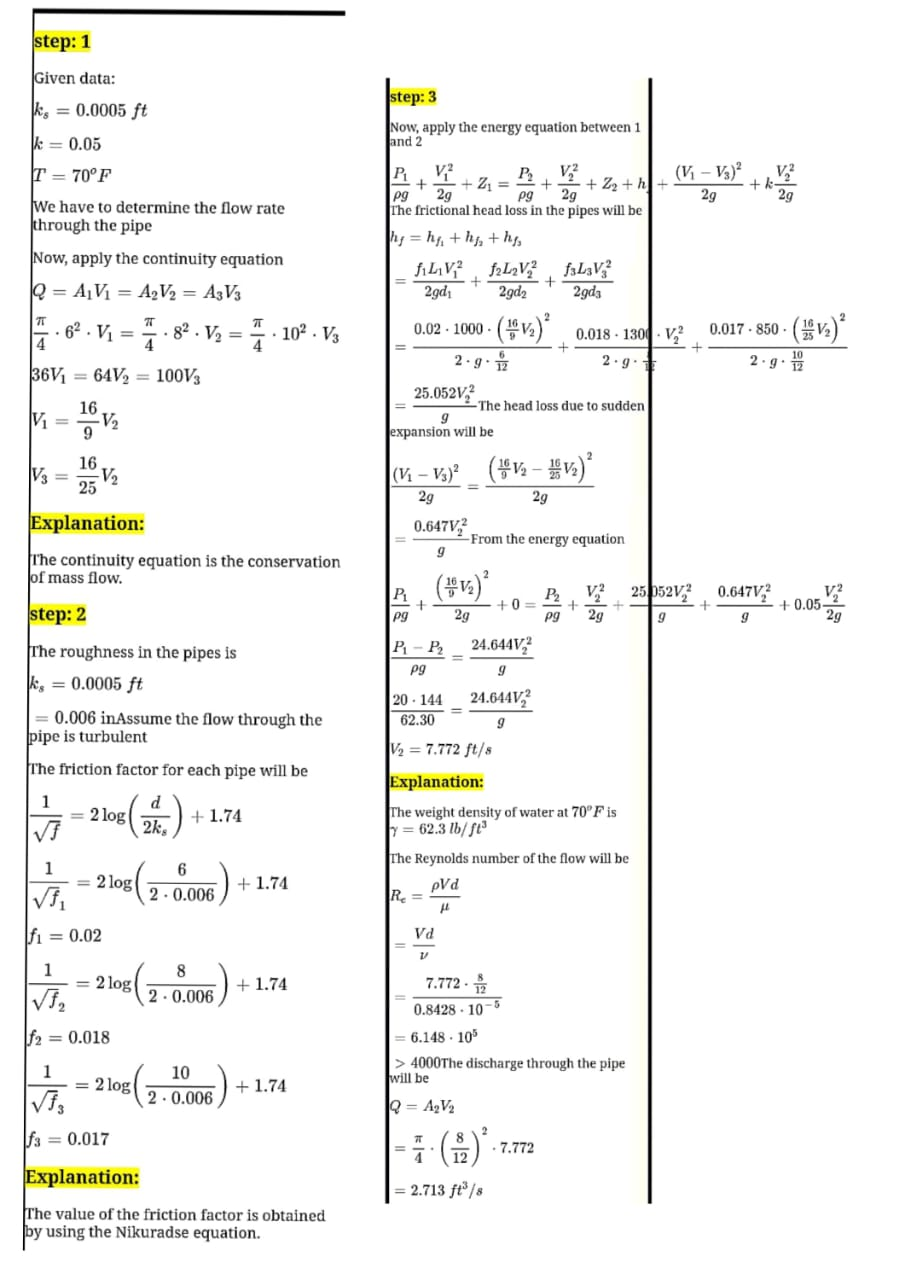
The pressure difference between points 1 and 2 in the series pipe system of the figure below is 20 psi. All the pipes are galvanized iron with roughness value of 0.0005 ft. The loss coefficient at the sudden contraction is 0.05. Determine the flow: rate in the system. The prevailing temperature is 70°F. 6inda OE nda | ooo son ———— 13001 a iven data: = 0.0005 ft Now, apply the energy equation between 1 k = 0.05 nd 2 v2 v2 w-w) WW =F LRN: BP PPA IRL A pg 29 pg 2 29 29 ‘e have to determine the flow rate The frictional head loss in the pipes will be rough the pipe hy = hy, + hy, + hy, Now, apply the continuity equation CALE ph fh = AV = MoV = AgVy FR Ta Tr f 2 PR I. a C8 Vh = I S107. 002-1000 ($2) 018.130. vz 0017-850 (23) —_— ee 2.9-% 2.9 2.9.3 6Vi = 64V; = 100V3 ” : 25.0521; 16 = ————=The head loss due to sudden i=—=W 9 [) xpansion will be 1 wy, Ly)’ vi = oy, vy (3% §w) 25 5 7 0.647V2 ———2 From the energy equation Ihe continuity equation is the conservation ? ) f 2 p ass flow Pp (Bw) py VE psn? 0edTv? v2 Lp 202 hy + ——2 + 0.055 Pg 29 2 9 9 2 2 e roughness in the pipes is Pp 204 Pg 9 ky = 0.0005 ft . 20-144 _ 24.60; = 0.006 inAssume the flow through the 230 5 ipe is turbulent a The friction factor for each pipe will be 1 d y 5 PF — — 2log( —— X ie weight density of water at 70°F is 77 ox +) +1 2 0 1 6 \e Reynolds number of the flow will be —— = 2log( -——— | + 1.74 Vd 77 (ams) * pV 1 " 1 = 0.02 va v 1 8 Ea 208) +174 7m. 4 2-0. — Vi, 0.008 05842810" f2 = 0.018 6.148 - 10° > 4000The discharge through the pipe 1 = 210g 10 ) +17 be Vi 20.006 er ] BH 3 = 0.017 x (8). =i (g) wm = 2.713 f%/s he value of the friction factor is obtained y using the Nikuradse equation.
Question:
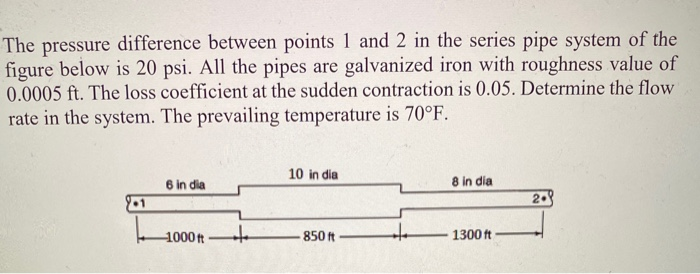
 The pressure difference between points 1 and 2 in the series pipe system of the
figure below is 20 psi. All the pipes are galvanized iron with roughness value of
0.0005 ft. The loss coefficient at the sudden contraction is 0.05. Determine the flow:
rate in the system. The prevailing temperature is 70°F.
6inda OE nda
| ooo son ———— 13001 a
iven data:
= 0.0005 ft
Now, apply the energy equation between 1
k = 0.05 nd 2
v2 v2 w-w) WW
=F LRN: BP PPA IRL A
pg 29 pg 2 29 29
‘e have to determine the flow rate The frictional head loss in the pipes will be
rough the pipe hy = hy, + hy, + hy,
Now, apply the continuity equation CALE ph fh
= AV = MoV = AgVy FR Ta Tr
f 2
PR I. a C8 Vh = I S107. 002-1000 ($2) 018.130. vz 0017-850 (23)
—_— ee
2.9-% 2.9 2.9.3
6Vi = 64V; = 100V3 ” :
25.0521;
16 = ————=The head loss due to sudden
i=—=W 9
[) xpansion will be
1 wy, Ly)’
vi = oy, vy (3% §w)
25 5 7
0.647V2
———2 From the energy equation
Ihe continuity equation is the conservation ? )
f 2 p
ass flow Pp (Bw) py VE psn? 0edTv? v2
Lp 202 hy + ——2 + 0.055
Pg 29 2 9 9 2
2
e roughness in the pipes is Pp 204
Pg 9
ky = 0.0005 ft .
20-144 _ 24.60;
= 0.006 inAssume the flow through the 230 5
ipe is turbulent a
The friction factor for each pipe will be
1 d y 5 PF
— — 2log( —— X ie weight density of water at 70°F is
77 ox +) +1 2 0
1 6 \e Reynolds number of the flow will be
—— = 2log( -——— | + 1.74 Vd
77 (ams) * pV
1 "
1 = 0.02 va
v
1 8
Ea 208) +174 7m. 4
2-0. —
Vi, 0.008 05842810"
f2 = 0.018 6.148 - 10°
> 4000The discharge through the pipe
1 = 210g 10 ) +17 be
Vi 20.006 er ]
BH
3 = 0.017 x (8).
=i (g) wm
= 2.713 f%/s
he value of the friction factor is obtained
y using the Nikuradse equation.
Asked by: MD ISRARUL HAQUE
Created at: 2025-08-27 20:14:39
Final Answer:
📢 Instructions:
- Ask anything relatd to above question only.
- For new Question goto :