 VIPSolutions
The pin-jointed truss shown is to be analysed to detemine its vertical displacement at joint D. The material and cross sectional geometry of th russ members are constant. NOTE : compression member forces are negative and tensile member forces are posite 10kN B§ —>20kN . | 3m 4m 3m ET ee TS For member AD, determine the value of 4 PL 10 be used in the calculation of te displacement. Present your value to 3 significant figures in kN Number
Question:
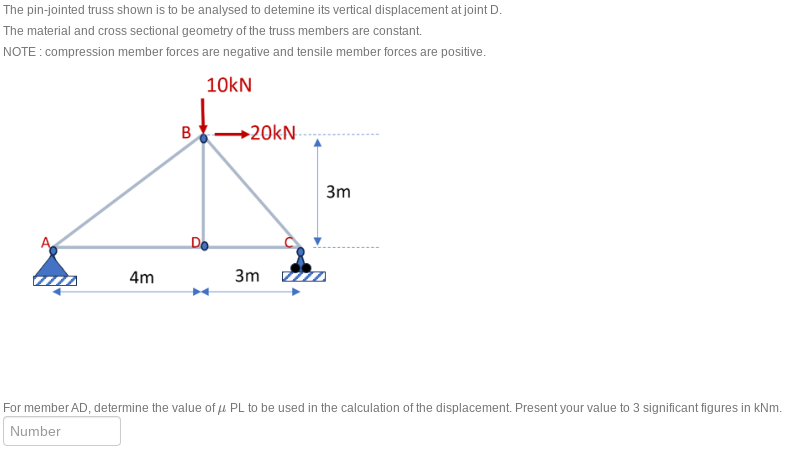 The pin-jointed truss shown is to be analysed to detemine its vertical displacement at joint D.
The material and cross sectional geometry of th russ members are constant.
NOTE : compression member forces are negative and tensile member forces are posite
10kN
B§ —>20kN .
| 3m
4m 3m
ET ee TS
For member AD, determine the value of 4 PL 10 be used in the calculation of te displacement. Present your value to 3 significant figures in kN
Number
This is AI generated Response.
Asked by: Bblue
Created at: 2025-07-27 06:44:36
Asked by: Bblue
Created at: 2025-07-27 06:44:36
Final Answer:
Rendered
Raw Text
Did you like this answer?
Let's break down the problem:
You are asked for **member AD**, to determine the value of \( \mu PL \) to be used in the displacement calculation. Typically,
- \( \mu \): Member force (in kN, either from the real structure or the virtual unit load case)
- \( P \): Member force due to the actual load
- \( L \): Length of the member (in m)
Since you are only asked for \( \mu PL \) for **member AD**, let's find its length first:
### Step 1: Length of Member AD
Member AD is horizontal, from A to D:
- \( L_{AD} = 4\, \text{m} \)
### Step 2: Virtual Unit Load (\( \mu \))
To find the vertical displacement at D, apply a **virtual unit load (1 kN)** vertically upward at D and analyze the member force in AD due to this virtual load. However, for member AD, the force due to a vertical load at D will be **zero** because the load is perpendicular to member AD (no vertical component in a horizontal member).
- \( \mu_{AD} = 0 \) (Force in AD due to a unit vertical load at D)
### Step 3: Real Load (\( P \))
You would need the force in member AD due to the actual loading. But since \( \mu_{AD} = 0 \), the product will be zero regardless of the value of \( P \).
### Step 4: Calculate \( \mu PL \) for member AD
\[
\mu_{AD} \cdot P_{AD} \cdot L_{AD} = 0 \cdot P_{AD} \cdot 4 = 0
\]
**Value (to 3 significant figures):**
\[
\boxed{0.00\ \text{kNm}}
\]
**Final Answer:**
> For member AD, the value of \( \mu PL \) to be used is **0.00 kNm**.
📢 Instructions:
- Ask anything relatd to above question only.
- For new Question goto :