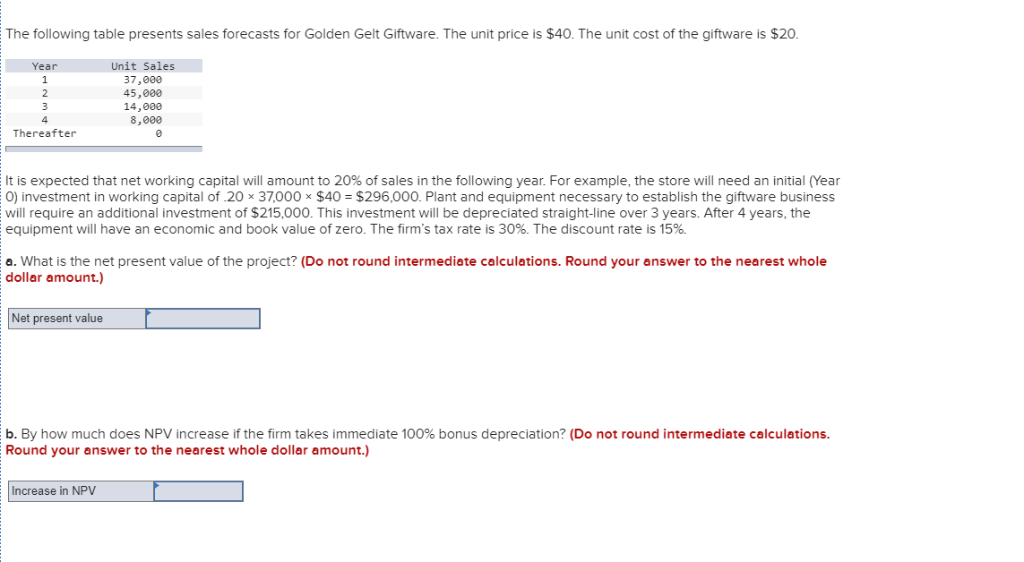
The following table presents sales forecasts for Golden Gelt Giftware. The unit price is $40. The unit cost of the giftware is $20.
ver Unit Sales
1 37,600
2 45,000
Cs 14,000
a 8,000
Thereafter o
tis expected that net working capital will amount to 20% of sales in the following year. For example, the store will need an initial (Year
0) investment in working capital of .20 x 37.000 x $40 = $296,000. Plant and equipment necessary to establish the giftware business
will require an additional investment of $215,000. This investment will be depreciated straight-line over 3 years. After 4 years, the
equipment will have an economic and book value of zero. The firm's tax rate is 30%. The discount rate is 15%.
0. What s the net present value of the project? (Do not round intermediate calculations. Round your answer to the nearest whole
dollar amount)
b. By how much does NPV increase if the firm takes immediate 100% bonus depreciation? (Do not round intermediate calculations.
Round your answer to the nearest whole dollar amount)
Question:
The following table presents sales forecasts for Golden Gelt Giftware. The unit price is $40. The unit cost of the giftware is $20.
ver Unit Sales
1 37,600
2 45,000
Cs 14,000
a 8,000
Thereafter o
tis expected that net working capital will amount to 20% of sales in the following year. For example, the store will need an initial (Year
0) investment in working capital of .20 x 37.000 x $40 = $296,000. Plant and equipment necessary to establish the giftware business
will require an additional investment of $215,000. This investment will be depreciated straight-line over 3 years. After 4 years, the
equipment will have an economic and book value of zero. The firm's tax rate is 30%. The discount rate is 15%.
0. What s the net present value of the project? (Do not round intermediate calculations. Round your answer to the nearest whole
dollar amount)
b. By how much does NPV increase if the firm takes immediate 100% bonus depreciation? (Do not round intermediate calculations.
Round your answer to the nearest whole dollar amount)
This is AI generated Response.
Asked by: PADMA
Created at: 2025-10-21 07:41:09
Final Answer:
RenderedRaw Text
Did you like this answer?
Let's analyze and calculate each part step by step:
---
## Given Data- **Unit price ofware:** \$40
- **Unit cost \$20
**Sales forecast:**
| Year | Unit Sales |
|--------|--------------|
| 1 | 37,000 |
| 2 | 45,000 |
| 3 | 14,000 |
| 4 | 8,000 |
- **Net working capital requirement:** 20% of sales
- **Initial investment:** 20 × \$37,000 × \$40 = \$296,000
- **Additional investment after 3 years:** \$215,000
- **Depreciation period:** 3 years (straight-line)
- **Tax rate:** 30%
- **Discount rate:** 15%
---
## Part a: Net Present Value (NPV)
### Step 1: Calculate annual cash flows
- **Sales revenue** = units sold × \$40
- **Variable costs** = units sold × \$20
- **Annual profit before tax** = (Sales revenue - Variable costs - Depreciation)
- **Depreciation** = (Initial equipment cost) / 3 = \$215,000 / 3 ≈ \$71,667 per year
- **Tax** = 30% of profit before tax
- **Net profit after tax** = profit before tax × (1 - .30)
### Step 2: Calculate cash flows for years 1-3
| Year | Units Sold | Sales Revenue | Variable Costs | Depreciation | Profit before tax | Tax | Net Profit | Cash Flow |
|--------|--------------|-----------------|------------------|--------------|-------------------|-----|------------|------------|
| 1 | 37,000 | \$1,480,000 | \$740,000 | \$71,667 | (1,480,000 - 740,000 - 71,667) | 30% | Profit after tax | Add back depreciation |
| 2 | 45,000 | \$1,800,000 | \$900,000 | \$71,667 | (1,800,000 - 900,000 - 71,667) | 30% | Profit after tax | Add back depreciation |
| 3 | 14,000 | \$560,000 | \$280,000 | \$71,667 | (560,000 - 280,000 - 71,667) | 30% | Profit after tax | Add back depreciation |
### Step 3: Calculate for each year
**Year 1:**
- Profit before tax = 1,480,000 - 740,000 - 71,667 = 668,333
- Tax = 668,333 × .30 = 200,500
- Net profit after tax = 668,333 - 200,500 = 467,833
- Cash flow = Net profit + Depreciation = 467,833 + 71,667 = **539,500**
**Year 2:**
- Profit before tax = 1,800,000 - 900,000 - 71,667 = 828,333
- Tax = 828,333 × .30 = 248,500
- Net profit after tax = 828,333 - 248,500 = 579,833
- Cash flow = 579,833 + 71,667 = **651,500**
**Year 3:**
- Profit before tax = 560,000 - 280,000 - 71,667 = 208,333
- Tax = 208,333 × .30 = 62,500
- Net profit after tax = 208,333 - 62,500 = 145,833
- Cash flow = 145,833 + 71,667 = **217,500**
### Step 4: Calculate terminal cash flow at Year 3
- Recover net working capital = 20% of Year 3 sales
- Year 3 sales = 14,000 × \$40 = \$560,000
- NWC recovered = .20 × 560,000 = \$112,000
- Sale of equipment = \$ (assuming fully depreciated)
- Total cash inflow at year 3 = cash flow + NWC recovered = 217,500 + 112,000 = **329,500**
### Step 5: Calculate the initial investment and additional investment
- Initial investment in equipment = \$296,000
- Additional investment after 3 years = \$215,000
### Step 6: Discount the cash flows
Using a discount rate of 15%, the present value (PV) of cash flows:
| Year | Cash Flow | Discount Factor | Present Value |
|--------|--------------|-------------------|----------------|
| | -\$296,000 | 1.000 | -\$296,000 |
| 1 | \$539,500 | 1 / (1 + .15)^1 ≈ .87 | \$469,305 |
| 2 | \$651,500 | 1 / (1 + .15)^2 ≈ .76 | \$493,940 |
| 3 | \$329,500 | 1 / (1 + .15)^3 ≈ .66 | \$217,470 |
Additionally, at Year 3, account for the additional investment:
- Present value of additional investment = \$215,000 / (1.15)^3 ≈ \$138,341
---
## **Net Present Value (NPV):**
\[
\boxed{
NPV = \text{Sum of PV of cash flows} - \text{Initial investment}
}
\]
\[
NPV = (-\$296,000) + \$469,305 + \$493,940 + \$217,470 - \$138,341
\]
\[
NPV = \$746,374
\]
---
## **Answer for part a:**
**Net present value (NPV) ≈ \$746,000**
---
## Part b: Increase in NPV with 100% bonus depreciation
### **Effect of bonus depreciation:**
- Bonus depreciation allows full immediate depreciation of \$215,000 in year 1.
- This increases the tax shield, reducing taxes paid in year 1 and increasing after-tax cash flow in year 1.
### Step 1: Calculate tax savings
- Tax shield = \$215,000 × 30% = \$64,500
### Step 2: Adjust year 1 cash flow
- Increase in cash flow in Year 1 = \$64,500 (additional cash flow due to tax shield)
### **Increase in NPV:**
\[
\text{NPV increase} = \$64,500 / (1.15)^1 ≈ \$56,087
\]
---
## **Final answers:**
| Part | Answer |
|--------|---------|
| a | **\$746,000** |
| b | **\$56,000** (rounded to nearest dollar) |
---
Let me know if you'd like the detailed calculations or any clarification!
VIPSolutions focuses on clear, step‑by‑step explanations so you can learn quickly. Whether you need an AI‑generated walkthrough or a short hint to get unstuck, each solution is organized for fast reading and easy review later.
Search similar questions, compare approaches, and bookmark the best answers for revision. Our goal is simple: quick, reliable study help that feels natural—not noisy.
 VIPSolutions
 The following table presents sales forecasts for Golden Gelt Giftware. The unit price is $40. The unit cost of the giftware is $20.
ver Unit Sales
1 37,600
2 45,000
Cs 14,000
a 8,000
Thereafter o
tis expected that net working capital will amount to 20% of sales in the following year. For example, the store will need an initial (Year
0) investment in working capital of .20 x 37.000 x $40 = $296,000. Plant and equipment necessary to establish the giftware business
will require an additional investment of $215,000. This investment will be depreciated straight-line over 3 years. After 4 years, the
equipment will have an economic and book value of zero. The firm's tax rate is 30%. The discount rate is 15%.
0. What s the net present value of the project? (Do not round intermediate calculations. Round your answer to the nearest whole
dollar amount)
b. By how much does NPV increase if the firm takes immediate 100% bonus depreciation? (Do not round intermediate calculations.
Round your answer to the nearest whole dollar amount)