 VIPSolutions
The diagram below shows a Initial block of mass m resting y d 4 against a spring with spring Vo=0 constant k that has been ol Hii il [m compressed a distance x. — After the block has slid a n Final ThE surface has distance d, it has speed vy. y . erin The coefficient of kinetic — Vi#0 friction between the block 00) : 0 and surface is py. The system i includes everything. 1. Draw the energy bar chart for this situation. — — 2. Use conservation of energy to write an equation describing the situation in question 1. Your equation must be expressed in terms of m, k, d, x, vf, p;, and g. Hint: Type ‘'mu_K' to enter i, into your expression.
Question:
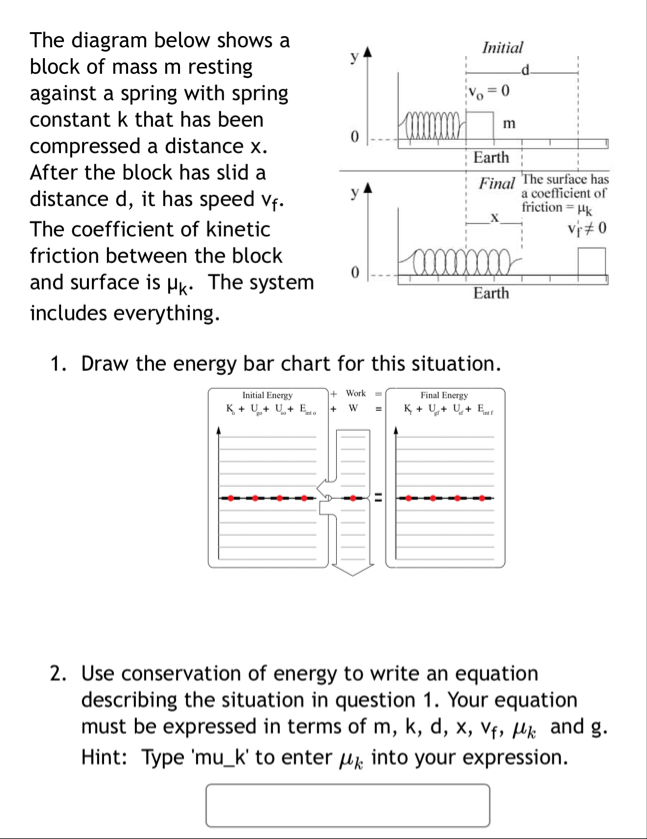 The diagram below shows a Initial
block of mass m resting y d 4
against a spring with spring Vo=0
constant k that has been ol Hii il [m
compressed a distance x. —
After the block has slid a n Final ThE surface has
distance d, it has speed vy. y . erin
The coefficient of kinetic — Vi#0
friction between the block 00)
: 0
and surface is py. The system i
includes everything.
1. Draw the energy bar chart for this situation.
— —
2. Use conservation of energy to write an equation
describing the situation in question 1. Your equation
must be expressed in terms of m, k, d, x, vf, p;, and g.
Hint: Type ‘'mu_K' to enter i, into your expression.
This is AI generated Response.
Asked by: Sahab Sharan
Created at: 2025-10-23 04:37:37
Asked by: Sahab Sharan
Created at: 2025-10-23 04:37:37
Final Answer:
Rendered
Raw Text
Did you like this answer?
Let's analyze the problem step by step:
---
# Energy Bar Chart Construction
## Initial Energy
- block of mass \( m \) starts at rest, so initial kinetic energy KE_{initial} = ).
- The has potential energy due to its height \( d \):
\[
PE_{initial} = m g d
\]
The spring is by a distance \( x \), storing elastic potential energy:
\[
PE_{spring} = \frac{1}{2} k x^2
\]
**Initial total energy:**
\[
E_{initial} = PE_{initial} + PE_{spring} = m g d + \frac{1}{2} k x^2
\]
---
## Final Energy
- After the block slides a distance \( d \), it has velocity \( v_f \).
- The potential energy due to height becomes zero (assuming it slides onto the surface at ground level).
- The spring is no longer compressed, so elastic potential energy is zero.
- The kinetic energy of the block is:
\[
KE_{final} = \frac{1}{2} m v_f^2
\]
- The surface has a coefficient of kinetic friction \( \mu_k \), which dissipates energy as work done against friction:
\[
W_{friction} = \mu_k m g d
\]
---
# Energy Bar Chart
### Initial state:
- Elastic potential energy: \( \frac{1}{2} k x^2 \)
- Gravitational potential energy: \( m g d \)
- Kinetic energy:
### Final state:
- Kinetic energy: \( \frac{1}{2} m v_f^2 \)
- Work done against friction: \( \mu_k m g d \)
---
# Energy Conservation Equation
Using conservation of energy, the initial energy minus the work done by friction equals the final kinetic energy:
\[
m g d + \frac{1}{2} k x^2 = \frac{1}{2} m v_f^2 + \mu_k m g d
\]
---
# Summary
The key equation describing the situation is:
\[
\boxed{
\frac{1}{2} m v_f^2 = m g d + \frac{1}{2} k x^2 - \mu_k m g d
}
\]
or equivalently:
\[
\boxed{
\frac{1}{2} m v_f^2 = (1 - \mu_k) m g d + \frac{1}{2} k x^2
}
\]
This equation accounts for the initial energy, energy lost due to friction, and the kinetic energy after sliding.
---
Feel free to ask if you'd like assistance with drawing the energy bar chart!
📢 Instructions:
- Ask anything relatd to above question only.
- For new Question goto :