 VIPSolutions
Take a= 12 in. and = 45°. (Figure 1) « Pata Determine the moment of inertia I, for the beam's cross-sectional area. Express your answer using three significant figures. o . “hoa Request Answer v ParB Determine the moment of inertia I, for the beam's cross-sectional area. Express your answer using three significant figures. ETE Figure 1of1 Request Answer y . B v Parc Determine the product of inertia Iq for the beam's cross-sectional area. a Express your answer using three significant figures. o . | TEE fo binpbpsine in. - oe 2in. 2in. Lun in
Question:
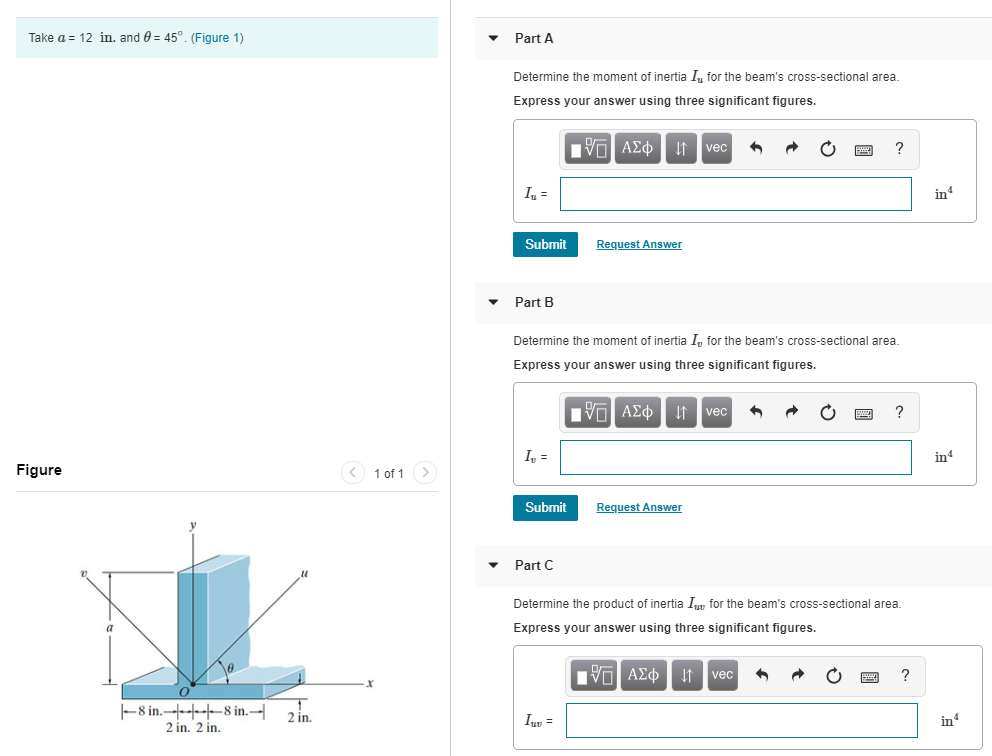 Take a= 12 in. and = 45°. (Figure 1) « Pata
Determine the moment of inertia I, for the beam's cross-sectional area.
Express your answer using three significant figures.
o .
“hoa
Request Answer
v ParB
Determine the moment of inertia I, for the beam's cross-sectional area.
Express your answer using three significant figures.
ETE
Figure 1of1
Request Answer
y
. B v Parc
Determine the product of inertia Iq for the beam's cross-sectional area.
a Express your answer using three significant figures.
o .
| TEE
fo binpbpsine
in. - oe
2in. 2in. Lun in
This is AI generated Response.
Asked by: Md Israrul Haque
Created at: 2025-08-25 21:07:09
Asked by: Md Israrul Haque
Created at: 2025-08-25 21:07:09
Final Answer:
Rendered
Raw Text
Did you like this answer?
Let's break down the problem using the given values:
- \( a = 12 \) in.
- \( \theta = 45^\circ \)
The moments of inertia with respect to the \(x\) and \(y\) axes are typically given (for a composite or built-up section) by summing the individual moments of inertia of each rectangle about the centroid, plus the parallel axis theorem as needed.
### 1. Moments of Inertia about \( x \) and \( y \) axes:
For a rectangle:
- About base: \( I_{\text{base}} = \frac{1}{12} b h^3 \)
- About side: \( I_{\text{side}} = \frac{1}{12} h b^3 \)
Let's assume you have already calculated \( I_x \) and \( I_y \).
### 2. Moments of Inertia about \( u \) and \( v \) axes:
The axes \( u \) and \( v \) are rotated by \( \theta = 45^\circ \):
The transformed moments of inertia are:
\[
I_u = I_x \cos^2\theta + I_y \sin^2\theta - 2I_{xy} \sin\theta\cos\theta
\]
\[
I_v = I_x \sin^2\theta + I_y \cos^2\theta + 2I_{xy} \sin\theta\cos\theta
\]
\[
I_{uv} = (I_y - I_x) \sin\theta\cos\theta + I_{xy} (\cos^2\theta - \sin^2\theta)
\]
### 3. Plug in the values:
For \( \theta = 45^\circ \):
- \( \sin\theta = \cos\theta = \frac{\sqrt{2}}{2} \)
- \( 2\sin\theta\cos\theta = \sin(2\theta) = 1 \)
\[
I_u = I_x \left(\frac{1}{2}\right) + I_y \left(\frac{1}{2}\right) - I_{xy}
\]
\[
I_v = I_x \left(\frac{1}{2}\right) + I_y \left(\frac{1}{2}\right) + I_{xy}
\]
\[
I_{uv} = (I_y - I_x) \left(\frac{1}{2}\right)
\]
### 4. You need \( I_x \), \( I_y \), and \( I_{xy} \):
Assume you have already calculated (for the composite section):
- \( I_x \)
- \( I_y \)
- \( I_{xy} \)
### 5. Substitute and Calculate:
Let's say, for example:
- \( I_x = A \)
- \( I_y = B \)
- \( I_{xy} = C \)
Then:
\[
I_u = \frac{A + B}{2} - C
\]
\[
I_v = \frac{A + B}{2} + C
\]
\[
I_{uv} = \frac{B - A}{2}
\]
---
#### **To get the actual numbers, you need to calculate the moments of inertia for the given T-section (shown in the figure) using the parallel axis theorem.**
If you provide the calculations for \( I_x \), \( I_y \), and \( I_{xy} \) or their values, I can plug them in for the final answers. Would you like to continue with the actual calculations for the T-section cross-section shown?
📢 Instructions:
- Ask anything relatd to above question only.
- For new Question goto :