 VIPSolutions
Section 1.6 Exercises Use this alternative algorithm for Problems 1 through 6. How does the answer you get compare to the anaweryou get from Knuskas algorithm? thems moh or xf th go, Kat ptf dhe min ein Jo J — — ‘They have hired contractors give them estimates on the cost \o| =) Loa 20 i © 2 of building seven different bridges, as shown in the diagram. A) | Bh NG To mrs presen te cto log each dn ; i et STH] Ll 23 ‘decide to build the cheapest network of bridges that would — o [~~ B 8 iota em vet ot ee rss amc, ml . i Ee, A Se Sr A eran a built. J ng tg 11 gc 4 ng te oc — ON [A y [ . yd RAN py . € EET) © B W ! B A 6. G N Co . . R 74 f VEAY% 2 A A = 7 N\ h EN,
Question:
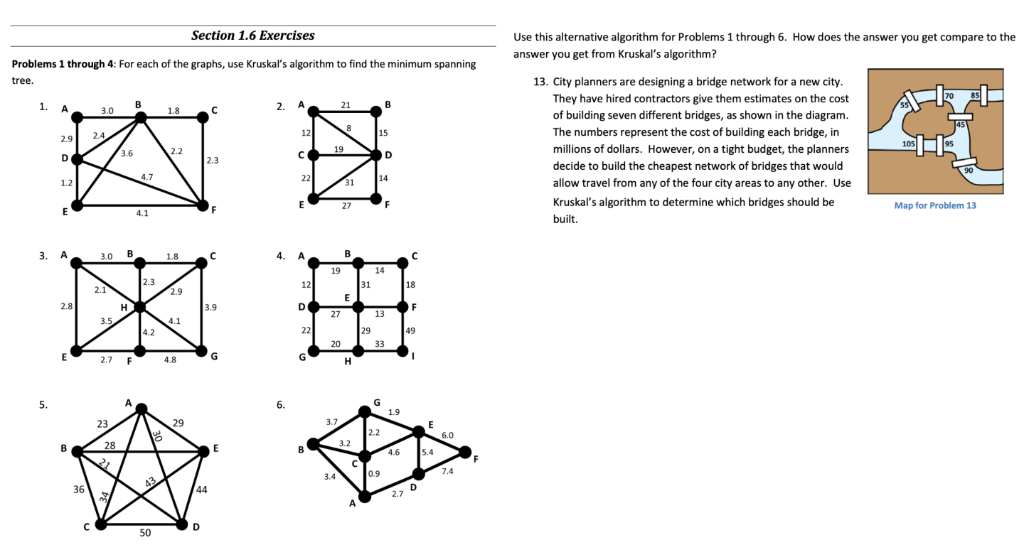 Section 1.6 Exercises Use this alternative algorithm for Problems 1 through 6. How does the answer you get compare to the
anaweryou get from Knuskas algorithm?
thems moh or xf th go, Kat ptf dhe min ein
Jo J — —
‘They have hired contractors give them estimates on the cost \o| =)
Loa 20 i © 2 of building seven different bridges, as shown in the diagram. A) |
Bh NG To mrs presen te cto log each dn
; i et STH]
Ll 23 ‘decide to build the cheapest network of bridges that would —
o [~~ B 8 iota em vet ot ee rss amc, ml
. i Ee, A Se Sr A eran
a built.
J ng tg 11 gc 4 ng te oc
—
ON [A y [ .
yd RAN py .
€ EET) © B W !
B A 6. G N
Co
. . R
74 f
VEAY% 2
A A =
7 N\ h
EN,
This is AI generated Response.
Asked by: Nehal Anurag
Created at: 2025-09-04 10:26:48
Asked by: Nehal Anurag
Created at: 2025-09-04 10:26:48
Final Answer:
Rendered
Raw Text
Did you like this answer?
Let's walk through how to use **Kruskal's Algorithm** to find the minimum spanning tree (MST) for **Problem 1** as an example.
### Kruskal’s Algorithm Steps
1. **Sort all the edges** in the graph in increasing order of their weights.
2. **Pick the smallest edge.** Check if it forms a cycle with the spanning tree formed so far. If it doesn’t, add it to the tree.
3. **Repeat** step 2 until there are (V-1) edges in the spanning tree, where V is the number of vertices.
---
### **Problem 1**
Vertices: A, B, C, D, E, F
Edges and Weights:
- AB: 3.0
- AC: 2.3
- AD: 2.9
- AE: 2.4
- AF: 4.7
- BC: 2.2
- BD: 3.6
- BE: 4.0
- BF: 2.3
- CD: 4.1
- CE: 2.7
- CF: 2.3
- DE: 4.7
- DF: 4.1
- EF: 4.1
#### **Step-by-Step Solution:**
1. **Sort edges by weight:**
- BC (2.2)
- AC (2.3)
- BF (2.3)
- CF (2.3)
- AE (2.4)
- AD (2.9)
- AB (3.0)
- BD (3.6)
- BE (4.0)
- CD (4.1)
- DF (4.1)
- EF (4.1)
- AF (4.7)
- DE (4.7)
2. **Start adding edges, skipping any that would form a cycle:**
- BC (2.2) → Add.
- AC (2.3) → Add.
- BF (2.3) → Add.
- CF (2.3) → Would form a cycle (B–C–F), skip.
- AE (2.4) → Add.
- AD (2.9) → Add.
Now we have edges: BC, AC, BF, AE, AD.
Count the vertices: A, B, C, D, E, F (6 vertices). For a spanning tree, we need **5 edges** (V-1).
So, the MST is complete.
#### **Final MST edges and total weight:**
- BC (2.2)
- AC (2.3)
- BF (2.3)
- AE (2.4)
- AD (2.9)
**Total Weight:** 2.2 + 2.3 + 2.3 + 2.4 + 2.9 = **12.1**
---
Would you like the step-by-step solution for any of the other graphs (2-6 or 13) as well?
📢 Instructions:
- Ask anything relatd to above question only.
- For new Question goto :