 VIPSolutions
rx Sv 3 — 01:28:51 » Question & © S | 4 ae - 14 - RR " BR E BA
Question:
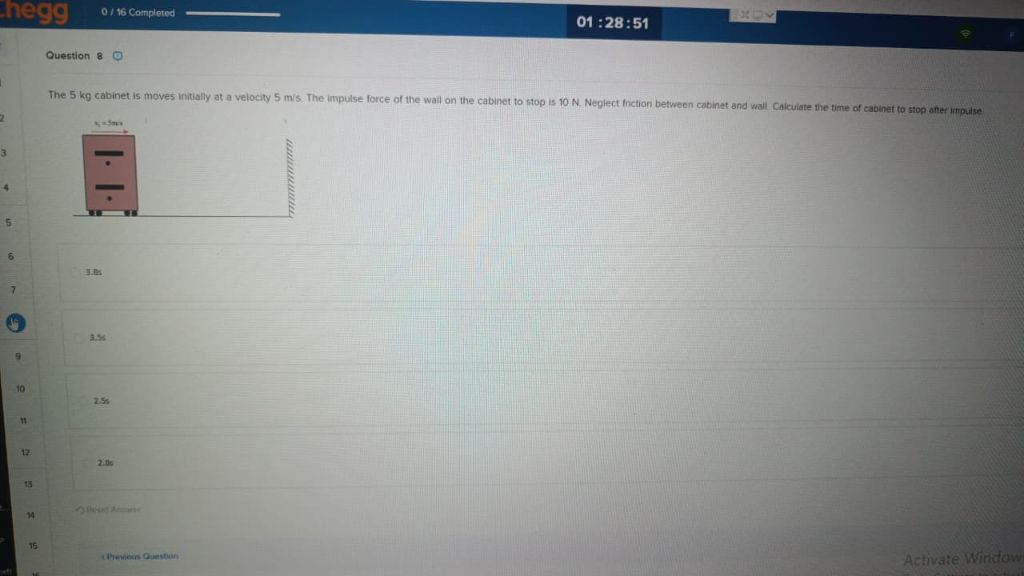 rx Sv
3 — 01:28:51 »
Question & © S
| 4
ae
- 14
- RR
" BR
E BA
This is AI generated Response.
Asked by: Veera manikanta
Created at: 2025-08-23 14:45:21
Asked by: Veera manikanta
Created at: 2025-08-23 14:45:21
Final Answer:
Rendered
Raw Text
Did you like this answer?
Let's break down the problem:
**Given:**
- Mass of cabinet, \( m = 5 \) kg
- Initial velocity, \( u = 5 \) m/s
- Impulse force, \( F = 10 \) N
- Final velocity, \( v = 0 \) m/s (since the cabinet stops)
- Neglect friction
We need to calculate the time \( t \) it takes the cabinet to stop.
### Step 1: Use Newton's Second Law
The force applied causes a change in momentum:
\[
F = \frac{\Delta p}{\Delta t}
\]
where \( \Delta p \) is the change in momentum.
### Step 2: Calculate Change in Momentum
\[
\Delta p = m(v-u) = 5 \times (0 - 5) = -25 \text{ kg m/s}
\]
### Step 3: Plug Into the Formula
\[
F = \frac{\Delta p}{t}
\]
\[
10 = \frac{25}{t}
\]
(Negative sign indicates direction, but we only need magnitude for time)
### Step 4: Solve for \( t \)
\[
t = \frac{25}{10}
\]
\[
t = 2.5 \text{ s}
\]
**The correct answer is:**
\[
\boxed{2.5 \text{ s}}
\]
So, select **2.5 s** as your answer.
📢 Instructions:
- Ask anything relatd to above question only.
- For new Question goto :