 VIPSolutions
Required information The figure shows the quadriceps and the patellar tendons attached to the patella (the kneecap). The weight of the patella is negligible in this situation. The tension Tin each tendon is 1.30 kN. Quadriceps T tendon Xx’ Patella 5 N\ F Femur _ i 0 Tag Patellar = tendon J80.0° Tibia V/ T Here, angle x= 46.5". — At what angle below the horizontal does the contact force F exerted on the patella by the femur act? Enter the angle in degrees where positive indicates right of the horizontal and negative indicates left of the horizontal.
Question:
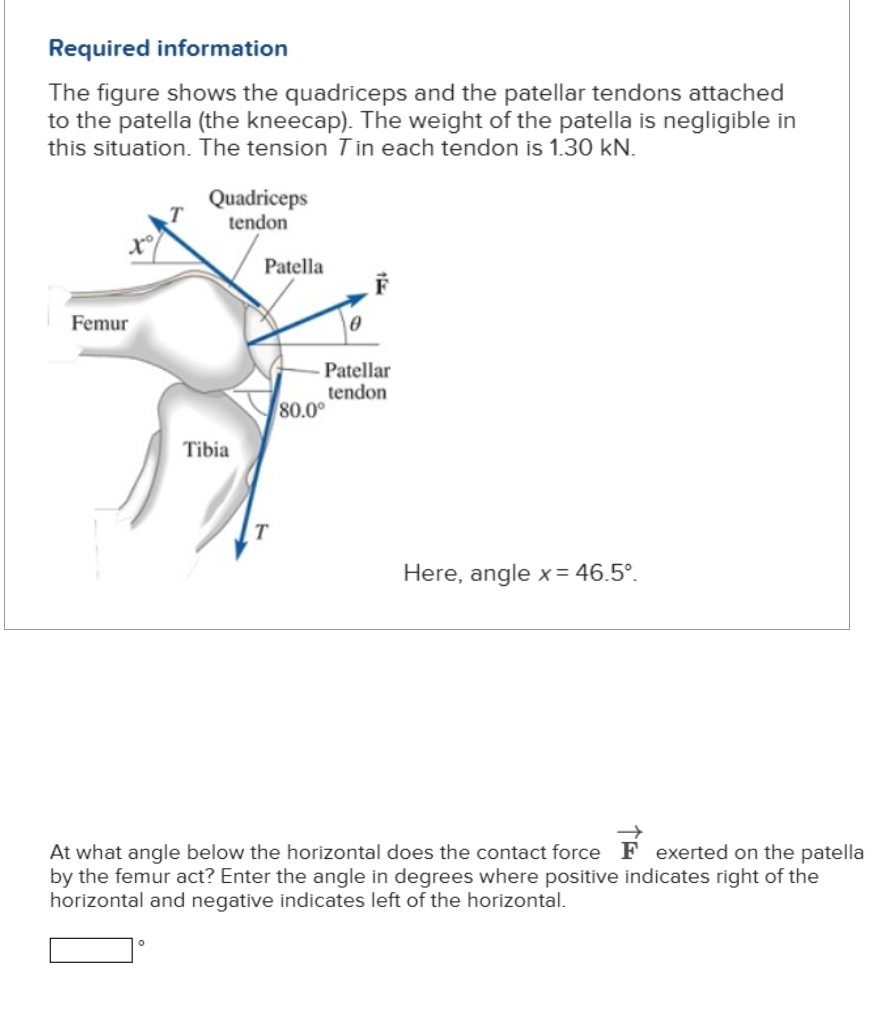 Required information
The figure shows the quadriceps and the patellar tendons attached
to the patella (the kneecap). The weight of the patella is negligible in
this situation. The tension Tin each tendon is 1.30 kN.
Quadriceps
T tendon
Xx’
Patella 5
N\ F
Femur _ i 0
Tag Patellar
= tendon
J80.0°
Tibia
V/
T
Here, angle x= 46.5".
—
At what angle below the horizontal does the contact force F exerted on the patella
by the femur act? Enter the angle in degrees where positive indicates right of the
horizontal and negative indicates left of the horizontal.
This is AI generated Response.
Asked by: Sahab Sharan
Created at: 2025-10-22 05:32:22
Asked by: Sahab Sharan
Created at: 2025-10-22 05:32:22
Final Answer:
Rendered
Raw Text
Did you like this answer?
Let's analyze the problem step by step.
### Given Data:
Tension in each tendon: \( = 1.30\, \{kN} \)
- Angle \( x = 46.5^\circ \)
- Angle between quadriceps tendon and patella: \( 80^\circ \)
- The force \( \vec{F} \) acts at an angle \( \theta \) (to be determined)
### Objective:
Find the angle below the horizontal where the contact force \( \vec{F} \) is exerted on the patella.
---
### Step 1: Resolve the Tendon Forces
- The quadriceps tendon exerts a force \( T \) at an angle \( x = 46.5^\circ \) above the horizontal.
- The patellar tendon exerts a force \( T \) at an \( 80^\circ \) angle relative to the horizontal (since the tendon is attached at an \( 80^\circ \) angle).
### Step 2: Write Force Components
- Quadriceps tendon:
\[
F_{Q_x} = T \cos x
\]
\[
F_{Q_y} = T \sin x
\]
- Patellar tendon:
\[
F_{P_x} = T \cos 80^\circ
\]
\[
F_{P_y} = T \sin 80^\circ
\]
### Step 3: Equilibrium Conditions
Assuming the system is in equilibrium, the sum of forces in the horizontal and vertical directions must be zero:
\[
\sum F_x =
\]
\[
\sum F_y =
\]
The contact force \( \vec{F} \) acts at an angle \( \theta \) below the horizontal, exerting components:
\[
F_x = F \cos \theta
\]
\[
F_y = -F \sin \theta
\]
(Note: Negative sign for \( F_y \) because it's downward if \( \theta \) is below the horizontal.)
---
### Step 4: Set Up Equations
In the horizontal direction:
\[
F_{Q_x} + F_{P_x} + F \cos \theta =
\]
In the vertical direction:
\[
F_{Q_y} + F_{P_y} - F \sin \theta =
\]
---
### Step 5: Solve for \( \theta \)
Dividing the vertical equation by the horizontal equation:
\[
\frac{F_{Q_y} + F_{P_y}}{F_{Q_x} + F_{P_x}} = \tan \theta
\]
Insert the known component expressions:
\[
\frac{T \sin x + T \sin 80^\circ}{T \cos x + T \cos 80^\circ} = \tan \theta
\]
Factor out \( T \):
\[
\frac{\sin x + \sin 80^\circ}{\cos x + \cos 80^\circ} = \tan \theta
\]
Now, substitute \( x = 46.5^\circ \):
\[
\sin 46.5^\circ \approx .73
\]
\[
\sin 80^\circ \approx .98
\]
\[
\cos 46.5^\circ \approx .68
\]
\[
\cos 80^\circ \approx .17
\]
Calculate numerator:
\[
.73 + .98 = 1.71
\]
Calculate denominator:
\[
.68 + .17 = .85
\]
Thus,
\[
\tan \theta = \frac{1.71}{.85} \approx 2.01
\]
Finally,
\[
\theta = \arctan(2.01) \approx 63.4^\circ
\]
---
### **Answer:**
\[
\boxed{
\theta \approx 63.4^\circ
}
\]
This is the angle **below the horizontal** where the contact force \( \vec{F} \) is exerted on the patella.
Question:
thepry fpr this question
This is AI generated Response.
Asked by: Sahab Sharan
Created at: 2025-10-22 05:36:56
Asked by: Sahab Sharan
Created at: 2025-10-22 05:36:56
Final Answer:
Rendered
Raw Text
Did you like this answer?
# Theory Behind the Problem
This problem involves understanding the mechanics of forces acting on the patella (kneecap) in the human body, particularly focusing on the quadriceps and patellar tendons. The analysis utilizes the principles of equilibrium and vector resolution of forces.
## Key Concepts
### 1. **Equilibrium of Forces**
The system is considered to be in equilibrium, meaning the net force in both the horizontal and vertical directions is zero. This is crucial for understanding how the forces balance each other out.
### 2. **Force Resolution**
Forces acting at angles must be broken down into their horizontal and vertical components using trigonometric functions:
- \( F_x = F \cos(\theta) \) for horizontal components
- \( F_y = F \sin(\theta) \) for vertical components
### 3. **Tendon Forces**
In this scenario:
- The quadriceps tendon exerts a force at an angle \( x \) above the horizontal.
- The patellar tendon exerts a force at an angle \( 80^\circ \).
### 4. **Tangential Relationships**
To find the angle of the contact force \( \vec{F} \), we utilize the tangent function, which relates the vertical and horizontal components of the force.
## Mathematical Breakdown
### 1. **Force Components Calculation**
For both tendons:
- **Quadriceps Tendon**:
- \( F_{Q_x} = T \cos(46.5^\circ) \)
- \( F_{Q_y} = T \sin(46.5^\circ) \)
- **Patellar Tendon**:
- \( F_{P_x} = T \cos(80^\circ) \)
- \( F_{P_y} = T \sin(80^\circ) \)
### 2. **Setting Up Equations**
Using equilibrium conditions:
- **Horizontal**:
\[
F_{Q_x} + F_{P_x} + F \cos \theta = 0
\]
- **Vertical**:
\[
F_{Q_y} + F_{P_y} - F \sin \theta = 0
\]
### 3. **Finding \( \theta \)**
By dividing the vertical equation by the horizontal one:
\[
\frac{F_{Q_y} + F_{P_y}}{F_{Q_x} + F_{P_x}} = \tan \theta
\]
### 4. **Substitution and Calculation**
Substituting the values and simplifying leads to:
\[
\tan \theta = \frac{1.71}{0.85} \approx 2.01
\]
Taking the arctangent gives the angle \( \theta \).
## Conclusion
The approach combines equilibrium principles with vector resolution to determine the angle of the contact force on the patella.
### Final Result
The angle below the horizontal where the contact force \( \vec{F} \) is exerted is approximately \( 63.4^\circ \).
📢 Instructions:
- Ask anything relatd to above question only.
- For new Question goto :