 VIPSolutions
Q7. Given two table find out the records which are not common in both? [[»] ID ID [>] [>] 10 10 20 10 10 20 30 40 20 null 30 50 30 30 40 40 Null 50 50 50 select a.id from table1 a left join table2 b on a.id=b.id where b.id is null & Ne OF 4
Question:
 Q7. Given two table find out the records
which are not common in both?
[[»] ID ID [>] [>]
10 10 20 10 10
20 30 40 20 null
30 50 30 30
40 40 Null
50 50 50
select a.id from table1 a
left join table2 b
on a.id=b.id
where b.id is null &
Ne OF 4
This is AI generated Response.
Asked by: Farhan Akhtar
Created at: 2025-08-08 20:32:42
Asked by: Farhan Akhtar
Created at: 2025-08-08 20:32:42
Final Answer:
Rendered
Raw Text
Did you like this answer?
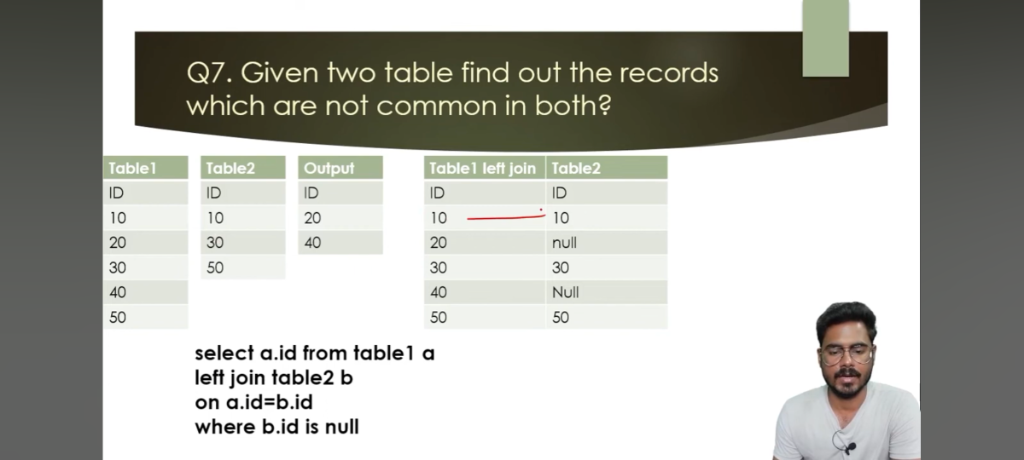
This image presents a SQL interview question:
**Question**:
"Given two tables, find out the records which are not common in both?"
**Tables:**
| Table1 | Table2 |
|--------|--------|
| 10 | 10 |
| 20 | 30 |
| 30 | 50 |
| 40 | |
| 50 | |
**Output required:**
```
ID
20
40
```
(IDs present in Table1 but *not* in Table2.)
**Approach:**
The solution uses a **LEFT JOIN** to find records in Table1 that do not exist in Table2:
```sql
SELECT a.id
FROM table1 a
LEFT JOIN table2 b
ON a.id = b.id
WHERE b.id IS NULL;
```
**Explanation:**
- The `LEFT JOIN` returns all rows from Table1 and the matched rows from Table2.
- If there is no match, the result is NULL from Table2.
- `WHERE b.id IS NULL` filters out only those rows where there was no match, i.e., the IDs not present in Table2.
**Diagram on the right:**
It visually shows how the join works, producing NULLs where there is no match, which are then filtered in the output.
**Summary:**
This SQL technique helps in finding records present in one table but not the other, commonly referred to as "anti-join".
📢 Instructions:
- Ask anything relatd to above question only.
- For new Question goto :