 VIPSolutions
Problem: Consider the function f(z) = z* + 322 — bz + 1. 1. Find the critical points of the function. 2. Determine whether each critical point is a local minimum, local maximum, or a saddle point. 3. Analyze the behavior of the function at the limits as £ — co and £ — —o0.
Question:
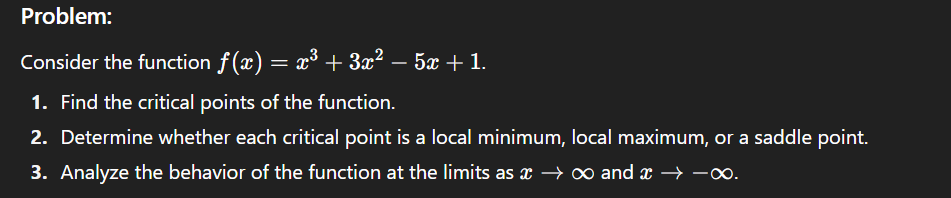 Problem:
Consider the function f(z) = z* + 322 — bz + 1.
1. Find the critical points of the function.
2. Determine whether each critical point is a local minimum, local maximum, or a saddle point.
3. Analyze the behavior of the function at the limits as £ — co and £ — —o0.
This is AI generated Response.
Asked by: Vishal
Created at: 2025-09-23 20:18:37
Asked by: Vishal
Created at: 2025-09-23 20:18:37
Final Answer:
Rendered
Raw Text
Did you like this answer?
# Solution
Given the function:
\[ f(x) = x^3 + 3x^2 - 5x + 1 \]
## 1. Find the Critical Points
Critical points occur where \( f'(x) = 0 \) or \( f'(x) \) is undefined.
First, compute the derivative:
\[
f'(x) = 3x^2 + 6x - 5
\]
Set the derivative equal to zero:
\[
3x^2 + 6x - 5 = 0
\]
Solve this quadratic equation:
\[
x = \frac{-6 \pm \sqrt{6^2 - 4 \cdot 3 \cdot (-5)}}{2 \cdot 3}
\]
\[
x = \frac{-6 \pm \sqrt{36 + 60}}{6}
\]
\[
x = \frac{-6 \pm \sqrt{96}}{6}
\]
\[
\sqrt{96} = 4\sqrt{6}
\]
So,
\[
x = \frac{-6 \pm 4\sqrt{6}}{6}
\]
\[
x = \frac{-3 \pm 2\sqrt{6}}{3}
\]
**Critical points:**
\[
x_1 = \frac{-3 + 2\sqrt{6}}{3}, \quad x_2 = \frac{-3 - 2\sqrt{6}}{3}
\]
---
## 2. Classify Each Critical Point
Use the second derivative test:
\[
f''(x) = 6x + 6
\]
- At \( x_1 = \frac{-3 + 2\sqrt{6}}{3} \):
\[
f''(x_1) = 6\left(\frac{-3 + 2\sqrt{6}}{3}\right) + 6 = -6 + 4\sqrt{6} + 6 = 4\sqrt{6}
\]
Since \( 4\sqrt{6} > 0 \), **local minimum**.
- At \( x_2 = \frac{-3 - 2\sqrt{6}}{3} \):
\[
f''(x_2) = 6\left(\frac{-3 - 2\sqrt{6}}{3}\right) + 6 = -6 - 4\sqrt{6} + 6 = -4\sqrt{6}
\]
Since \( -4\sqrt{6} < 0 \), **local maximum**.
---
## 3. Behavior as \( x \to \infty \) and \( x \to -\infty \)
For large \( |x| \), the cubic term \( x^3 \) dominates.
- As \( x \to \infty \), \( f(x) \to \infty \)
- As \( x \to -\infty \), \( f(x) \to -\infty \)
---
## **Summary Table**
| Critical Point | Nature | Second Derivative |
|--------------------------------------------------|----------------|-------------------|
| \( x_1 = \frac{-3 + 2\sqrt{6}}{3} \) | Local Minimum | \( > 0 \) |
| \( x_2 = \frac{-3 - 2\sqrt{6}}{3} \) | Local Maximum | \( < 0 \) |
**End Behavior:**
- \( x \to \infty, f(x) \to \infty \)
- \( x \to -\infty, f(x) \to -\infty \)
📢 Instructions:
- Ask anything relatd to above question only.
- For new Question goto :