 VIPSolutions
Problem 3. (50 points) For a binary transmission channel, we know that the probability of receiving a bit in error when a 1 is transmitted is 0.45 while the probability of receiving a bit in error when a 0 is transmitted is 0.25. (1) Determine the probability of receiving the bit correctly when a 1 is transmitted. (10 points) (2) If the probability that a 1 is sent is 0.35, determine the probability that a 0 is transmitted. (10 points) (3) Determine the total probability that any bit is received in error. (10 points) (4) Determine the total probability that any bit is received correctly. (10 points) (5) Determine the probability that a 0 was transmitted given that a 0 was received. (10 points)
Question:
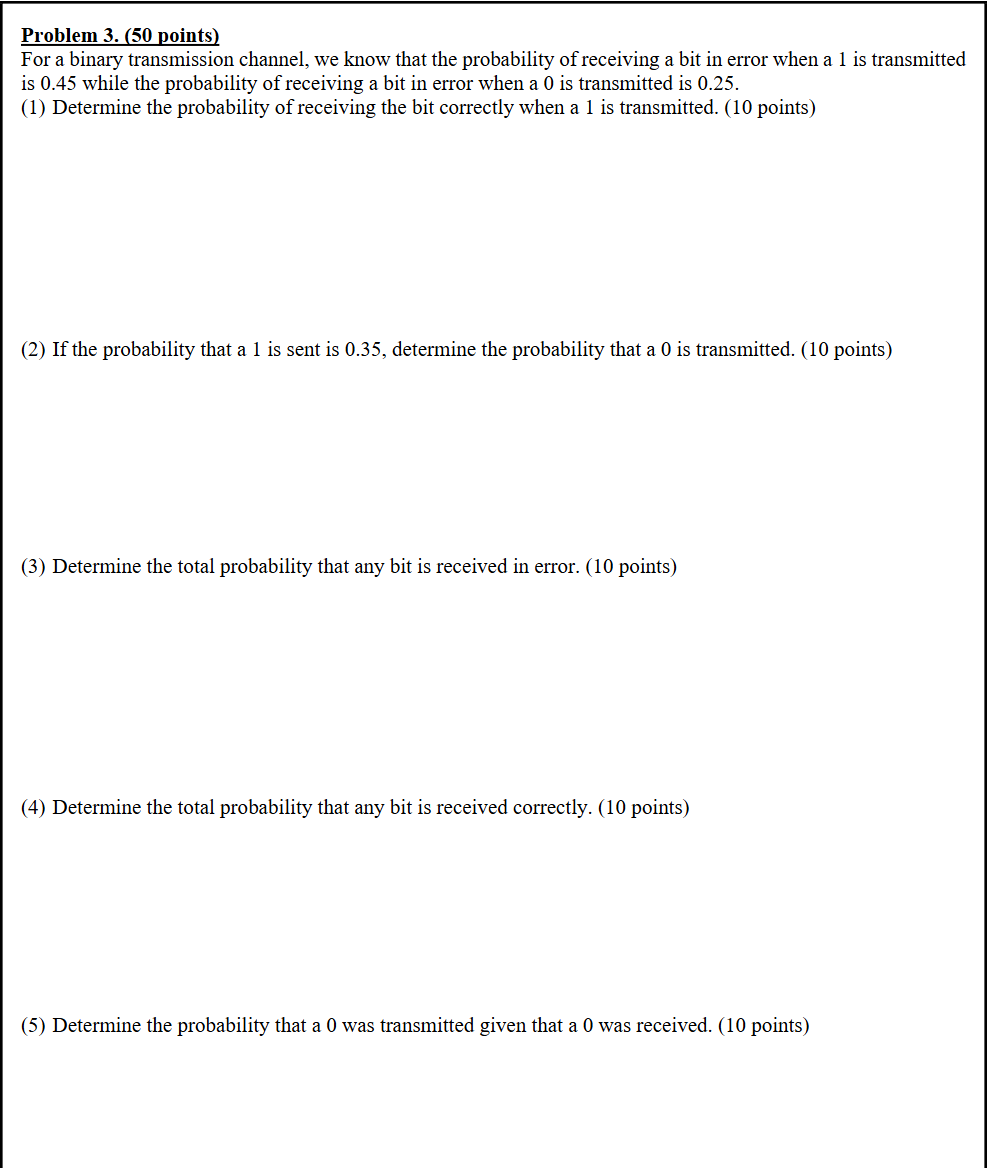 Problem 3. (50 points)
For a binary transmission channel, we know that the probability of receiving a bit in error when a 1 is transmitted
is 0.45 while the probability of receiving a bit in error when a 0 is transmitted is 0.25.
(1) Determine the probability of receiving the bit correctly when a 1 is transmitted. (10 points)
(2) If the probability that a 1 is sent is 0.35, determine the probability that a 0 is transmitted. (10 points)
(3) Determine the total probability that any bit is received in error. (10 points)
(4) Determine the total probability that any bit is received correctly. (10 points)
(5) Determine the probability that a 0 was transmitted given that a 0 was received. (10 points)
This is AI generated Response.
Asked by: nayan
Created at: 2025-10-04 13:26:06
Asked by: nayan
Created at: 2025-10-04 13:26:06
Final Answer:
Rendered
Raw Text
Did you like this answer?
# Solution to Problem 3
Let's denote:
- \( P(E|1) \): Probability of error when 1 is transmitted = .45
- \( P(E|) \): Probability of error when is transmitted = .25
- \( P(1) \): Probability that a 1 is sent = .35
- \( P() \): Probability that a is sent
---
## 1. Probability of Receiving the Bit Correctly When a 1 is Transmitted
\[
P(\text{Correct}|1) = 1 - P(E|1) = 1 - .45 = \boxed{.55}
\]
---
## 2. Probability that a is Transmitted
Since only or 1 can be transmitted:
\[
P() = 1 - P(1) = 1 - .35 = \boxed{.65}
\]
---
## 3. Total Probability That Any Bit is Received in Error
\[
P(E) = P(E|1)P(1) + P(E|)P()
\]
\[
= (.45)(.35) + (.25)(.65) = .1575 + .1625 = \boxed{.32}
\]
---
## 4. Total Probability That Any Bit is Received Correctly
\[
P(C) = 1 - P(E) = 1 - .32 = \boxed{.68}
\]
Alternatively, you could calculate directly:
\[
P(C) = P(C|1)P(1) + P(C|)P()
\]
\[
P(C|1) = 1 - P(E|1) = .55
\]
\[
P(C|) = 1 - P(E|) = .75
\]
\[
P(C) = (.55)(.35) + (.75)(.65) = .1925 + .4875 = .68
\]
---
## 5. Probability that a was Transmitted Given a was Received
We want \(P(|\text{received })\). Use Bayes’ theorem:
\[
P(|\text{rec }) = \frac{P(\text{rec }|)P()}{P(\text{rec })}
\]
Where:
- \(P(\text{rec }|) = 1 - P(E|) = .75\)
- \(P(\text{rec }|1) = P(E|1) = .45\)
- \(P(\text{rec }) = P(\text{rec }|)P() + P(\text{rec }|1)P(1)\)
\[
= (.75)(.65) + (.45)(.35) = .4875 + .1575 = .645
\]
So,
\[
P(|\text{rec }) = \frac{.75 \times .65}{.645} = \frac{.4875}{.645} \approx \boxed{.756}
\]
📢 Instructions:
- Ask anything relatd to above question only.
- For new Question goto :