 VIPSolutions
Problem 2 Three (very small) beads with masses m, m, and 1 can slide without friction on a (very thin) fixed ring of radius a and are connected to each other by (weightless) springs of equal stiffuess k and equilibrium length [ = v/3a. Find the normal frequencies and normal modes of vibration for this system. Interpret the physical meaning of the modes you have found. oe ) 3 mu
Question:
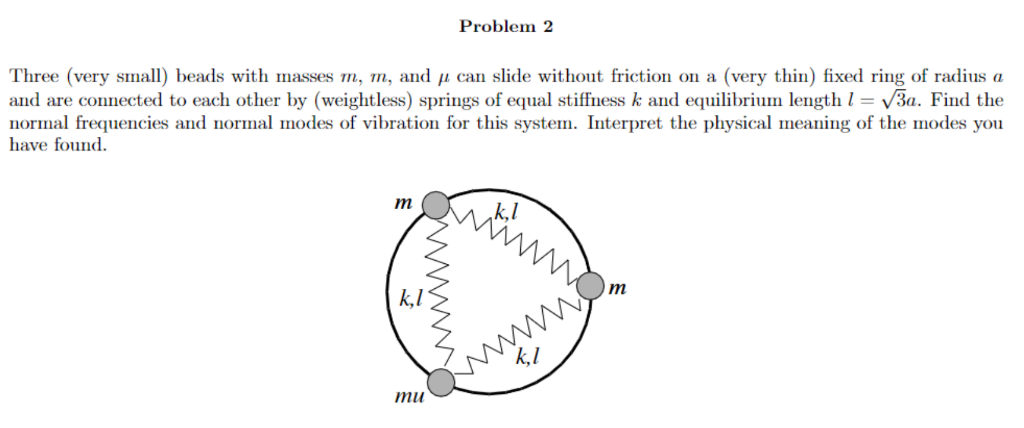 Problem 2
Three (very small) beads with masses m, m, and 1 can slide without friction on a (very thin) fixed ring of radius a
and are connected to each other by (weightless) springs of equal stiffuess k and equilibrium length [ = v/3a. Find the
normal frequencies and normal modes of vibration for this system. Interpret the physical meaning of the modes you
have found.
oe ) 3
mu
This is AI generated Response.
Asked by: Adapaka Jagadeesh
Created at: 2025-07-29 02:28:37
Asked by: Adapaka Jagadeesh
Created at: 2025-07-29 02:28:37
Final Answer:
Rendered
Raw Text
Did you like this answer?
Let's break down the problem step by step:
### **Problem Restatement**
Three beads with masses \(m\), \(m\), and \(\mu\) are free to slide on a frictionless ring of radius \(a\). They are connected by springs of stiffness \(k\) and equilibrium length \(l = \sqrt{3}a\). Find the normal frequencies and normal modes of vibration.
---
## **1. Geometry and Coordinates**
Since the beads are constrained to a ring, each bead’s position can be described by an angle \(\theta_i\) (for \(i = 1,2,3\)), measured from some reference direction.
Let the masses be at angular positions:
- \(\theta_1\) (mass \(m\))
- \(\theta_2\) (mass \(m\))
- \(\theta_3\) (mass \(\mu\))
The equilibrium positions are at \(120^\circ\) from each other because the springs are at their equilibrium length \(l = \sqrt{3}a\) (which is the chord length subtending \(120^\circ\) at the center of the ring).
---
## **2. Small Oscillations: Set Up the Equations**
Let the small angular displacements from equilibrium be:
- \(\theta_1 = \theta_{1,0} + \eta_1\)
- \(\theta_2 = \theta_{2,0} + \eta_2\)
- \(\theta_3 = \theta_{3,0} + \eta_3\)
where \(\eta_i\) are small.
---
### **Kinetic Energy**
\[ T = \frac{1}{2} m a^2 (\dot{\eta}_1^2 + \dot{\eta}_2^2) + \frac{1}{2} \mu a^2 \dot{\eta}_3^2 \]
---
### **Potential Energy**
For small displacements, the extension of each spring connecting beads \(i\) and \(j\) is:
\[
\Delta l_{ij} \approx a |\eta_i - \eta_j|
\]
Thus, the potential energy due to the springs is:
\[
V = \frac{1}{2} k a^2 \left[ (\eta_1 - \eta_2)^2 + (\eta_2 - \eta_3)^2 + (\eta_3 - \eta_1)^2 \right]
\]
---
## **3. Equations of Motion**
Write the Lagrangian \( L = T - V \):
\[
L = \frac{1}{2} m a^2 (\dot{\eta}_1^2 + \dot{\eta}_2^2) + \frac{1}{2} \mu a^2 \dot{\eta}_3^2 - \frac{1}{2} k a^2 \left[ (\eta_1 - \eta_2)^2 + (\eta_2 - \eta_3)^2 + (\eta_3 - \eta_1)^2 \right]
\]
Calculate the equations of motion for each \(\eta_i\):
#### For \(\eta_1\):
\[
m a^2 \ddot{\eta}_1 = -k a^2 [2\eta_1 - \eta_2 - \eta_3]
\]
\[
m \ddot{\eta}_1 = -k [2\eta_1 - \eta_2 - \eta_3]
\]
#### For \(\eta_2\):
\[
m \ddot{\eta}_2 = -k [2\eta_2 - \eta_3 - \eta_1]
\]
#### For \(\eta_3\):
\[
\mu \ddot{\eta}_3 = -k [2\eta_3 - \eta_1 - \eta_2]
\]
---
## **4. Matrix Form**
Express in vector form:
\[
\begin{pmatrix}
m & 0 & 0 \\
0 & m & 0 \\
0 & 0 & \mu
\end{pmatrix}
\begin{pmatrix}
\ddot{\eta}_1 \\
\ddot{\eta}_2 \\
\ddot{\eta}_3
\end{pmatrix}
= -k
\begin{pmatrix}
2 & -1 & -1 \\
-1 & 2 & -1 \\
-1 & -1 & 2
\end{pmatrix}
\begin{pmatrix}
\eta_1 \\
\eta_2 \\
\eta_3
\end{pmatrix}
\]
---
## **5. Normal Modes and Frequencies**
Assume solutions of the form \(\eta_i = A_i e^{i\omega t}\):
\[
\text{(Mass matrix)} \cdot (-\omega^2 \mathbf{A}) = -k \cdot (\text{Spring matrix}) \cdot \mathbf{A}
\]
\[
\left[ k (\text{Spring matrix}) - \omega^2 (\text{Mass matrix}) \right] \mathbf{A} = 0
\]
Nontrivial solutions exist when:
\[
\det \left| k
\begin{pmatrix}
2 & -1 & -1 \\
-1 & 2 & -1 \\
-1 & -1 & 2
\end{pmatrix}
- \omega^2
\begin{pmatrix}
m & 0 & 0 \\
0 & m & 0 \\
0 & 0 & \mu
\end{pmatrix}
\right| = 0
\]
---
## **6. Eigenvalue Problem**
Let \(\omega^2 = \lambda\), divide by \(k\):
\[
\begin{pmatrix}
2-\frac{\lambda}{k}m & -1 & -1 \\
-1 & 2-\frac{\lambda}{k}m & -1 \\
-1 & -1 & 2-\frac{\lambda}{k}\mu
\end{pmatrix}
\]
Set determinant to zero:
---
### **Special Case:** \(\mu = m\) (All masses equal)
The eigenvalues are well known for a symmetric 3-mass ring:
- Zero mode (all move together): \(\omega_0 = 0\)
- Doubly-degenerate mode: \(\omega^2 = 3k/m\)
### **General Case:** \(\mu \neq m\)
Let’s find the eigenvalues for general \(\mu\).
Let
- \(x = \omega^2 / k\)
The characteristic equation is:
\[
\left|
\begin{matrix}
2 - m x & -1 & -1 \\
-1 & 2 - m x & -1 \\
-1 & -1 & 2 - \mu x
\end{matrix}
\right| = 0
\]
Expand the determinant:
\[
(2-mx)\begin{vmatrix}
2-mx & -1\\
-1 & 2-\mu x
\end{vmatrix}
- [-1]\begin{vmatrix}
-1 & -1\\
-1 & 2-\mu x
\end{vmatrix}
+ [-1]\begin{vmatrix}
-1 & 2-mx\\
-1 & -1
\end{vmatrix}
\]
Calculate each minor:
First minor:
\[
\begin{vmatrix}
2-mx & -1\\
-1 & 2-\mu x
\end{vmatrix}
= (2-mx)(2-\mu x) - (-1)(-1) = (2-mx)(2-\mu x) - 1
\]
Second minor:
\[
\begin{vmatrix}
-1 & -1\\
-1 & 2-\mu x
\end{vmatrix}
= (-1)(2-\mu x) - (-1)(-1) = -2 + \mu x - 1 = \mu x - 3
\]
Third minor:
\[
\begin{vmatrix}
-1 & 2-mx\\
-1 & -1
\end{vmatrix}
= (-1)(-1) - (-1)(2-mx) = 1 + 2 - mx = 3 - mx
\]
So the full determinant:
\[
(2-mx)\left[(2-mx)(2-\mu x) - 1\right] + (\mu x - 3) + (3 - mx) = 0
\]
Let’s expand further:
\[
(2-mx)[(2-mx)(2-\mu x) - 1] + (\mu x - 3) + (3 - mx) = 0
\]
\[
(2-mx)[(2-mx)(2-\mu x) - 1] + (\mu x - mx)
\]
\[
(2-mx)[(2-mx)(2-\mu x) - 1] + x(\mu - m)
\]
Let’s expand \((2-mx)(2-\mu x)\):
\[
(2-mx)(2-\mu x) = 4 - 2\mu x - 2mx + m\mu x^2
\]
Now, plug in:
\[
(2-mx)[(4 - 2\mu x - 2mx + m\mu x^2) - 1] + x(\mu - m) = 0
\]
\[
(2-mx)[3 - 2\mu x - 2mx + m\mu x^2] + x(\mu - m) = 0
\]
Let’s expand:
\[
(2-mx)(3 - 2\mu x - 2mx + m\mu x^2) + x(\mu - m) = 0
\]
Expand the first term:
\[
= (2)(3 - 2\mu x - 2mx + m\mu x^2) - mx(3 - 2\mu x - 2mx + m\mu x^2)
\]
\[
= [6 - 4\mu x - 4mx + 2m\mu x^2] - [3mx - 2m\mu x^2 - 2m^2 x^2 + m^2\mu x^3]
\]
So sum:
\[
6 - 4\mu x - 4mx + 2m\mu x^2 - 3mx + 2m\mu x^2 + 2m^2 x^2 - m^2\mu x^3 + x(\mu - m) = 0
\]
Group terms:
- Constant: \(6\)
- \(x\) terms: \(-4\mu x - 4mx - 3mx + x(\mu - m)\)
- \(x^2\) terms: \(2m\mu x^2 + 2m\mu x^2 + 2m^2 x^2\)
- \(x^3\) term: \(-m^2\mu x^3\)
So:
- \(x\) terms: \(-4\mu x - 7mx + \mu x - mx = (-4\mu x + \mu x) + (-7mx - mx) = (-3\mu x) + (-8mx)\)
- \(x^2\) terms: \(2m\mu x^2 + 2m\mu x^2 + 2m^2 x^2 = 4m\mu x^2 + 2m^2 x^2\)
Therefore:
\[
6 - 3\mu x - 8mx + 4m\mu x^2 + 2m^2 x^2 - m^2\mu x^3 = 0
\]
Or, rearranged:
\[
- m^2\mu x^3 + (4m\mu + 2m^2)x^2 + (-3\mu - 8m)x + 6 = 0
\]
This cubic equation gives the three normal mode frequencies, as \(\omega^2 = xk\).
---
## **7. Physical Interpretation**
- **Zero mode:** All beads move together around the ring (rotation); this is the translation symmetry of the system (\(\omega_0 = 0\)).
- **Other two modes:** Relative oscillations of the beads (their patterns depend on the mass values, but for \(\mu = m\), they correspond to the two degenerate modes of the symmetric triangle).
---
## **Summary**
### **Normal frequencies:**
Find the roots \(x_i\) of:
\[
- m^2\mu x^3 + (4m\mu + 2m^2)x^2 + (-3\mu - 8m)x + 6 = 0
\]
Normal frequencies: \(\omega_i^2 = x_i k\), \(i = 1,2,3\).
### **Normal modes:**
- Zero mode: all beads move together.
- Other modes: beads move in relative opposition, their nature depending on the values of \(m\) and \(\mu\).
---
If you want explicit forms for the normal modes for a particular value of \(\mu\), let me know!
📢 Instructions:
- Ask anything relatd to above question only.
- For new Question goto :