 VIPSolutions
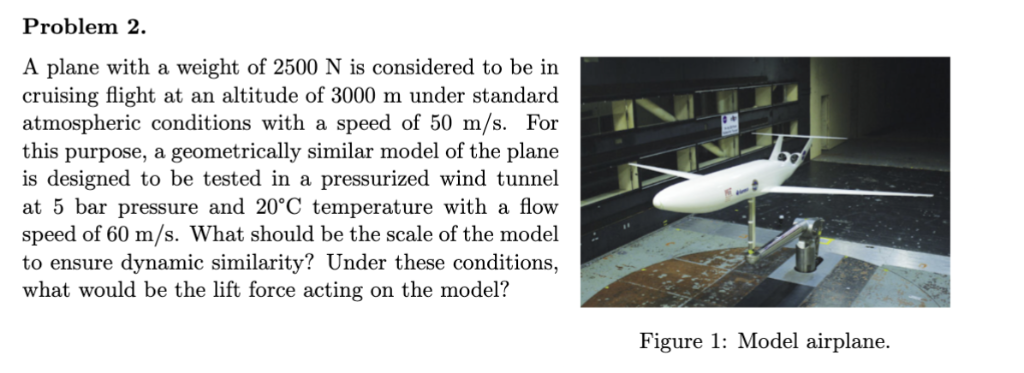
Problem 2. A plane with a weight of 2500 N is considered to be in cruising flight at an altitude of 3000 m under standard atmospheric conditions with a speed of 50 m/s. For Bg this purpose, a geometrically similar model of the plane yd is designed to be tested in a pressurized wind tunnel at 5 bar pressure and 20°C temperature with a flow : speed of 60 m/s. What should be the scale of the model Po] pl to ensure dynamic similarity? Under these conditions, 3 >>" “d w— what would be the lift force acting on the model? # GTR on Figure 1: Model airplane.
Question:
 Problem 2.
A plane with a weight of 2500 N is considered to be in
cruising flight at an altitude of 3000 m under standard
atmospheric conditions with a speed of 50 m/s. For Bg
this purpose, a geometrically similar model of the plane yd
is designed to be tested in a pressurized wind tunnel
at 5 bar pressure and 20°C temperature with a flow :
speed of 60 m/s. What should be the scale of the model Po] pl
to ensure dynamic similarity? Under these conditions, 3 >>" “d w—
what would be the lift force acting on the model? # GTR on
Figure 1: Model airplane.
This is AI generated Response.
Asked by: Veera manikanta
Created at: 2025-09-08 18:58:14
Asked by: Veera manikanta
Created at: 2025-09-08 18:58:14
Final Answer:
Rendered
Raw Text
Did you like this answer?
Let’s break down the problem step-by-step.
### **Step 1: Dynamic Similarity and Reynolds Number**
For dynamic similarity in wind tunnel testing, the Reynolds number (\( Re \)) should be the same for both the actual plane (prototype) and the model.
\[
Re = \frac{\rho V L}{\mu}
\]
Where:
- \( \rho \) = density of air,
- \( V \) = velocity,
- \( L \) = characteristic length,
- \( \mu \) = dynamic viscosity.
### **Step 2: Gather Information**
#### **Prototype (Full-Scale Plane)**
- **Weight:** 2500 N
- **Altitude:** 3000 m
- **Speed:** 50 m/s
Standard atmospheric properties at 3000 m:
- **Temperature:** ≈ 268 K (−5°C)
- **Pressure:** ≈ 70 kPa (0.7 bar)
- **Density (\( \rho_p \)):** ≈ 0.909 kg/m³
- **Viscosity (\( \mu_p \)):** ≈ 1.7 × 10⁻⁵ kg/(m·s)
#### **Model (Wind Tunnel)**
- **Pressure:** 5 bar = 500,000 Pa
- **Temperature:** 20°C = 293 K
- **Speed:** 60 m/s
From the ideal gas law, density (\( \rho \)) at 5 bar and 20°C:
\[
\rho = \frac{P}{R \cdot T}
\]
Where \( R = 287 \) J/(kg·K).
\[
\rho_m = \frac{500,000}{287 \times 293} \approx 5.98 \text{ kg/m}^3
\]
Dynamic viscosity at 20°C (\( \mu_m \)): ≈ 1.8 × 10⁻⁵ kg/(m·s) (for air).
### **Step 3: Reynolds Number Similarity**
Let \( \lambda \) be the scale ratio (\( L_m = \lambda L_p \)).
Set \( Re_m = Re_p \):
\[
\frac{\rho_m V_m L_m}{\mu_m} = \frac{\rho_p V_p L_p}{\mu_p}
\]
\[
\frac{\rho_m V_m \lambda L_p}{\mu_m} = \frac{\rho_p V_p L_p}{\mu_p}
\]
\[
\lambda = \frac{\rho_p V_p \mu_m}{\rho_m V_m \mu_p}
\]
### **Step 4: Plug in Values**
\[
\lambda = \frac{0.909 \times 50 \times 1.8 \times 10^{-5}}{5.98 \times 60 \times 1.7 \times 10^{-5}}
\]
Calculate numerator:
\[
0.909 \times 50 = 45.45
\]
\[
45.45 \times 1.8 \times 10^{-5} = 8.181 \times 10^{-4}
\]
Calculate denominator:
\[
5.98 \times 60 = 358.8
\]
\[
358.8 \times 1.7 \times 10^{-5} = 6.0996 \times 10^{-3}
\]
Now, the scale:
\[
\lambda = \frac{8.181 \times 10^{-4}}{6.0996 \times 10^{-3}} \approx 0.134
\]
So, the model should be about **1/7.5th** the size of the prototype.
---
### **Step 5: Lift Force on the Model**
Lift force is given by:
\[
L = C_L \frac{1}{2} \rho V^2 S
\]
For dynamic similarity, \( C_L \) is the same for model and prototype. The ratio of lift forces will be:
\[
\frac{L_m}{L_p} = \frac{\rho_m V_m^2 S_m}{\rho_p V_p^2 S_p}
\]
Since \( S_m = \lambda^2 S_p \):
\[
L_m = L_p \frac{\rho_m}{\rho_p} \left(\frac{V_m}{V_p}\right)^2 \lambda^2
\]
Plug in the numbers:
- \( L_p = 2500 \) N
- \( \rho_m = 5.98 \)
- \( \rho_p = 0.909 \)
- \( V_m = 60 \)
- \( V_p = 50 \)
- \( \lambda = 0.134 \)
\[
L_m = 2500 \times \frac{5.98}{0.909} \times \left(\frac{60}{50}\right)^2 \times (0.134)^2
\]
Now, calculate step by step:
1. \( \frac{5.98}{0.909} \approx 6.58 \)
2. \( \left(\frac{60}{50}\right)^2 = (1.2)^2 = 1.44 \)
3. \( (0.134)^2 = 0.01796 \)
Now combine:
\[
L_m = 2500 \times 6.58 \times 1.44 \times 0.01796
\]
\[
= 2500 \times 6.58 = 16450
\]
\[
16450 \times 1.44 = 23688
\]
\[
23688 \times 0.01796 \approx 425 \text{ N}
\]
---
## **Summary of Answers**
### **1. Scale of the Model:**
\[
\boxed{0.134}
\]
(The model should be 13.4% the size of the prototype.)
### **2. Lift Force on the Model:**
\[
\boxed{425 \text{ N}}
\]
If you need a more detailed step-by-step explanation or clarification, let me know!
📢 Instructions:
- Ask anything relatd to above question only.
- For new Question goto :