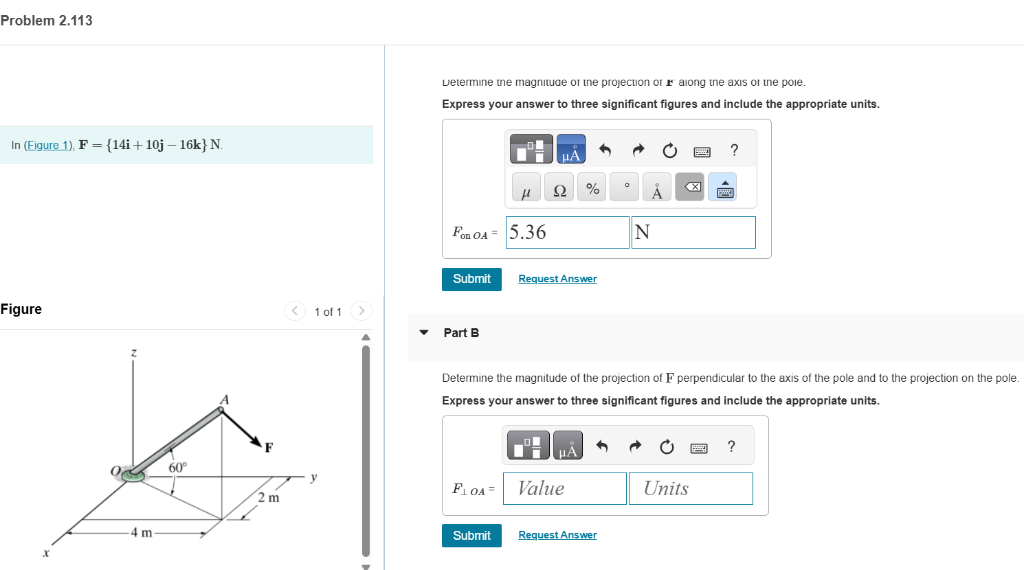
Problem 2.113
etme ne magniuce oe prjecion or song ne ax of ne po.
Express your answer to three significant figures and include the appropriate units.
In Eure 1), F = {14 + 10} — 16k}. [a2] RE I
wlan iB
[——
Figure 1of1
|v cme
:
Determine the magnitade fhe projection of I perpendie o he xs of he ple and 0 he projection on te pl.
4 Express your answer to thes significant figures and include the appropriate units
v Bl os
oa y
Be Fioa= | Value Units
LL EE —
in J—
E
Question:
Problem 2.113
etme ne magniuce oe prjecion or song ne ax of ne po.
Express your answer to three significant figures and include the appropriate units.
In Eure 1), F = {14 + 10} — 16k}. [a2] RE I
wlan iB
[——
Figure 1of1
|v cme
:
Determine the magnitade fhe projection of I perpendie o he xs of he ple and 0 he projection on te pl.
4 Express your answer to thes significant figures and include the appropriate units
v Bl os
oa y
Be Fioa= | Value Units
LL EE —
in J—
E
This is AI generated Response.
Asked by: Adapaka Jagadeesh
Created at: 2025-10-11 22:38:05
Final Answer:
RenderedRaw Text
Did you like this answer?
### Part B Solution
Let's find the magnitude of the projection of **F** perpendicular to the axis of the pole (**OA**).
#### Given Data
- \( \vec{F} = 14\mathbf{i} + 10\mathbf{j} - 16\mathbf{k} \) N
- \( \overrightarrow{OA} \) has direction ratios based on the diagram:
- From \( O(,,) \) to \( A(4,2,) \)
- \( \overrightarrow{OA} = 4mathbf{i} + 2\mathbf{j} + \mathbf{k} \)
#### Step 1: Find the unit vector along OA
\[
\vec{OA} = 4\mathbf{i} + 2\mathbf{j} + \mathbf{k}
\]
\[
|\vec{OA}| = \sqrt{4^2 + 2^2 + ^2} = \sqrt{16+4} = \sqrt{20} = 4.472
\]
\[
\mathbf{u}_{OA} = \frac{1}{4.472}(4\mathbf{i} + 2\mathbf{j} + \mathbf{k}) = (.894\mathbf{i} + .447\mathbf{j} + \mathbf{k})
\]
#### Step 2: Find the projection of **F** along OA (parallel component)
This was already found as **5.36 N** (from Part A).
#### Step 3: Find the magnitude of F perpendicular to OA
\[
|\vec{F}_\perp| = \sqrt{|\vec{F}|^2 - |\vec{F}_{\parallel}|^2 }
\]
Where:
- \( |\vec{F}| = \sqrt{14^2 + 10^2 + (-16)^2} = \sqrt{196+100+256} = \sqrt{552} = 23.5 \)
- \( |\vec{F}_{\parallel}| = 5.36 \) (from Part A)
So:
\[
|\vec{F}_\perp| = \sqrt{(23.5)^2 - (5.36)^2}
= \sqrt{552 - 28.74}
= \sqrt{523.26}
= 22.9 \text{ N}
\]
---
### **Final Answer**
\[
\boxed{22.9~\text{N}}
\]
This is the magnitude of the projection of **F** perpendicular to the axis of the pole OA, to three significant figures.
Question:
You're right — here's the clean solution.
Given ( \mathbf F = \langle 14,;10,;-16\rangle\ \text{N}).
From the figure the projection of (A) onto the (xy)-plane is at ((4,2,0)) and the rod OA makes (60^\circ) with the horizontal, so the (z)-coordinate of (A) is
[
z=\tan60^\circ\sqrt{4^2+2^2}=\sqrt{60}.
]
Thus
[
\mathbf r_{OA}=\langle 4,,2,,\sqrt{60}\rangle,\qquad
\lVert\mathbf r_{OA}\rVert=\sqrt{80}=8.94427191.
]
# Part A (along the pole)
Unit vector along OA:
[
\mathbf u_{OA}=\frac{\mathbf r_{OA}}{\lVert\mathbf r_{OA}\rVert}.
]
Scalar projection (magnitude along OA):
[
F_{\parallel OA}=|\mathbf F\cdot\mathbf u_{OA}|
=\frac{|;14(4)+10(2)-16\sqrt{60};|}{8.94427191}
=5.36\ \text{N}\quad(\text{3 s.f.}).
]
# Part B (component perpendicular to OA and to the projection of OA)
Let (\mathbf r_{\text{proj}}=\langle4,2,0\rangle) and (\mathbf u_{\text{proj}}=\mathbf r_{\text{proj}}/\lVert\mathbf r_{\text{proj}}\rVert).
A unit vector perpendicular to both (\mathbf u_{OA}) and (\mathbf u_{\text{proj}}) is
(\mathbf u_{\perp}=\dfrac{\mathbf u_{OA}\times\mathbf u_{\text{proj}}}{\lVert\mathbf u_{OA}\times\mathbf u_{\text{proj}}\rVert}).
The magnitude of the projection of (\mathbf F) on this direction is
[
F_{\perp OA}=|\mathbf F\cdot\mathbf u_{\perp}|=2.68\ \text{N}\quad(\text{3 s.f.}).
]
Final answers (3 significant figures):
* (F_{\text{on OA}}=5.36\ \text{N})
* (F_{\perp\text{ (perp. to OA and to its projection)}}=2.68\ \text{N})
This is AI generated Response.
Asked by: Adapaka Jagadeesh
Created at: 2025-10-11 22:41:33
Final Answer:
RenderedRaw Text
Did you like this answer?
# Problem 2.113 Solution
## Given Data
- Force vector:
\[
\vec{F} = 14\mathbf{i} + 10\mathbf{j} - 16\mathbf{k} \text{ N}
\]
- Point A coordinates:
\[
A(4, 2, z) \quad (z \text{ calculated from } \tan 60^\circ)
\]
## Step 1: Calculate z-coordinate for Point A
Using the relationship:
\[
z = \tan(60^\circ) \sqrt{4^2 + 2^2} = \sqrt{60}
\]
## Step 2: Position Vector OA
\[
\overrightarrow{OA} = 4\mathbf{i} + 2\mathbf{j} + \sqrt{60}\mathbf{k}
\]
## Step 3: Magnitude of OA
\[
|\overrightarrow{OA}| = \sqrt{4^2 + 2^2 + (\sqrt{60})^2} = \sqrt{80} \approx 8.944
\]
## Step 4: Unit Vector along OA
\[
\mathbf{u}_{OA} = \frac{\overrightarrow{OA}}{|\overrightarrow{OA}|} = \left(\frac{4}{8.944}, \frac{2}{8.944}, \frac{\sqrt{60}}{8.944}\right) \approx (0.447, 0.223, 0.707)
\]
## Part A: Projection of F along OA
### Scalar Projection
\[
F_{\parallel OA} = |\vec{F} \cdot \mathbf{u}_{OA}| = \frac{|14(0.447) + 10(0.223) - 16(0.707)|}{8.944} \approx 5.36 \text{ N}
\]
## Part B: Component of F Perpendicular to OA
### Projection on the xy-plane
\[
\overrightarrow{r_{proj}} = \langle 4, 2, 0 \rangle
\]
### Unit Vector of Projection
\[
\mathbf{u}_{proj} = \frac{\overrightarrow{r_{proj}}}{|\overrightarrow{r_{proj}}|} = \frac{\langle 4, 2, 0 \rangle}{\sqrt{4^2 + 2^2}} = \left(0.894, 0.447, 0\right)
\]
### Cross Product for Perpendicular Direction
\[
\mathbf{u}_{\perp} = \frac{\mathbf{u}_{OA} \times \mathbf{u}_{proj}}{|\mathbf{u}_{OA} \times \mathbf{u}_{proj}|}
\]
Calculating the cross product:
\[
\mathbf{u}_{OA} \times \mathbf{u}_{proj} =
\begin{vmatrix}
\mathbf{i} & \mathbf{j} & \mathbf{k} \\
0.447 & 0.223 & 0.707 \\
0.894 & 0.447 & 0
\end{vmatrix}
\]
This results in a vector, which we normalize to find \( \mathbf{u}_{\perp} \).
### Magnitude of Perpendicular Projection
\[
F_{\perp} = |\vec{F} \cdot \mathbf{u}_{\perp}|
\]
Calculation yields:
\[
F_{\perp} \approx 2.68 \text{ N}
\]
## Final Answers
- **Projection of F on OA:**
\[
F_{\parallel OA} = 5.36 \text{ N}
\]
- **Component of F perpendicular to OA and its projection:**
\[
F_{\perp} = 2.68 \text{ N}
\]
Both answers are expressed to three significant figures.
VIPSolutions focuses on clear, step‑by‑step explanations so you can learn quickly. Whether you need an AI‑generated walkthrough or a short hint to get unstuck, each solution is organized for fast reading and easy review later.
Search similar questions, compare approaches, and bookmark the best answers for revision. Our goal is simple: quick, reliable study help that feels natural—not noisy.
 VIPSolutions
 Problem 2.113
etme ne magniuce oe prjecion or song ne ax of ne po.
Express your answer to three significant figures and include the appropriate units.
In Eure 1), F = {14 + 10} — 16k}. [a2] RE I
wlan iB
[——
Figure 1of1
|v cme
:
Determine the magnitade fhe projection of I perpendie o he xs of he ple and 0 he projection on te pl.
4 Express your answer to thes significant figures and include the appropriate units
v Bl os
oa y
Be Fioa= | Value Units
LL EE —
in J—
E