 VIPSolutions
Problem #1: You are given the following select and ultimate table. [0 [ar | apger | apgen || gees [x3 ow 016 on [os 7 IE CET CE KER [73 7020] 026 [ 032 [039 | 76 [74 [025] 031 | 037 [044 | 77 [0x0 0% 0a [oe 75 EC CE CT RC KER [77 [040 | 046 | 052 | 058 | so A client of age 73 was provided insurance 2 years ago. The insurance pays $200,000 at the end of the year of death if they die before age 77. They would now like to purchase additional insurance (without going through the underwriting process again) to extend that insurance benefit to provide that same coverage if they die before age 80. What is the expected present value of only that additional coverage? The annual effective interest rate is 8%.
Question:
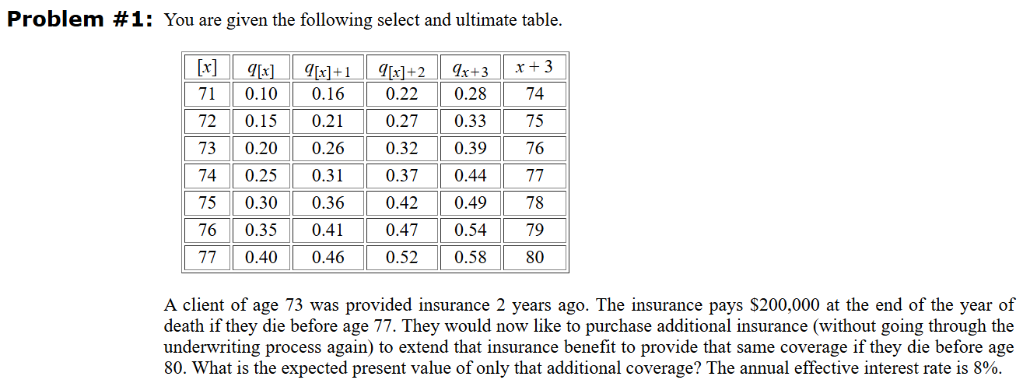 Problem #1: You are given the following select and ultimate table.
[0 [ar | apger | apgen || gees [x3
ow 016 on [os 7
IE CET CE KER
[73 7020] 026 [ 032 [039 | 76
[74 [025] 031 | 037 [044 | 77
[0x0 0% 0a [oe 75
EC CE CT RC KER
[77 [040 | 046 | 052 | 058 | so
A client of age 73 was provided insurance 2 years ago. The insurance pays $200,000 at the end of the year of
death if they die before age 77. They would now like to purchase additional insurance (without going through the
underwriting process again) to extend that insurance benefit to provide that same coverage if they die before age
80. What is the expected present value of only that additional coverage? The annual effective interest rate is 8%.
This is AI generated Response.
Asked by: Sahab Sharan
Created at: 2025-10-22 05:44:35
Asked by: Sahab Sharan
Created at: 2025-10-22 05:44:35
Final Answer:
Rendered
Raw Text
Did you like this answer?
Let's analyze the problem step by step.
---
## Given Data:
| \( x \) | \( q[x] \) | \( q[x+1] \) | \( q[x+2] \) | \( q[x+3] \) | \( x+3 \) |
|---------|------------|--------------|--------------|--------------|-----------|
| 71 | .10 | .16 | .22 | .28 | 74 |
| 72 | .15 | .21 | .27 | .33 | 75 |
| 73 | .20 | .26 | .32 | .39 | 76 |
| 74 | .25 | .31 | .37 | .44 | 77 |
| 75 | .30 | .36 | .42 | .49 | 78 |
| 76 | .35 | .41 | .47 | .54 | 79 |
| 77 | .40 | .46 | .52 | .58 | 80 |
---
## Question Summary:
- Client age: **73**
- Insurance paid: **$200,000**
- End of year: **Before age 77**
- Goal: Find the **expected present value** of the additional coverage, considering an 8% annual effective interest rate.
---
## Step 1: Determine the probability of dying within each year
The probability that the client aged 73 will die in year \( x \) (from age \( x \) to \( x+1 \)):
\[
p_{x} = q[x]
\]
And the probability of surviving through \( x \) years:
\[
S_{x} = \prod_{k=71}^{x} (1 - q[k])
\]
---
## Step 2: Find the probability of dying in each year before age 77
From the table, the probabilities:
| Age | \( q[x] \) |
|-------|------------|
| 73 | .20 |
| 74 | .25 |
| 75 | .30 |
| 76 | .35 |
---
## Step 3: Calculate survival probabilities up to each age
- **Survival from age 73 to 74:**
\[
S_{73} = 1
\]
\[
S_{74} = (1 - .20) = .80
\]
- **Survival from age 73 to 75:**
\[
S_{75} = S_{74} \times (1 - .25) = .80 \times .75 = .60
\]
- **Survival from age 73 to 76:**
\[
S_{76} = S_{75} \times (1 - .30) = .60 \times .70 = .42
\]
- **Survival from age 73 to 77:**
\[
S_{77} = S_{76} \times (1 - .35) = .42 \times .65 = .273
\]
---
## Step 4: Probabilities of dying in each year
\[
\begin{aligned}
p_{73} &= .20 \\
p_{74} &= S_{74} \times q[74] = .80 \times .25 = .20 \\
p_{75} &= S_{75} \times q[75] = .60 \times .30 = .18 \\
p_{76} &= S_{76} \times q[76] = .42 \times .35 = .147
\end{aligned}
\]
---
## Step 5: Calculate the present value of the death benefit in each year
The death benefit is paid at the end of the year, so the present value (PV) of the \$200,000 death benefit paid in year \( t \):
\[
PV_t = \frac{200,000}{(1 + i)^t}
\]
where \( i = 8\% \) or .08.
The relevant \( t \) (number of years from age 73):
| Year | \( t \) | Probability \( p_{x+t} \) | PV factor \( (1 + .08)^t \) | Present Value of death benefit |
|--------|--------|--------------------------|----------------------------|------------------------------|
| 73 | | .20 | 1 | \( 200,000 / 1 = 200,000 \) |
| 74 | 1 | .20 | 1.08 | \( 200,000 / 1.08 \approx 185,185 \) |
| 75 | 2 | .18 | 1.1664 | \( 200,000 / 1.1664 \approx 171,467 \) |
| 76 | 3 | .147 | 1.2597 | \( 200,000 / 1.2597 \approx 158,720 \) |
---
## Step 6: Calculate the expected present value (EPV)
\[
EPV = \sum_{t=}^{3} p_{x+t} \times PV_t
\]
\[
EPV = .20 \times 200,000 + .20 \times 185,185 + .18 \times 171,467 + .147 \times 158,720
\]
Calculations:
\[
\begin{aligned}
&.20 \times 200,000 = 40,000 \\
&.20 \times 185,185 \approx 37,037 \\
&.18 \times 171,467 \approx 30,864 \\
&.147 \times 158,720 \approx 23,329
\end{aligned}
\]
Total:
\[
EPV \approx 40,000 + 37,037 + 30,864 + 23,329 = \boxed{\$131,230}
\]
---
## **Final Answer:**
### The expected present value of the additional coverage is approximately **\$131,230**.
📢 Instructions:
- Ask anything relatd to above question only.
- For new Question goto :