 VIPSolutions
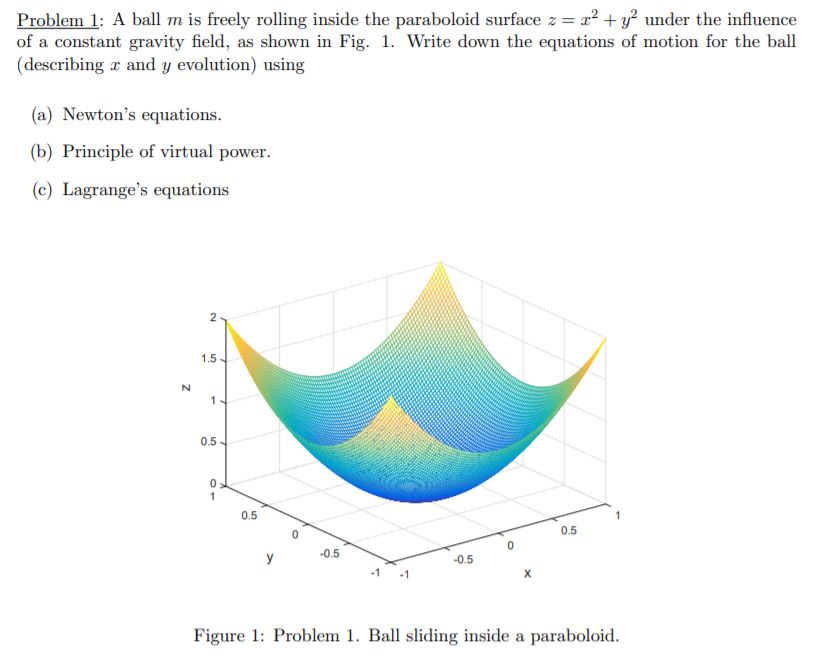
Problem 1: A ball m is freely rolling inside the paraboloid surface = = 2 + y* under the influence of a constant gravity field, as shown in Fig. 1. Write down the equations of motion for the ball (describing z and y evolution) using (a) Newton's equations. (b) Principle of virtual power. (c) Lagrange’s equations ! = 0s oo ! 0s 1 0 0s y os os Ela x Figure 1: Problem 1. Ball sliding inside a paraboloid.
Question:
 Problem 1: A ball m is freely rolling inside the paraboloid surface = = 2 + y* under the influence
of a constant gravity field, as shown in Fig. 1. Write down the equations of motion for the ball
(describing z and y evolution) using
(a) Newton's equations.
(b) Principle of virtual power.
(c) Lagrange’s equations
! =
0s oo
!
0s 1
0 0s
y os os
Ela x
Figure 1: Problem 1. Ball sliding inside a paraboloid.
This is AI generated Response.
Asked by: Kumar
Created at: 2025-07-25 22:03:32
Asked by: Kumar
Created at: 2025-07-25 22:03:32
Final Answer:
Rendered
Raw Text
Did you like this answer?
Let's address each part of the problem for a ball of mass \( m \) rolling inside the paraboloid \( z = x^2 + y^2 \) under gravity.
---
### (a) **Newton’s Equations**
The ball is constrained to the surface \( z = x^2 + y^2 \). The only forces acting are gravity and the normal reaction from the surface. The equations of motion are:
1. **Force components:**
- Gravity: \( \vec{F}_g = -mg \hat{z} \)
- Normal force: \( \vec{N} \) (unknown, but perpendicular to the surface)
2. **Constraint equation:**
\[
z - x^2 - y^2 = 0
\]
3. **Newton’s second law (with constraint):**
\[
m\ddot{\vec{r}} = -mg\hat{z} + N\hat{n}
\]
where \( \hat{n} \) is the unit normal to the surface.
4. **Unit normal:**
\[
\hat{n} = \frac{\nabla f}{|\nabla f|}, \quad f(x, y, z) = z - x^2 - y^2
\]
\[
\nabla f = (-2x, -2y, 1)
\]
\[
|\nabla f| = \sqrt{4x^2 + 4y^2 + 1}
\]
So,
\[
\hat{n} = \frac{(-2x, -2y, 1)}{\sqrt{4x^2 + 4y^2 + 1}}
\]
5. **For \( x \) and \( y \):**
Project the force balance onto the tangent plane (eliminate the normal force component).
The tangent plane is spanned by \( \hat{x} \) and \( \hat{y} \), so write Newton’s equation for \( x \) and \( y \):
\[
m\ddot{x} = -N\frac{2x}{\sqrt{4x^2 + 4y^2 + 1}}
\]
\[
m\ddot{y} = -N\frac{2y}{\sqrt{4x^2 + 4y^2 + 1}}
\]
Use the constraint to relate \( \ddot{z} \) to \( \ddot{x} \) and \( \ddot{y} \):
\[
z = x^2 + y^2 \implies \dot{z} = 2x\dot{x} + 2y\dot{y}
\]
\[
\ddot{z} = 2\dot{x}^2 + 2x\ddot{x} + 2\dot{y}^2 + 2y\ddot{y}
\]
The full equations can be derived by substituting for \( N \) using the constraint and the full force balance in \( z \).
---
### (b) **Principle of Virtual Power**
The virtual power principle states that for each virtual velocity \( (\delta \dot{x}, \delta \dot{y}) \) consistent with the constraint,
\[
\sum \vec{F}_i \cdot \delta \vec{v}_i = 0
\]
where \( \vec{F}_i \) are the applied forces, and \( \delta \vec{v}_i \) are admissible virtual velocities.
For our case, the admissible virtual displacements \( (\delta x, \delta y, \delta z) \) must satisfy the constraint:
\[
\delta z = 2x\delta x + 2y\delta y
\]
The virtual work (power) done by gravity:
\[
\delta W = -mg \delta z = -mg (2x \delta x + 2y \delta y)
\]
So, the virtual power equation (for kinetic energy change) is:
\[
m(\ddot{x} \delta x + \ddot{y} \delta y + \ddot{z} \delta z) = -mg \delta z
\]
But with the constraint linking \( \delta z \) to \( \delta x, \delta y \), you substitute and equate coefficients to find the equations of motion.
---
### (c) **Lagrange’s Equations**
The kinetic energy (assuming the ball is sliding, not rolling):
\[
T = \frac{1}{2}m(\dot{x}^2 + \dot{y}^2 + \dot{z}^2)
\]
but \( \dot{z} = 2x\dot{x} + 2y\dot{y} \), so:
\[
T = \frac{1}{2}m\left[\dot{x}^2 + \dot{y}^2 + (2x\dot{x} + 2y\dot{y})^2\right]
\]
\[
= \frac{1}{2}m\left[\dot{x}^2 + \dot{y}^2 + 4x^2\dot{x}^2 + 8xy\dot{x}\dot{y} + 4y^2\dot{y}^2\right]
\]
\[
= \frac{1}{2}m\left[(1+4x^2)\dot{x}^2 + (1+4y^2)\dot{y}^2 + 8xy\dot{x}\dot{y}\right]
\]
The potential energy:
\[
V = mgz = mg(x^2 + y^2)
\]
The Lagrangian:
\[
L = T - V
\]
The Euler-Lagrange equations:
\[
\frac{d}{dt} \left( \frac{\partial L}{\partial \dot{q}_i} \right) - \frac{\partial L}{\partial q_i} = 0, \quad q_i = x, y
\]
Apply for \( x \) and \( y \):
\[
\frac{d}{dt} \left( m[(1+4x^2)\dot{x} + 4xy\dot{y}] \right) - 2mgx = 0
\]
\[
\frac{d}{dt} \left( m[(1+4y^2)\dot{y} + 4xy\dot{x}] \right) - 2mgy = 0
\]
---
#### **Summary of Equations of Motion:**
- **Newton:** Use force balance and eliminate normal force using the constraint.
- **Virtual Power:** Project dynamics onto virtual displacements compatible with the constraint.
- **Lagrange:** Use the Lagrangian above and derive the Euler-Lagrange equations for \( x \) and \( y \).
If you need a more detailed derivation for any part, let me know!
📢 Instructions:
- Ask anything relatd to above question only.
- For new Question goto :