 VIPSolutions
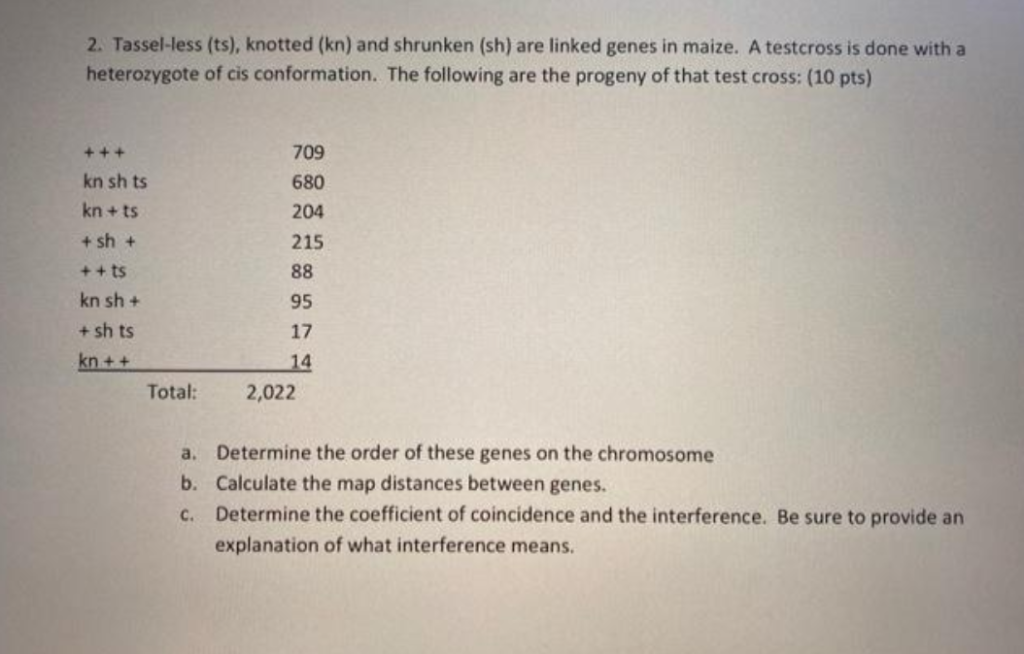
peak = = as, . , knotted (kn) and shrunken (sh) are linked genes in maize. A testcross is done with ote of cis conformation. The following are the progeny of that test cross: (10 pts) da v shits 680 G ts 204 a he 215 “i fs I 88 p nsh+ 95 Pp shits 17 x n+ g 4 id Total: 2,022 2 Ri: = a. Determine the order of these genes on the chromosome a L b. Calculate the map distances between genes. ! ~ ¢. Determine the coefficient of coincidence and the interference. Be sure to provid 1 explanation of what interference means. Jl ™ fi ia Ie [a 45a A rr
Question:
 peak = =
as, .
, knotted (kn) and shrunken (sh) are linked genes in maize. A testcross is done with
ote of cis conformation. The following are the progeny of that test cross: (10 pts)
da v
shits 680 G
ts 204 a
he 215 “i
fs I 88 p
nsh+ 95 Pp
shits 17 x
n+ g 4 id
Total: 2,022 2
Ri: =
a. Determine the order of these genes on the chromosome a L
b. Calculate the map distances between genes. !
~ ¢. Determine the coefficient of coincidence and the interference. Be sure to provid 1
explanation of what interference means. Jl
™ fi
ia Ie
[a 45a
A rr
This is AI generated Response.
Asked by: Nikita Gaikwad
Created at: 2025-06-18 20:28:48
Asked by: Nikita Gaikwad
Created at: 2025-06-18 20:28:48
Final Answer:
Rendered
Raw Text
Did you like this answer?
Let's break down the genetics problem step by step:
### 2. Tassel-less (ts), knotted (kn), and shrunken (sh) are linked genes in maize.
A testcross is done with a heterozygote of cis conformation. The progeny is:
| Phenotype | Number |
|-----------|--------|
| + + + | 709 |
| kn sh ts | 680 |
| kn + ts | 204 |
| + sh + | 215 |
| + + ts | 88 |
| kn sh + | 95 |
| + sh ts | 17 |
| kn + + | 14 |
| **Total** | 2,022 |
#### a. **Determine the order of these genes on the chromosome.**
**Step 1: Identify parental, single crossover (SCO), and double crossover (DCO) classes.**
- **Parental classes:** Highest numbers (most frequent)
- + + + (709)
- kn sh ts (680)
- **DCO classes:** Lowest numbers (least frequent)
- + sh ts (17)
- kn + + (14)
- **SCO classes:** The rest
- kn + ts (204)
- + sh + (215)
- + + ts (88)
- kn sh + (95)
**Step 2: Find the gene order**
Compare parental and DCO classes to determine which gene is in the middle:
Parental: + + +, kn sh ts
DCO: + sh ts, kn + +
Let's write the alleles for each gene:
| Class | kn | sh | ts |
|-------------|----|----|----|
| + + + | + | + | + |
| kn sh ts | kn | sh | ts |
| + sh ts | + | sh | ts |
| kn + + | kn | + | + |
Compare parental (+ + +) to DCO (+ sh ts):
- + → + (same)
- + → sh (different)
- + → ts (different)
So, "sh" and "ts" are switched in the DCO compared to parental.
Compare parental (kn sh ts) to DCO (kn + +):
- kn → kn (same)
- sh → + (different)
- ts → + (different)
So, again "sh" and "ts" are switched.
**Conclusion:** The gene that differs between the parental and double crossover is **sh**. Therefore, **sh** is in the middle.
**Gene order:**
- kn --- sh --- ts
---
#### b. **Calculate the map distances between genes.**
**Map distance (in cM) = (Recombinants between the two genes / Total progeny) × 100**
Let's group the recombinants:
1. **kn and sh:**
- Single crossovers between kn and sh:
- kn + ts (204)
- + sh + (215)
- Double crossovers (both types involve a crossover in both intervals, so count both DCO classes):
- + sh ts (17)
- kn + + (14)
- **Total recombinants = 204 + 215 + 17 + 14 = 450**
- **Map distance = (450 / 2022) × 100 = 22.26 cM**
2. **sh and ts:**
- Single crossovers between sh and ts:
- + + ts (88)
- kn sh + (95)
- Double crossovers (same as above):
- + sh ts (17)
- kn + + (14)
- **Total recombinants = 88 + 95 + 17 + 14 = 214**
- **Map distance = (214 / 2022) × 100 = 10.58 cM**
---
#### c. **Determine the coefficient of coincidence (c.o.c.) and the interference.**
**Expected DCO frequency = (recomb. freq. between kn-sh) × (recomb. freq. between sh-ts) × total progeny**
- kn-sh recomb. freq. = 450 / 2022 = 0.2226
- sh-ts recomb. freq. = 214 / 2022 = 0.1058
**Expected DCO = 0.2226 × 0.1058 × 2022 = 47.59 ≈ 48**
**Observed DCO = 17 (+ sh ts) + 14 (kn + +) = 31**
**Coefficient of coincidence (c.o.c.):**
\[ c.o.c. = \frac{\text{Observed DCO}}{\text{Expected DCO}} = \frac{31}{48} = 0.65 \]
**Interference (I):**
\[ I = 1 - \text{c.o.c.} = 1 - 0.65 = 0.35 \]
**Explanation of interference:**
Interference is the phenomenon where a crossover in one region of a chromosome reduces the probability of another crossover nearby. Here, an interference of 0.35 means that 35% of the expected double crossovers did not occur because a crossover in one region interfered with the occurrence of another nearby.
---
### **Summary Table**
| Step | Result |
|---------|----------------------------|
| a) | kn — sh — ts |
| b) | kn-sh: 22.3 cM <br> sh-ts: 10.6 cM |
| c) | c.o.c. = 0.65 <br> interference = 0.35 |
Let me know if you'd like a more detailed explanation or step-by-step working for any part!
📢 Instructions:
- Ask anything relatd to above question only.
- For new Question goto :