 VIPSolutions
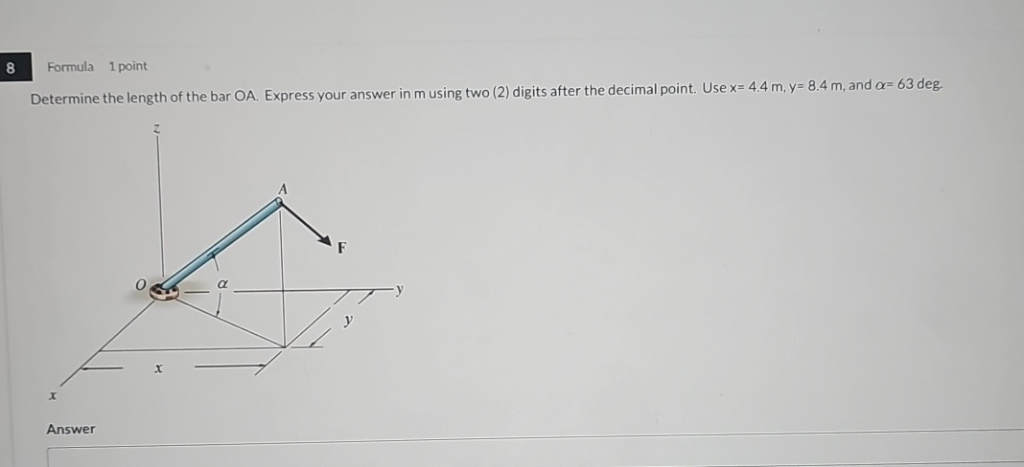
[ll en Determine the length of the bar OA. Express your answer in m using two (2) digits after the decimal point. Use x= 44m,y=84m,and a= 63 deg. A | F oll ’ ZZ 4 = — x Answer TE _-.
Question:
 [ll en
Determine the length of the bar OA. Express your answer in m using two (2) digits after the decimal point. Use x= 44m,y=84m,and a= 63 deg.
A
| F
oll ’
ZZ 4
= —
x
Answer
TE _-.
This is AI generated Response.
Asked by: VARRI NAVEEN
Created at: 2025-09-26 18:15:44
Asked by: VARRI NAVEEN
Created at: 2025-09-26 18:15:44
Thought Process:
Rendered
Raw Text
**Analyzing a geometry problem**
I'm looking at a shape, specifically with point O at the base and then considering a vector leading to point A. The vector has components along the x direction (4.4 m) and y direction (8.4 m). I'm wondering about the angle α, which seems to be the angle between OA and its projection on the plane. I need to clarify if α is with the projection or the floor. The goal is to find the length of bar OA using the given values.**Clarifying geometric relationships**
I'm examining the diagram, noticing a vertical segment from point A down to the plane. The foot of that segment touches the base, where I see arrows indicating x and y. The horizontal distance from O to the foot involves calculating √(x² + y²). Now, I'm considering angle α, which might be between OA and its projection on the plane. The label for α seems to be close to where bar OA meets the ground, but I’m also spotting some extra triangular features in the diagram that are confusing.**Exploring angle relationships**
I’m considering the possibility that angle α could be between the projection of OA on the plane and the x-axis. There's a small triangular wedge near O on the xy-plane displaying α in relation to the projection and the x-axis, which seems plausible since a wedge is also drawn inside the triangular base. I need to look more closely. When I zoom in, it looks like there’s a wedge showing α between the projection line from O to the foot and the positive y-axis direction. It’s worth paying attention to how those lines interact!**Assessing angles and axes**
I’m noticing some confusion about the y-axis line at point O; it seems to be along the top horizontal. In a 3D view, the y-axis goes right, the x-axis moves diagonally outward, and the z-axis goes vertical. The base triangular wedge suggests that the direction from O to the foot has x and y components. It seems like angle α might be related to that direction and the x-axis. However, since I don't have height z, I'll need to focus on α as the angle of the bar above the plane rather than its orientation on the plane.**Investigating angle relationships**
I’m trying to determine how angle α relates to the length of bar OA and its vertical height. It gets complex, as α might be between OA and various projections. If α is with the horizontal plane, I can use relationships like sin, cos, and tan to compute lengths. With x and y known, r can be determined, but I'm unsure how α fits without a vertical height z.
After analyzing the diagram, it seems α might actually show the angle between OA and the horizontal projection. However, without the height z, I can't fully compute OA. It looks like the wedge labeled α is a clue for further calculations, but I need to clarify its significance in relation to both projections and the angles involved. It's all quite tricky but essential to get the right length calculations!**Calculating length of OA**
I’m considering a method to compute the length of OA using the values for x, y, and α. If α represents the elevation angle, I can use the formula L = √(x² + y²) / cos(α). Plugging in the numbers, I find the projection length r = √(4.4² + 8.4²) equals approximately 9.49 m. So using cos(63°), I compute L to be about 20.90 m. I’ll make sure to show all steps clearly, rounding to two decimal places as instructed!
Final Answer:
Rendered
Raw Text
Did you like this answer?
20.90 m
Explanation:
- The horizontal projection of OA has length r = sqrt(x^2 + y^2) = sqrt(4.4^2 + 8.4^2) = 9.49 m.
- If α is the elevation angle of OA above the horizontal plane, then r = L cos α, so L = r / cos α.
- L = 9.49 / cos(63°) ≈ 20.90 m.
📢 Instructions:
- Ask anything relatd to above question only.
- For new Question goto :