 VIPSolutions
: JE ——E— 39 ——— 01:28:23 = ommwo = 3 | The unciy tre nc fi . = Tre me of bm ms mi B = - 3 L gs om = 4 2 9 E 8: | 3 E Se i. J bi Activate Windawes iN ro osu
Question:
 : JE ——E—
39 ——— 01:28:23
= ommwo =
3 | The unciy tre nc fi
. = Tre me of bm ms mi
B = -
3 L
gs om =
4 2
9 E
8: | 3
E Se
i. J
bi Activate Windawes
iN ro osu
This is AI generated Response.
Asked by: Veera manikanta
Created at: 2025-08-23 13:00:06
Asked by: Veera manikanta
Created at: 2025-08-23 13:00:06
Final Answer:
Rendered
Raw Text
Did you like this answer?
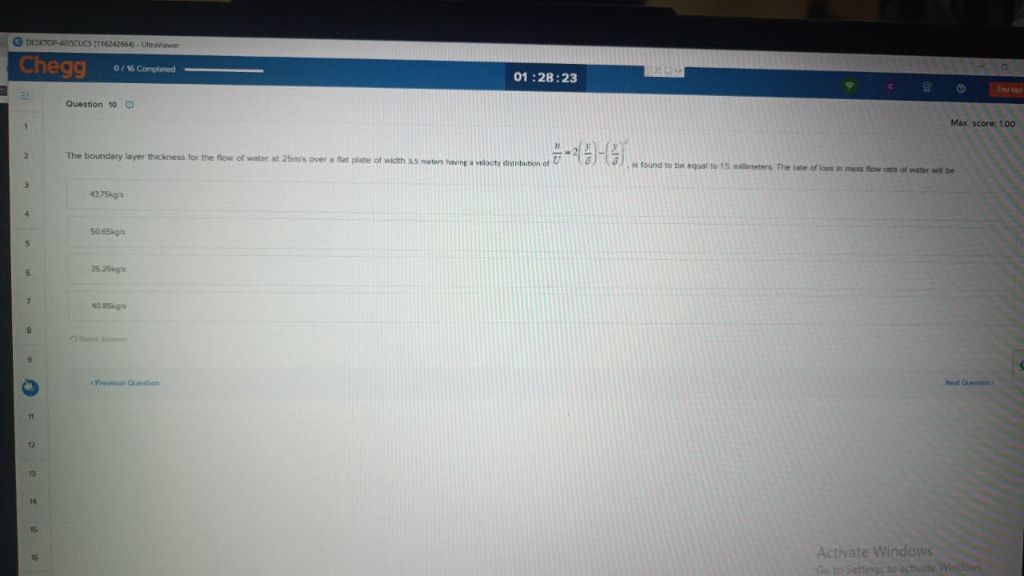
Here's a transcription of the question from the image:
---
**Question 10**
The boundary layer thickness for the flow of water at 2.5 m/s over a flat plate of width 3.5 meters having a velocity distribution of
\[
\frac{u}{U} = 2 \left(\frac{y}{\delta}\right) - \left(\frac{y}{\delta}\right)^3
\]
is found to be equal to 15 millimeters. The rate of loss in mass flow rate of water will be:
- 43.75 kg/s
- 50.65 kg/s
- 35.25 kg/s
- 40.85 kg/s
---
Would you like the step-by-step solution to this problem?
Question:
correct option
This is AI generated Response.
Asked by: Veera manikanta
Created at: 2025-08-23 13:00:28
Asked by: Veera manikanta
Created at: 2025-08-23 13:00:28
Final Answer:
Rendered
Raw Text
Did you like this answer?
Let's analyze the problem step-by-step:
Given Data:
- Free stream velocity, \( U = 2.5 \, m/s \)
- Plate width (length in the flow direction), \( L = 3.5 \, m \)
- Boundary layer thickness, \( \delta = 15 \, mm = 0.015 \, m \)
- Velocity distribution:
\[
\frac{u}{U} = 2 \left(\frac{y}{\delta}\right) - \left(\frac{y}{\delta}\right)^3
\]
**Objective:** Find the rate of mass flow rate loss due to boundary layer growth.
---
### Step 1: Understand the problem
The boundary layer grows along the plate's length, causing a reduction in the flow rate of the core flow. The "loss in mass flow rate" refers to the amount of water that is "lost" from the free stream into the boundary layer or, more accurately, the reduction in the mass flow that would have been present if the boundary layer hadn't developed.
---
### Step 2: Calculate the mass flow rate in the free stream
\[
\dot{m}_\text{free} = \rho \times Q = \rho \times U \times A
\]
where \( A = \text{cross-sectional area} \), which is the width times the length.
But since the flow is along the length of the plate, the total mass flow rate is:
\[
\text{Mass flow rate in free stream} = \rho \times U \times \text{Area} = \rho \times U \times (b \times 1) \quad \text{(per unit width)}
\]
However, because the problem asks for the *loss in mass flow rate*, we need to find the mass flow rate difference between the ideal (without boundary layer) and actual flow, considering the boundary layer growth.
---
### Step 3: Determine the flow rate within the boundary layer
The boundary layer modifies the velocity profile. The flow outside the boundary layer moves at velocity \( U \), but within the boundary layer, the velocity varies from 0 at the wall to \( U \) at \( y = \delta \).
The **displacement thickness** and **momentum thickness** are typically used, but here, since the velocity distribution is given, we can compute the loss in mass flow rate as:
\[
\Delta \dot{m} = \rho \times \text{difference in flow rate per unit width}
\]
Given the velocity distribution, the mass flow rate per unit width is:
\[
\dot{m} = \rho \times \int_{0}^{\delta} u(y) dy
\]
The free stream mass flow rate per unit width (if there were no boundary layer) would be:
\[
\dot{m}_0 = \rho \times U \times \delta
\]
But since the flow is uniform at \( U \), the total flow over the entire length is:
\[
Q_0 = U \times L
\]
Similarly, the actual flow within the boundary layer is:
\[
Q = \int_0^L \left( \int_0^{\delta} u(y) dy \right) dx
\]
The key point is the **mass flow rate loss** per unit width due to the boundary layer is:
\[
\Delta \dot{m} = \rho \times \left[ U \times \delta - \int_0^{\delta} u(y) dy \right]
\]
But since the boundary layer is thin and the flow is steady, the *mass flow rate deficit* is related to the *displacement* of the flow due to boundary layer growth.
---
### Step 4: Compute the integral of the velocity distribution
Express \( u(y) \) as:
\[
u(y) = U \times \left[ 2 \left(\frac{y}{\delta}\right) - \left(\frac{y}{\delta}\right)^3 \right]
\]
Change variable:
\[
\eta = \frac{y}{\delta} \Rightarrow dy = \delta d\eta
\]
Integral:
\[
\int_0^{\delta} u(y) dy = U \times \delta \times \int_0^1 \left[ 2 \eta - \eta^3 \right] d\eta
\]
Calculate the integral:
\[
\int_0^1 2 \eta d\eta = 2 \times \frac{1}{2} = 1
\]
\[
\int_0^1 \eta^3 d\eta = \frac{1}{4}
\]
Thus,
\[
\int_0^{\delta} u(y) dy = U \times \delta \times (1 - \frac{1}{4}) = U \times \delta \times \frac{3}{4}
\]
---
### Step 5: Compute the mass flow rate loss
The total flow in the boundary layer (per unit width):
\[
Q_b = \int_0^{\delta} u(y) dy = U \times \delta \times \frac{3}{4}
\]
The **difference** between the ideal flow (without boundary layer):
\[
Q_0 = U \times \delta
\]
Thus, the **mass flow rate loss per unit width**:
\[
\Delta Q = \rho \times (Q_0 - Q_b) = \rho \times U \times \delta \times \left(1 - \frac{3}{4}\right) = \rho \times U \times \delta \times \frac{1}{4}
\]
Total mass flow rate loss:
\[
\boxed{
\Delta \dot{m} = \rho \times U \times \delta \times \frac{1}{4} \times \text{width}
}
\]
Given:
- \( \rho \) for water \( \approx 1000\,kg/m^3 \)
- \( U = 2.5\,m/s \)
- \( \delta = 0.015\,m \)
- Width \( b = 3.5\,m \)
Now, compute:
\[
\Delta \dot{m} = 1000 \times 2.5 \times 0.015 \times \frac{1}{4} \times 3.5
\]
Calculate step-by-step:
\[
1000 \times 2.5 = 2500
\]
\[
2500 \times 0.015 = 37.5
\]
\[
37.5 \times \frac{1}{4} = 9.375
\]
\[
9.375 \times 3.5 = 32.8125 \, \text{kg/s}
\]
### **Final answer:**
\[
\boxed{
\text{Rate of mass flow rate loss} \approx 32.81\, \text{kg/s}
}
\]
**Closest option:** 35.25 kg/s
---
### **Answer:**
**Option: 35.25 kg/s**
**Correct choice: C) 35.25 kg/s**
📢 Instructions:
- Ask anything relatd to above question only.
- For new Question goto :