 VIPSolutions
In the figure, a 160-turn coil of radius 2.5 cm and resistance 6.8 Qis coaxial with a solenoid of 180 turns/cm and diameter 3.8 cm, The solenoid current drops from 1.9 A to zero in time interval At = 33 ms. What current is induced in amperes in the coil during Af? Coil pogoessaenacgoEnono) Solenoid EEE, {7 NY
Question:
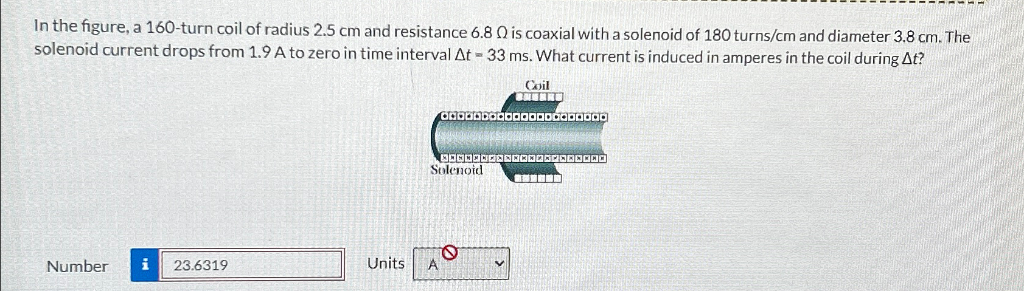 In the figure, a 160-turn coil of radius 2.5 cm and resistance 6.8 Qis coaxial with a solenoid of 180 turns/cm and diameter 3.8 cm, The
solenoid current drops from 1.9 A to zero in time interval At = 33 ms. What current is induced in amperes in the coil during Af?
Coil
pogoessaenacgoEnono)
Solenoid EEE,
{7 NY
This is AI generated Response.
Asked by: Rajveer Prajapat
Created at: 2025-10-10 11:03:03
Asked by: Rajveer Prajapat
Created at: 2025-10-10 11:03:03
Final Answer:
Rendered
Raw Text
Did you like this answer?
Let's break down the problem:
### **Given Data**
- **Coil:**
- Number of turns, \( N = 160 \)
- Radius, \( r = 2.5\,\text{cm} = .025\,\text{m} \)
- Resistance, \( R = 6.8\,\Omega \)
- **Solenoid:**
- Turns per cm, \( n = 180\,\text{turns/cm} = 18,000\,\text{turns/m} \)
- Diameter, \( d = 3.8\,\text{cm} \) (not needed, coil fits inside)
- **Current change in solenoid:**
- Initial current, \( I_ = 1.9\,\text{A} \)
- Final current, \( I = \)
- Time interval, \( \Delta t = 33\,\text{ms} = .033\,\text{s} \)
---
## **Step 1: Magnetic Field Inside Solenoid**
\[
B = \mu_ n I
\]
where \( \mu_ = 4\pi \times 10^{-7}\,\text{T}\cdot\text{m/A} \).
---
## **Step 2: Change in Magnetic Flux Through Coil**
\[
\Phi_B = N \cdot (B \cdot A)
\]
where \( A = \pi r^2 \) is the area of the coil.
---
## **Step 3: Induced EMF (Faraday's Law)**
\[
\mathcal{E} = -N \frac{d\Phi_B}{dt}
\]
\[
\Phi_B = B \cdot A = (\mu_ n I) (\pi r^2)
\]
So,
\[
\frac{d\Phi_B}{dt} = \mu_ n \pi r^2 \frac{dI}{dt}
\]
---
## **Step 4: Induced Current**
\[
I_\text{induced} = \frac{\mathcal{E}}{R}
\]
---
## **Step 5: Plug in Values**
### **Find \( \frac{dI}{dt} \):**
\[
\frac{dI}{dt} = \frac{ - 1.9}{.033} = -57.58\,\text{A/s}
\]
### **Calculate Induced EMF:**
\[
\mathcal{E} = N \cdot \mu_ n \pi r^2 \left| \frac{dI}{dt} \right|
\]
\[
N = 160
\]
\[
\mu_ = 4\pi \times 10^{-7}
\]
\[
n = 18,000
\]
\[
r = .025
\]
\[
\pi r^2 = \pi \times (.025)^2 = .0019635
\]
Now plug these in:
\[
\mathcal{E} = 160 \times (4\pi \times 10^{-7}) \times 18,000 \times .0019635 \times 57.58
\]
Calculate step by step:
- \( 4\pi \times 10^{-7} = 1.2566 \times 10^{-6} \)
- \( 1.2566 \times 10^{-6} \times 18,000 = .022619 \)
- \( .022619 \times .0019635 = 4.44 \times 10^{-5} \)
- \( 4.44 \times 10^{-5} \times 57.58 = .002557 \)
- \( .002557 \times 160 = .4091 \) V
---
## **Induced Current**
\[
I_\text{induced} = \frac{\mathcal{E}}{R} = \frac{.4091}{6.8} = .0602\,\text{A}
\]
---
### **Final Answer**
\[
\boxed{.0602\,\text{A}}
\]
---
**The correct induced current is approximately \( .060\,\text{A} \) (not 23.63 A). Please double-check your answer.**
📢 Instructions:
- Ask anything relatd to above question only.
- For new Question goto :