 VIPSolutions
In humans, hypotrichosis (sparse body hair) is a rare autosomal recessive condition. Let h = hypotrichosis and H = Normal. Family A consists of two phenotypically normal parents with five children: the first two have hypotrichosis, and the rest are normal. a. What are the genotypes of the parents? Explain. b. What is the chance that all the normal children are heterozygous?
Question:
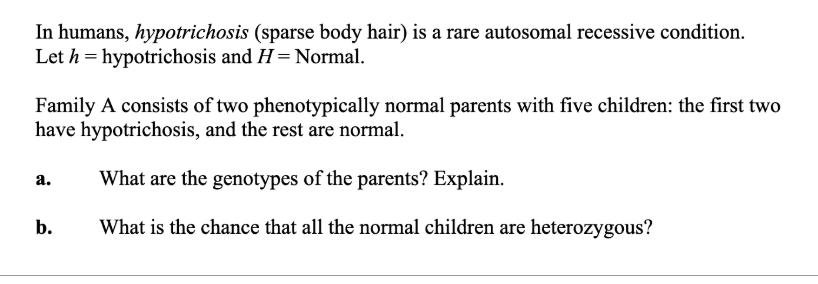 In humans, hypotrichosis (sparse body hair) is a rare autosomal recessive condition.
Let h = hypotrichosis and H = Normal.
Family A consists of two phenotypically normal parents with five children: the first two
have hypotrichosis, and the rest are normal.
a. What are the genotypes of the parents? Explain.
b. What is the chance that all the normal children are heterozygous?
This is AI generated Response.
Asked by: Nikita Gaikwad
Created at: 2025-06-20 16:07:12
Asked by: Nikita Gaikwad
Created at: 2025-06-20 16:07:12
Final Answer:
Rendered
Raw Text
Did you like this answer?
Let's break down the problem step by step.
### Given Information
- **Hypotrichosis** (h) is autosomal recessive.
- **Normal** (H) is the dominant allele.
- Two phenotypically normal parents have five children: two with hypotrichosis, three normal.
---
## **a. What are the genotypes of the parents? Explain.**
### **Key Points:**
- Both parents are normal **phenotypically** (so they cannot be hh).
- Two children have hypotrichosis (hh). The only way to get "hh" children is if both parents carry the "h" allele.
- Therefore, both parents must be **heterozygous** (Hh).
### **Explanation:**
- The cross is **Hh × Hh**.
- Punnett square:
| | H | h |
|-----|---|---|
| **H** | HH | Hh |
| **h** | Hh | hh |
- **Genotypic ratio:** 1 HH : 2 Hh : 1 hh
- **Phenotypic ratio:** 3 normal : 1 hypotrichosis
**Answer:**
> The genotypes of both parents are **Hh** (heterozygous). This is because only Hh × Hh can produce hh (affected) children, and parents are phenotypically normal.
---
## **b. What is the chance that all the normal children are heterozygous?**
### **Let’s break this down:**
- 5 children: 2 are hh (affected), 3 are normal (either HH or Hh).
- For each normal child, what is the probability they are Hh?
#### **Probability for a normal child to be Hh:**
From the Punnett square above:
- Probabilities among offspring:
- HH: 1/4
- Hh: 2/4 = 1/2
- hh: 1/4
But **given they are normal** (i.e., not hh), their possible genotypes are **HH** and **Hh**.
- Probability a normal child is **Hh**:
- Probability of Hh among normals = P(Hh) / [P(HH) + P(Hh)] = (1/2) / (3/4) = 2/3
#### **Probability all 3 normal children are Hh:**
- Each has a 2/3 chance of being Hh.
- Probability all 3 are Hh = (2/3) × (2/3) × (2/3) = **8/27**
---
### **Summary of Answers:**
**a.** The genotypes of the parents are both **Hh** (heterozygous), because only heterozygous normal parents can have children with the recessive condition.
**b.** The chance that all the normal children are heterozygous (**Hh**) is **8/27**.
📢 Instructions:
- Ask anything relatd to above question only.
- For new Question goto :