 VIPSolutions
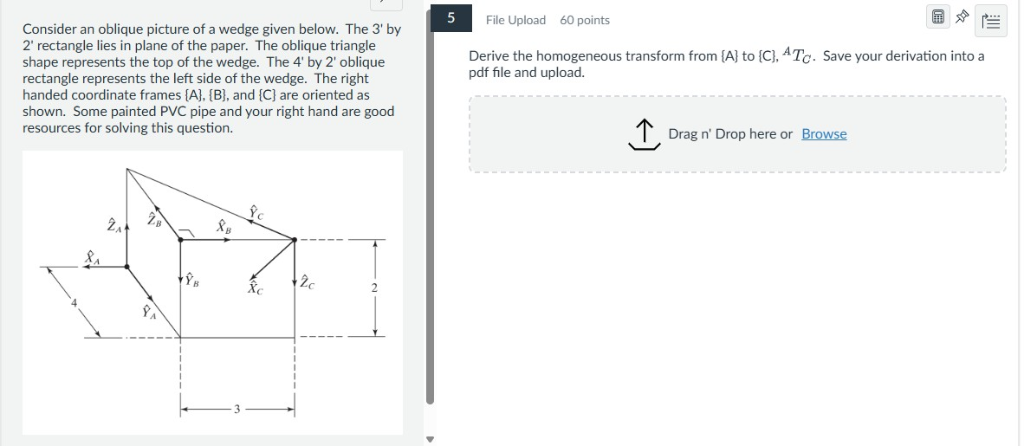
ile Uploa oints Pp Consider an oblique picture of a wedge given below. The 3' by Flelploxd ‘Gp 8 # p= 2' rectangle lies in pl: f the . The obli triangle eo er then Ta BC Derive the homogeneous transform from [A] to [C), AT. Save your derivation into a rectangle represents the left side of the wedge. The right pdf file and upload. handed coordinate frames [A], (B], and [C] are oriented as shown. Some painted PVC pipe and your right hand are good resources for solving this question. 4 Oren Drophere or Browse Ev Je 2 po) \ Ti 5 1% 2 AN 7 Bl 1 1 (N—
Question:
 ile Uploa oints Pp
Consider an oblique picture of a wedge given below. The 3' by Flelploxd ‘Gp 8 # p=
2' rectangle lies in pl: f the . The obli triangle
eo er then Ta BC Derive the homogeneous transform from [A] to [C), AT. Save your derivation into a
rectangle represents the left side of the wedge. The right pdf file and upload.
handed coordinate frames [A], (B], and [C] are oriented as
shown. Some painted PVC pipe and your right hand are good
resources for solving this question. 4 Oren Drophere or Browse
Ev
Je
2
po)
\ Ti 5 1% 2
AN 7 Bl
1 1
(N—
This is AI generated Response.
Asked by: Adapaka Jagadeesh
Created at: 2025-09-01 22:20:46
Asked by: Adapaka Jagadeesh
Created at: 2025-09-01 22:20:46
Final Answer:
Rendered
Raw Text
Did you like this answer?
Let's break down **how to solve for the homogeneous transformation matrix \( {}^A T_C \)** step by step:
---
### **Step 1: Understanding the Problem**
You are given three frames:
- Frame \(\{A\}\): Origin at the lower left corner.
- Frame \(\{B\}\): Origin at the lower left of the oblique rectangle.
- Frame \(\{C\}\): Origin at the upper right of the oblique rectangle.
You are to find the homogeneous transformation from frame \(\{A\}\) to frame \(\{C\}\), denoted as \( {}^A T_C \).
---
### **Step 2: Frame Positions**
#### **Frame \(\{A\}\)**
- Origin: Lower left.
- Axes: Standard orientation.
#### **Frame \(\{C\}\)**
- Origin: Upper right.
- Oriented as shown in the diagram.
---
### **Step 3: Find the Translation Vector**
Let’s find the coordinates of the origin of frame \(\{C\}\) **with respect to \(\{A\}\)**.
- Along \(x_A\): 3 units (width of rectangle)
- Along \(y_A\): 2 units (height of rectangle)
- Along \(z_A\): 4 units (height to the top)
So, the **translation vector** from \(\{A\}\) to \(\{C\}\) is:
\[
{}^A \mathbf{p}_C =
\begin{bmatrix}
3 \\
2 \\
4
\end{bmatrix}
\]
---
### **Step 4: Find the Rotation Matrix**
Now, we need to express the axes of \(\{C\}\) in terms of \(\{A\}\).
Let's denote:
- \( \hat{x}_C \), \( \hat{y}_C \), \( \hat{z}_C \) in terms of \(\{A\}\).
#### **From the diagram**:
- \( \hat{x}_C \): Along the top edge of the wedge (parallel to \(x_A\)), so
\[
\hat{x}_C = \begin{bmatrix} 1 \\ 0 \\ 0 \end{bmatrix}
\]
- \( \hat{y}_C \): Along the short side (parallel to \(y_A\)), so
\[
\hat{y}_C = \begin{bmatrix} 0 \\ 1 \\ 0 \end{bmatrix}
\]
- \( \hat{z}_C \): Perpendicular to the rectangle (parallel to \(z_A\)), so
\[
\hat{z}_C = \begin{bmatrix} 0 \\ 0 \\ 1 \end{bmatrix}
\]
*Assuming the axes are aligned as above; if the diagram shows a different orientation for \(\{C\}\), adjust accordingly.*
---
### **Step 5: Assembling the Homogeneous Transformation**
The general homogeneous transformation is:
\[
{}^A T_C = \begin{bmatrix}
R & \mathbf{p} \\
0 & 1
\end{bmatrix}
\]
Where:
- \(R\) is the 3x3 rotation matrix (columns are the unit vectors of \(\{C\}\) in terms of \(\{A\}\))
- \(\mathbf{p}\) is the 3x1 translation vector.
Given our findings:
\[
R = \begin{bmatrix}
1 & 0 & 0 \\
0 & 1 & 0 \\
0 & 0 & 1
\end{bmatrix}
\]
\[
\mathbf{p} = \begin{bmatrix}
3 \\
2 \\
4
\end{bmatrix}
\]
So,
\[
{}^A T_C = \begin{bmatrix}
1 & 0 & 0 & 3 \\
0 & 1 & 0 & 2 \\
0 & 0 & 1 & 4 \\
0 & 0 & 0 & 1
\end{bmatrix}
\]
---
### **Step 6: Write Up Your Derivation**
**To submit:**
1. Write out the above steps, explaining your reasoning.
2. Show the vector calculations for the frame origins and axes.
3. Assemble the final matrix as above.
4. Save as a PDF and upload.
---
#### **If the axes of \(\{C\}\) are not aligned with \(\{A\}\) (e.g., rotated), you need to calculate the direction vectors for the axes based on the geometry in the diagram and build the rotation matrix accordingly.**
---
If you have doubts about the axis orientation, upload your work-in-progress and I can help further!
📢 Instructions:
- Ask anything relatd to above question only.
- For new Question goto :