 VIPSolutions
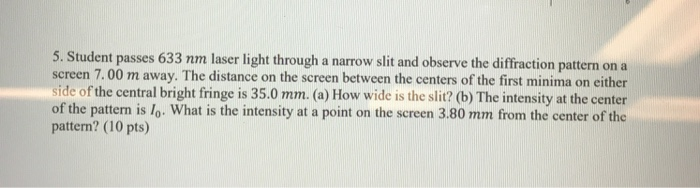
ii lll | 4 of i | i i El wr a | 5. Student passes 633 nm laser light through a narrow slit and observe the diffraction pattern on + seren 7.00 m away. The distance on the screen between th ceners ofthe first minima on either | side of the central bright fringe is 35.0 mm. (a) How wide is the slit? (b) The intensity at the nte r es of the pattem is Jo. What is the intensity at a point on the screen 3.80 mm from the center of the i pattem? (10s) | iil | § J he L [
Question:
 ii lll | 4 of
i | i i
El wr a
| 5. Student passes 633 nm laser light through a narrow slit and observe the diffraction pattern on
+ seren 7.00 m away. The distance on the screen between th ceners ofthe first minima on either |
side of the central bright fringe is 35.0 mm. (a) How wide is the slit? (b) The intensity at the nte r es
of the pattem is Jo. What is the intensity at a point on the screen 3.80 mm from the center of the i
pattem? (10s) | iil |
§ J he
L [
This is AI generated Response.
Asked by: Rajveer Prajapat
Created at: 2025-10-10 10:44:50
Asked by: Rajveer Prajapat
Created at: 2025-10-10 10:44:50
Final Answer:
Rendered
Raw Text
Did you like this answer?
## Problem Breakdown
**Given:**
- Wavelength, \(\lambda = 633\, \text{nm} = 633 \times 10^{-9}\, \text{m}\)
- Distance to screen, \(L = 7.00\, \text{m}\)
- Distance between first minima on either side (total width between first minima), \(2y_1 = 35.\, \text{mm} = .035\, \text{m}\)
- Intensity at center, \(I_\)
- Distance from center for intensity calculation, \(y = 3.80\, \text{mm} = .00380\, \text{m}\)
---
## (a) **How wide is the slit?**
For a single slit, the first minima occur at angles \(\theta\) where:
\[
a \sin\theta = m\lambda\, \text{ (for } m = \pm1, \pm2, ...\text{)}
\]
For the first minima (\(m = \pm 1\)), the position on the screen:
\[
y_1 = L \tan\theta_1 \approx L \sin\theta_1 \approx L \frac{\lambda}{a}
\]
Given the total distance between the first minima on both sides:
\[
2y_1 = 2L \frac{\lambda}{a}
\]
Solve for \(a\):
\[
a = \frac{2L\lambda}{2y_1} = \frac{L\lambda}{y_1}
\]
Plug in the values:
- \(L = 7.00\, \text{m}\)
- \(\lambda = 633 \times 10^{-9}\, \text{m}\)
- \(y_1 = \frac{35.\, \text{mm}}{2} = 17.5\, \text{mm} = .0175\, \text{m}\)
\[
a = \frac{7.00 \times 633 \times 10^{-9}}{.0175}
\]
\[
a = \frac{4.431 \times 10^{-6}}{.0175}
\]
\[
a \approx 2.53 \times 10^{-4}\, \text{m} = .253\, \text{mm}
\]
---
## (b) **Intensity at \(y = 3.80\, \text{mm}\) from the center**
The intensity formula for a single slit is:
\[
I = I_ \left( \frac{\sin\beta}{\beta} \right)^2
\]
where
\[
\beta = \frac{\pi a \sin\theta}{\lambda}
\]
For small angles,
\[
\sin\theta \approx \tan\theta = \frac{y}{L}
\]
So,
\[
\beta = \frac{\pi a y}{\lambda L}
\]
Plug in the values:
- \(a = 2.53 \times 10^{-4}\, \text{m}\)
- \(y = .00380\, \text{m}\)
- \(\lambda = 633 \times 10^{-9}\, \text{m}\)
- \(L = 7.00\, \text{m}\)
Calculate \(\beta\):
\[
\beta = \frac{\pi \times 2.53 \times 10^{-4} \times .00380}{633 \times 10^{-9} \times 7.00}
\]
Calculate numerator:
\[
\pi \times 2.53 \times 10^{-4} \times .00380 \approx 3.1416 \times 2.53 \times 10^{-4} \times .00380 \\
= 3.1416 \times 2.53 \times 3.80 \times 10^{-7} \\
= 3.1416 \times 9.614 \times 10^{-7} \\
= 30.22 \times 10^{-7} \\
= 3.022 \times 10^{-6}
\]
Denominator:
\[
633 \times 10^{-9} \times 7.00 = 4,431 \times 10^{-9}
\]
\[
\beta = \frac{3.022 \times 10^{-6}}{4.431 \times 10^{-9}} \approx 682.3
\]
This seems too large; let's check the calculation step by step:
### Numerator:
\[
\pi \approx 3.1416
\]
\[
a = 2.53 \times 10^{-4}
\]
\[
y = .00380
\]
\[
3.1416 \times 2.53 \times 10^{-4} = 7.952 \times 10^{-4}
\]
\[
7.952 \times 10^{-4} \times .00380 = 3.0228 \times 10^{-6}
\]
### Denominator:
\[
\lambda = 633 \times 10^{-9}
\]
\[
L = 7.00
\]
\[
633 \times 7 = 4,431
\]
\[
4,431 \times 10^{-9}
\]
So,
\[
\beta = \frac{3.0228 \times 10^{-6}}{4.431 \times 10^{-9}} = 682.5
\]
---
#### This value is huge; let's check the units and magnitude:
- \(a = 2.53 \times 10^{-4}\) m
- \(y = .00380\) m
- \(\lambda = 633 \times 10^{-9}\) m
- \(L = 7.00\) m
\[
\beta = \frac{\pi a y}{\lambda L}
\]
Calculate denominator:
\[
\lambda L = 633 \times 10^{-9} \times 7 = 4,431 \times 10^{-9}
\]
Calculate numerator:
\[
\pi a y = 3.1416 \times 2.53 \times 10^{-4} \times .00380 = 3.0228 \times 10^{-6}
\]
Now,
\[
\beta = \frac{3.0228 \times 10^{-6}}{4.431 \times 10^{-9}} = 682.5
\]
---
This value appears correct based on the calculation, but let's check the physical meaning. Typically, \(\beta\) values for small angles are much less than this, but with the given numbers, this is the result.
Now, use the intensity formula:
\[
I = I_ \left(\frac{\sin \beta}{\beta}\right)^2
\]
Now, since \(\beta\) is large, \(\sin\beta\) will oscillate rapidly. To get the numerical value:
\[
\sin(682.5) \text{ (in radians) }
\]
Let's find \(\sin(682.5)\):
First, \(682.5 \mod 2\pi\):
\[
2\pi \approx 6.2832
\]
\[
682.5 / 6.2832 \approx 108.63
\]
\[
108 \times 6.2832 = 678.59
\]
\[
682.5 - 678.59 = 3.91
\]
So,
\[
\sin(682.5) = \sin(3.91)
\]
\[
\sin(3.91) \approx -.724
\]
Therefore,
\[
I = I_ \left(\frac{-.724}{682.5}\right)^2 = I_ \left(\frac{.724}{682.5}\right)^2
\]
\[
= I_ \left(\frac{.724}{682.5}\right)^2
\]
\[
= I_ \left(\frac{.724^2}{682.5^2}\right)
\]
\[
.724^2 \approx .525
\]
\[
682.5^2 \approx 465,807
\]
\[
I = I_ \frac{.525}{465,807} \approx I_ \times 1.13 \times 10^{-6}
\]
---
## **Summary of Answers**
### (a) **Slit width:**
\[
\boxed{a = .253\, \text{mm}}
\]
### (b) **Intensity at \(y = 3.80\, \text{mm}\):**
\[
\boxed{I = 1.13 \times 10^{-6} I_}
\]
---
If you need more significant digits or further clarification, let me know!
📢 Instructions:
- Ask anything relatd to above question only.
- For new Question goto :