 VIPSolutions
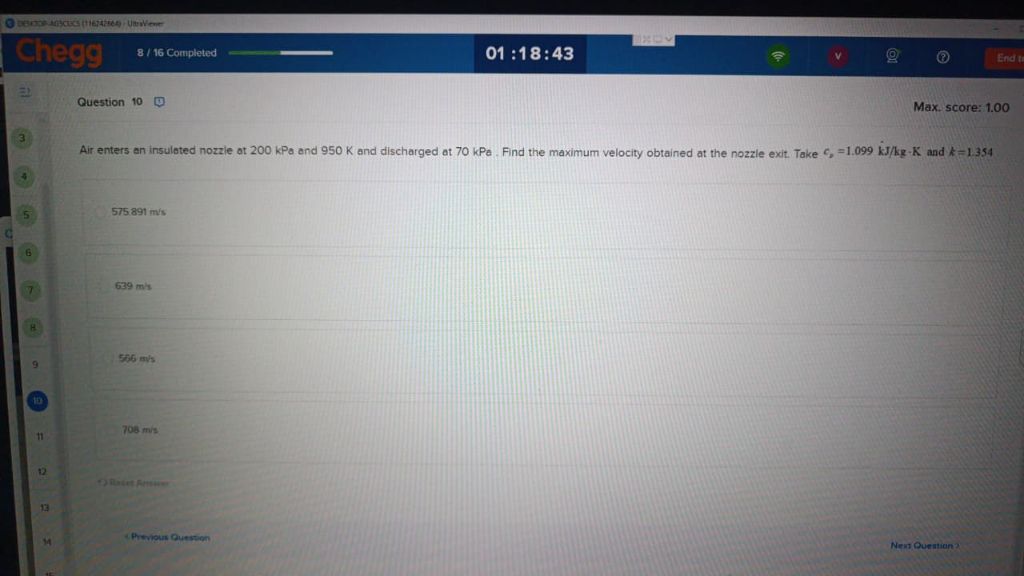
ie 01:18:43 sestion 10 © EE > 0) 9 B. BERS Bh insulated nozzle ot 200 kPa end S50 K end discharged at 70 kPa Find the maximum velocity obtained ot the nozzle ext. Take 6 = 1099 KIER | sane x 3 a E = 2 % i Ce Ra BERR
Question:
 ie 01:18:43
sestion 10 © EE
> 0)
9 B.
BERS Bh insulated nozzle ot 200 kPa end S50 K end discharged at 70 kPa Find the maximum velocity obtained ot the nozzle ext. Take 6 = 1099 KIER
| sane x
3 a
E =
2
% i
Ce
Ra BERR
This is AI generated Response.
Asked by: Veera manikanta
Created at: 2025-08-16 15:57:04
Asked by: Veera manikanta
Created at: 2025-08-16 15:57:04
Final Answer:
Rendered
Raw Text
Did you like this answer?
Let's solve the problem step-by-step:
**Given:**
- Inlet Pressure, \( P_1 = 200 \) kPa
- Inlet Temperature, \( T_1 = 950 \) K
- Exit Pressure, \( P_2 = 70 \) kPa
- \( c_p = 1.099 \) kJ/kg·K = **1099 J/kg·K**
- \( k = 1.354 \)
- The nozzle is insulated (adiabatic process).
We are to **find the maximum velocity at the nozzle exit**.
---
### **Step 1: Apply the Steady Flow Energy Equation (SFEE)**
For an insulated nozzle, the SFEE simplifies to:
\[
h_1 + \frac{V_1^2}{2} = h_2 + \frac{V_2^2}{2}
\]
Assume inlet velocity \( V_1 \) is negligible, so:
\[
h_1 = h_2 + \frac{V_2^2}{2}
\]
\[
\Rightarrow V_2 = \sqrt{2(h_1 - h_2)}
\]
---
### **Step 2: Calculate \( h_1 \) and \( h_2 \)**
For an ideal gas,
\[
h = c_p T
\]
So,
\[
h_1 = c_p T_1
\]
To find \( h_2 = c_p T_2 \), we need \( T_2 \).
---
### **Step 3: Find \( T_2 \) using Isentropic Relations**
For an isentropic process (adiabatic and reversible):
\[
\frac{T_2}{T_1} = \left(\frac{P_2}{P_1}\right)^{\frac{k-1}{k}}
\]
Plug in the values:
\[
\frac{T_2}{950} = \left(\frac{70}{200}\right)^{\frac{1.354-1}{1.354}}
\]
First, calculate the exponent:
\[
\frac{k-1}{k} = \frac{1.354-1}{1.354} = \frac{0.354}{1.354} \approx 0.2614
\]
Now,
\[
\left(\frac{70}{200}\right)^{0.2614} = (0.35)^{0.2614}
\]
Calculate \( (0.35)^{0.2614} \):
\[
\ln(0.35) = -1.0498
\]
\[
-1.0498 \times 0.2614 = -0.2743
\]
\[
e^{-0.2743} \approx 0.760
\]
So,
\[
T_2 = 950 \times 0.760 = 722 \text{ K}
\]
---
### **Step 4: Calculate \( h_1 \) and \( h_2 \)**
\[
h_1 = 1099 \times 950 = 1,044,050 \text{ J/kg}
\]
\[
h_2 = 1099 \times 722 = 793,478 \text{ J/kg}
\]
---
### **Step 5: Find \( V_2 \)**
\[
V_2 = \sqrt{2 (h_1 - h_2)}
\]
\[
= \sqrt{2 \times (1,044,050 - 793,478)}
\]
\[
= \sqrt{2 \times 250,572}
\]
\[
= \sqrt{501,144}
\]
\[
\approx 708 \text{ m/s}
\]
---
### **Final Answer:**
The **maximum velocity at the nozzle exit is**:
\[
\boxed{708\ \text{m/s}}
\]
So the correct option is **708 m/s**.
📢 Instructions:
- Ask anything relatd to above question only.
- For new Question goto :