 VIPSolutions
Question: In a two-player game, players A and B are given the following strategic scenario: |_| Down | (3,2 | 15) “yn | @3 « (i) Is there any Nash Equilibrium for this game? If yes, what is it? « (ii) In a mixed strategy, Player A plays Left with probability p and Right with probability 1 - p. Player B plays Up with probability ¢ and Down with probability — q. « (iif) Find the values of p and q such that hese strategies form an equilibrium. « (iv) What is the expected payoff of the game?
Question:
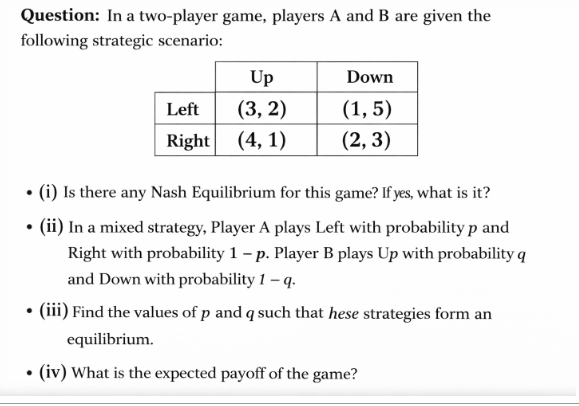 Question: In a two-player game, players A and B are given the
following strategic scenario:
|_| Down |
(3,2 | 15)
“yn | @3
« (i) Is there any Nash Equilibrium for this game? If yes, what is it?
« (ii) In a mixed strategy, Player A plays Left with probability p and
Right with probability 1 - p. Player B plays Up with probability ¢
and Down with probability — q.
« (iif) Find the values of p and q such that hese strategies form an
equilibrium.
« (iv) What is the expected payoff of the game?
This is AI generated Response.
Asked by: Vikram Kumar
Created at: 2026-03-05 03:07:41
Asked by: Vikram Kumar
Created at: 2026-03-05 03:07:41
Final Answer:
Rendered
Raw Text
Did you like this answer?
Let's solve each part step by step:
---
## (i) **Nash Equilibrium (Pure Strategy)**
Let’s write out the payoffs for both players:
| | Up | Down |
|---------|---------|---------|
| **Left** | (3, 2) | (1, 5) |
| **Right** | (4, 1) | (2, 3) |
### Find Best Responses
#### Player A (Row Player):
- If B plays **Up**: A chooses Right (4 > 3)
- If B plays **Down**: A chooses Left (1 < 2), so A chooses Right
#### Player B (Column Player):
- If A plays **Left**: B chooses Down (5 > 2)
- If A plays **Right**: B chooses Down (3 > 1)
**Therefore, (Right, Down) = (2, 3) is the only pure-strategy Nash equilibrium.**
---
## (ii) **Mixed Strategy Setup**
Let:
- Player A plays **Left** with probability \( p \), **Right** with \( 1-p \).
- Player B plays **Up** with probability \( q \), **Down** with \( 1-q \).
---
## (iii) **Find Mixed Strategy Nash Equilibrium**
Each player must be indifferent between their two strategies.
### For Player A (Row):
Expected payoff for **Left**:
\[
E_A(\text{Left}) = 3q + 1(1-q) = 3q + 1 - q = 1 + 2q
\]
Expected payoff for **Right**:
\[
E_A(\text{Right}) = 4q + 2(1-q) = 4q + 2 - 2q = 2 + 2q
\]
Set equal for indifference:
\[
1 + 2q = 2 + 2q \implies 1 = 2
\]
This is a contradiction, which implies **Player A will never mix**; A will always play **Right**.
### For Player B (Column):
Expected payoff for **Up**:
\[
E_B(\text{Up}) = 2p + 1(1-p) = 2p + 1 - p = 1 + p
\]
Expected payoff for **Down**:
\[
E_B(\text{Down}) = 5p + 3(1-p) = 5p + 3 - 3p = 3 + 2p
\]
Set equal for indifference:
\[
1 + p = 3 + 2p \implies 1 + p = 3 + 2p \implies 1 - 3 = 2p - p \implies -2 = p
\]
But probability \( p \) cannot be negative. So **Player B will always play Down**.
---
**So, the only Nash Equilibrium is (Right, Down), i.e., pure strategy.**
---
## (iv) **Expected Payoff**
At equilibrium (Right, Down):
- Player A gets **2**
- Player B gets **3**
**Expected payoff:** (2, 3)
---
### **Summary Table**
| Part | Answer |
|------|--------|
| (i) | Yes, (Right, Down) is the only Nash Equilibrium (pure strategy) |
| (ii) | Mixed strategies do not exist here as equilibria; only pure strategies do. |
| (iii)| \( p = \) (A always plays Right), \( q = \) (B always plays Down) |
| (iv) | Expected payoff: (2, 3) |
---
Let me know if you would like the analysis for other cases or more details!
Question:
(i) Nash Equilibrium (Pure Strategy) 2.(ii) Mixed Strategy Setup 3.(iii) Find Mixed Strategy Nash Equilibrium 4.(iv) Expected Payoff please provide each parts 50 words answer summary or Explanation
This is AI generated Response.
Asked by: Vikram Kumar
Created at: 2026-03-05 03:28:12
Asked by: Vikram Kumar
Created at: 2026-03-05 03:28:12
Final Answer:
Rendered
Raw Text
Did you like this answer?
# Summary of Game Analysis
## (i) Nash Equilibrium (Pure Strategy)
The pure-strategy Nash equilibrium for the game is (Right, Down) with payoffs (2, 3). Player A prefers Right regardless of Player B’s choice, while Player B always opts for Down to maximize their payoff against A's strategies.
## (ii) Mixed Strategy Setup
In the mixed strategy setup, Player A plays Left with probability \( p \) and Right with probability \( 1-p \). Player B plays Up with probability \( q \) and Down with probability \( 1-q \). The mixed strategies aim to create indifference between choices for both players.
## (iii) Find Mixed Strategy Nash Equilibrium
Analysis reveals that Player A will always play Right, leading to no mixed strategy equilibrium for A. Similarly, Player B will always play Down. Therefore, the mixed strategies do not yield an equilibrium as both players have dominant strategies.
## (iv) Expected Payoff
At the equilibrium (Right, Down), Player A receives an expected payoff of 2, while Player B receives 3. Thus, the expected payoff of the game at this equilibrium is (2, 3), reflecting the final outcomes of their strategies.
📢 Instructions:
- Ask anything relatd to above question only.
- For new Question goto :