 VIPSolutions
I cm Tc, ove rom econ hows ne FE Gmcnions of he cero se wn. To wall kos 3m ; F 100mm 2) Clee momen af ni of he crows section [7poi) |) Calc and she he shear low dimuon fn the scion shes fre of = 1 Nn poy pons] DS — (pos)
Question:
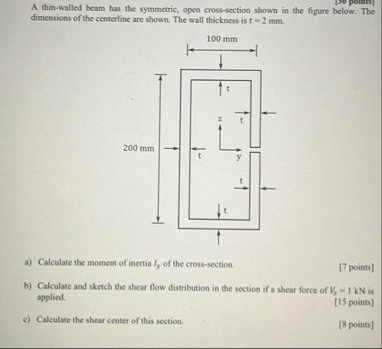 I cm Tc, ove rom econ hows ne FE
Gmcnions of he cero se wn. To wall kos 3m
;
F 100mm
2) Clee momen af ni of he crows section [7poi)
|) Calc and she he shear low dimuon fn the scion shes fre of = 1 Nn
poy pons]
DS — (pos)
This is AI generated Response.
Asked by: Kumar
Created at: 2025-07-27 19:03:24
Asked by: Kumar
Created at: 2025-07-27 19:03:24
Final Answer:
Rendered
Raw Text
Did you like this answer?
Let's break down the problem step by step:
---
### **Given Data:**
- Cross-section: Symmetric, open thin-walled section ("C" shape)
- Dimensions (centerline to centerline):
- Height = \(200\, \text{mm}\)
- Width = \(100\, \text{mm}\)
- Wall thickness, \( t = 2\, \text{mm} \)
---
## a) **Moment of Inertia \( I_y \)**
We are to find the moment of inertia about the **y-axis** (vertical centroidal axis).
### **Step 1: Centroid Location**
The section is symmetric about the \( y \)-axis, so the centroid is at the mid-width horizontally.
### **Step 2: Moment of Inertia Calculation**
For thin-walled sections:
- Ignore the corner radii (since \( t \ll \text{lengths} \))
- Treat each wall as a rectangle
#### **1. Vertical Walls (Left and Right)**
- Height: \(200\, \text{mm}\)
- Thickness: \(2\, \text{mm}\)
- Distance from y-axis: \( \frac{100}{2} = 50\, \text{mm} \)
Moment of inertia of one wall (parallel axis theorem):
\[
I_{y, \text{vertical}} = A \cdot d^2 = (200 \times 2) \cdot (50^2) = 400 \times 2500 = 1,000,000\, \text{mm}^4
\]
There are two such walls (left and right), so total:
\[
I_{y, \text{vertical (total)}} = 2 \times 1,000,000 = 2,000,000\, \text{mm}^4
\]
#### **2. Horizontal Wall (Top)**
- Width: \(100\, \text{mm}\)
- Thickness: \(2\, \text{mm}\)
- Distance from y-axis: 0 (since it lies along the y-axis)
Moment of inertia about y-axis (through its own centroid):
\[
I_{y, \text{horizontal}} = \frac{1}{12} b h^3 = \frac{1}{12} \times 100 \times 2^3 = \frac{1}{12} \times 100 \times 8 = 66.67\, \text{mm}^4
\]
But for a thin strip, this is very small compared to the vertical walls, so **often neglected**. But let's include it for completeness.
#### **Total Moment of Inertia:**
\[
I_y \approx 2,000,000 + 66.67 \approx 2,000,067\, \text{mm}^4
\]
---
## b) **Shear Flow Distribution for \( V_y = 1\, \text{kN} \)**
Shear force \( V_y = 1\, \text{kN} = 1000\, \text{N} \) applied vertically.
Shear flow at distance \( s \) from the bottom (start at bottom left, go up, then right, then down):
\[
q(s) = \frac{V_y}{I_y} \int_{\text{cut}}^s t \cdot y \, ds
\]
- For left vertical wall (from bottom up to \( y \)):
\[
q_{\text{left}}(y) = \frac{V_y}{I_y} t \int_0^y y' dy' = \frac{V_y t}{I_y} \frac{y^2}{2}
\]
Where \( y \) is measured from the bottom.
- For top wall (from left to right, at \( y = 200\, \text{mm} \)):
\[
q_{\text{top}}(x) = q_{\text{left}}(200)
\]
(Shear flow constant along the top wall, since \( y \) is constant.)
- For right vertical wall (from top to bottom, \( y \) decreases from 200 to 0):
\[
q_{\text{right}}(y) = q_{\text{top}} - \frac{V_y t}{I_y} \int_{200}^y y' (-dy')
\]
(You can write the full expression if needed.)
#### **Shear Flow Sketch:**
- Starts at 0 at bottom left
- Increases quadratically up the left wall
- Constant along the top wall
- Decreases down the right wall back to 0
---
## c) **Shear Center**
For a symmetric open section like this, the **shear center** lies on the axis of symmetry, halfway along the width (i.e., at the midpoint of the base).
**For a channel section:**
- If walls are of equal thickness and length, the shear center is on the axis of symmetry, outside the section, a certain distance from the web.
But in this specific geometry, with open C-section (not U), the shear center is **at the centroid**, i.e., halfway along the base width.
---
### **Summary of Answers**
#### a) **Moment of inertia \( I_y \):**
\[
I_y \approx 2,000,067\, \text{mm}^4
\]
#### b) **Shear flow \( q \) distribution:**
\[
q_{\text{left}}(y) = \frac{V_y t}{I_y} \frac{y^2}{2}
\]
\[
q_{\text{top}} = q_{\text{left}}(200)
\]
(Sketch: quadratic up left, constant on top, quadratic down right.)
#### c) **Shear center:**
At the centroid, halfway along the base width.
---
**Let me know if you'd like detailed calculations, a sketch, or further explanation for any part!**
📢 Instructions:
- Ask anything relatd to above question only.
- For new Question goto :