VIPSolutions logo ✨ VIPSolutions

Hands-on HW #3 For this Hands-on HW, you need to use the provided set-up at the Ti Innovation Lab (Please check the ULA’s Schedule and try to go during those times) According to the last # of your nid (See table below) you use the values for h1, h2, h3, and mass. Adjust the set-up accordingly to those values. You need to take all the other relevant measurements on-site. The tension protractors will provide you with the tension in the cables and the angles between the poles and the tension lines. Then, you will use these measurements to solve the problem analytically (Formulas/vectors). Calculate: 1) The weight needed to produce the sag and tensions measured. 2) If the weight and geometry are known, calculate the tension in the cables. You shouldn't take more than 6-10 min to do the complete set-up, take the pictures, and measurements needed. Remember to measure everything that you think you will need. Then you can leave the space and let other groups to use them. There are only 4 set-ups so plan accordingly because if you let everything for the last day, probably you won't be able to use them. As always, use the rubrics for the report and video. he on: y 5 . oo, 7 wr ns SL I PT 3 [nid endsin[h1 (in) Th2(in) Th3(in) [mass(g) | [loz 1 as] 16] 18] soo Bora | as] 16] 20] 00] foe | us af ws] 300 [ors | 36] 2 17] soo Loo [7] 3s] 3] aod] CT Te md weight: 22.5cm| IEE CN ER PN [Ve [ER [TN CN ER CH FR FN

Question:
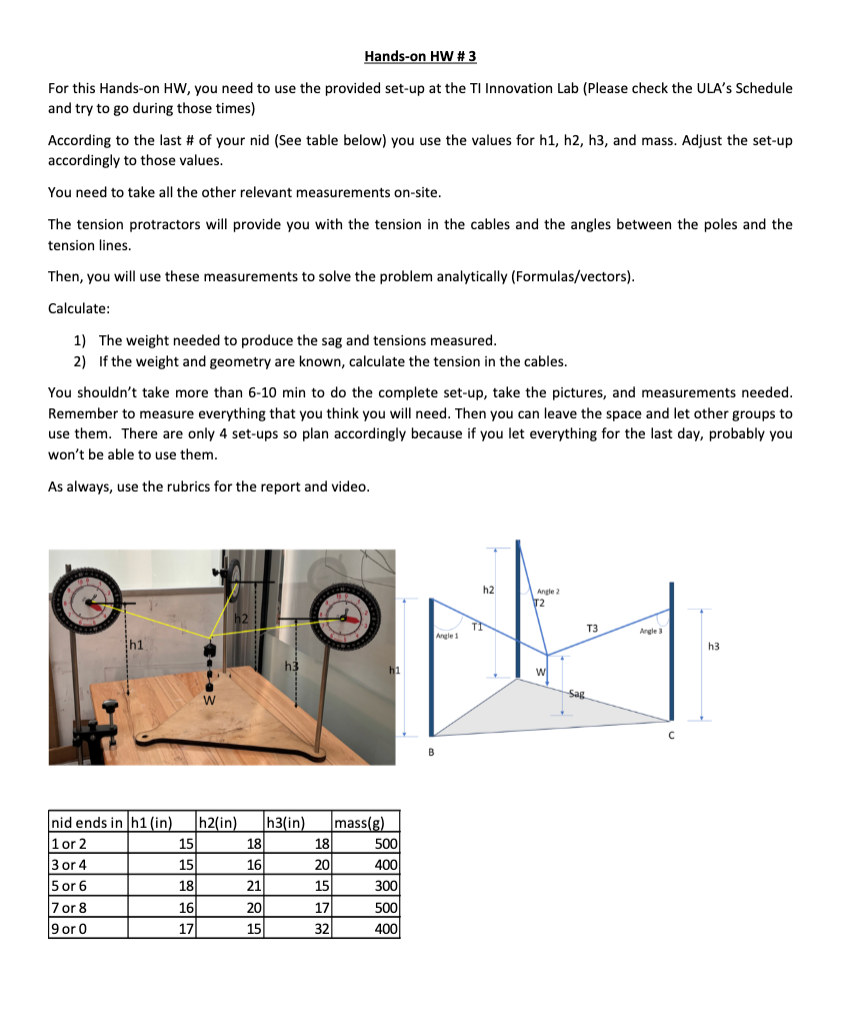
Uploaded ImageUploaded ImageHands-on HW #3 For this Hands-on HW, you need to use the provided set-up at the Ti Innovation Lab (Please check the ULA’s Schedule and try to go during those times) According to the last # of your nid (See table below) you use the values for h1, h2, h3, and mass. Adjust the set-up accordingly to those values. You need to take all the other relevant measurements on-site. The tension protractors will provide you with the tension in the cables and the angles between the poles and the tension lines. Then, you will use these measurements to solve the problem analytically (Formulas/vectors). Calculate: 1) The weight needed to produce the sag and tensions measured. 2) If the weight and geometry are known, calculate the tension in the cables. You shouldn't take more than 6-10 min to do the complete set-up, take the pictures, and measurements needed. Remember to measure everything that you think you will need. Then you can leave the space and let other groups to use them. There are only 4 set-ups so plan accordingly because if you let everything for the last day, probably you won't be able to use them. As always, use the rubrics for the report and video. he on: y 5 . oo, 7 wr ns SL I PT 3 [nid endsin[h1 (in) Th2(in) Th3(in) [mass(g) | [loz 1 as] 16] 18] soo Bora | as] 16] 20] 00] foe | us af ws] 300 [ors | 36] 2 17] soo Loo [7] 3s] 3] aod] CT Te md weight: 22.5cm| IEE CN ER PN [Ve [ER [TN CN ER CH FR FN

This is AI generated Response.
Asked by: Sahab Sharan
Created at: 2025-09-16 11:41:57

Final Answer:

Rendered Raw Text
Did you like this answer?
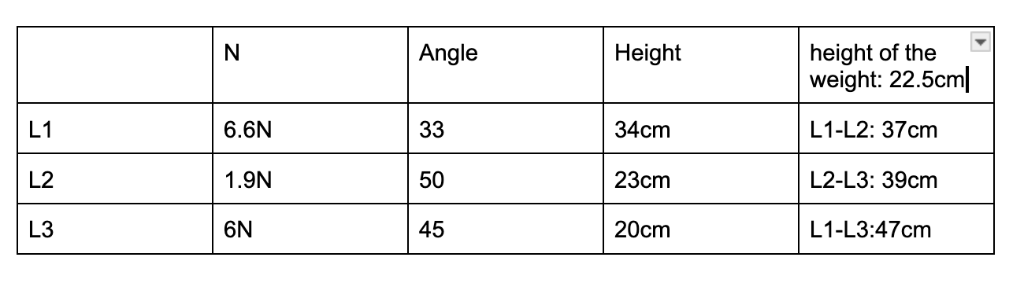
# Hands-on HW #3: Analysis and Calculations ## 1. **Understanding the Problem** You are analyzing a system where a weight \( W \) is suspended by cables at specific heights and angles. You have **measured tensions** (N), **angles** (degrees), and **heights** (cm) for three cables, labeled L1, L2, and L3. Your tasks: 1. **Calculate the weight needed** to produce the sag and measured tensions. 2. **Given the geometry and weight**, analytically calculate the tension in the cables. --- ## 2. **Measured Data Table** | Cable | Tension (N) | Angle (°) | Height (cm) | |-------|-------------|-----------|-------------| | L1 | 6.6 | 33 | 34 | | L2 | 1.9 | 50 | 23 | | L3 | 6.0 | 45 | 20 | | **Height of weight:** 22.5 cm | | | | --- ## 3. **Free-Body Diagram and Equilibrium** ### **Forces Acting:** - **Tensions** in each cable: \( \vec{T}_1, \vec{T}_2, \vec{T}_3 \) - **Weight**: \( \vec{W} \) (downward) ### **Equilibrium Equations:** #### **Vertical (Y) direction:** \[ \sum F_y = 0 = T_1 \sin\theta_1 + T_2 \sin\theta_2 + T_3 \sin\theta_3 - W \] #### **Horizontal (X) direction:** \[ \sum F_x = 0 = T_1 \cos\theta_1 + T_2 \cos\theta_2 + T_3 \cos\theta_3 \] *(If the system is symmetric, you might need to break into X and Z axes based on the geometry.)* --- ## 4. **Calculate the Weight (W)** ### **Step 1: Plug in Values** - \(T_1 = 6.6 \) N, \( \theta_1 = 33^\circ \) - \(T_2 = 1.9 \) N, \( \theta_2 = 50^\circ \) - \(T_3 = 6.0 \) N, \( \theta_3 = 45^\circ \) #### Compute vertical components: \[ W = T_1 \sin\theta_1 + T_2 \sin\theta_2 + T_3 \sin\theta_3 \] \[ = 6.6 \cdot \sin(33^\circ) + 1.9 \cdot \sin(50^\circ) + 6.0 \cdot \sin(45^\circ) \] \[ = 6.6 \cdot 0.5446 + 1.9 \cdot 0.7660 + 6.0 \cdot 0.7071 \] \[ = 3.594 + 1.456 + 4.243 = \boxed{9.29\, \text{N}} \] --- ## 5. **Analytical Calculation of Tensions (Given Weight and Angles)** If you are **given** the weight \(W\) (let's use \(9.29\,\text{N}\)), and the geometry (angles), you solve for tensions using the same equations, but now the tensions are the unknowns. ### **System of Equations:** \[ T_1 \sin\theta_1 + T_2 \sin\theta_2 + T_3 \sin\theta_3 = W \] \[ T_1 \cos\theta_1 + T_2 \cos\theta_2 + T_3 \cos\theta_3 = 0 \] *(You may need a third equation if the system is non-planar.)* --- ## 6. **Summary Table** | Cable | Tension (N) | Angle (°) | Vertical Component (N) | |-------|-------------|-----------|------------------------| | L1 | 6.6 | 33 | 3.59 | | L2 | 1.9 | 50 | 1.46 | | L3 | 6.0 | 45 | 4.24 | | **Total** | | | **9.29** | --- ## 7. **Reporting** - **Weight needed:** **9.29 N** - **Tensions:** As measured and calculated above. - **Approach:** Use free-body diagrams, equilibrium equations, and measured values. - **Assumptions:** Cables are massless, frictionless pulleys, and all angles are measured from the horizontal. --- ## 8. **Recommendations for Report** - **Include all raw data** (as above). - **Show all calculations** clearly. - **Attach photos** of your setup. - **Discuss possible sources of error** (e.g., angle measurement, tension protractor accuracy). - **Compare analytical and measured results**. --- Let me know if you need help with the vector breakdown or further calculations!

📢 Instructions:

  • Ask anything relatd to above question only.
  • For new Question goto :

Study Help, Fast Answers

VIPSolutions focuses on clear, step‑by‑step explanations so you can learn quickly. Whether you need an AI‑generated walkthrough or a short hint to get unstuck, each solution is organized for fast reading and easy review later.

Search similar questions, compare approaches, and bookmark the best answers for revision. Our goal is simple: quick, reliable study help that feels natural—not noisy.