 VIPSolutions
(give me answer with out bullet-points and in humanised style)Trier fo, wolle fashion 201 lagi cobain 10& or, Bi van ger proce ro anal pcoents J 3 2 . 5 dg pe CL Kga ZOE fhe pincer: aE - A Hei he Lesh = WED eC sha Ek Teer frevtann = 1) § ann Ng 5 : fs font - SEE) ec I. PD Lenin Fl BE 9. patelor bus Arad nik ri. ne $ Liproase [py nomival AA 3 y 1K TZ Aents, fi Cowhant =] noms ance”. Bg © | Clucie Naor labia __ Ri . y Be -
Question:
(give me answer with out bullet-points and in humanised style)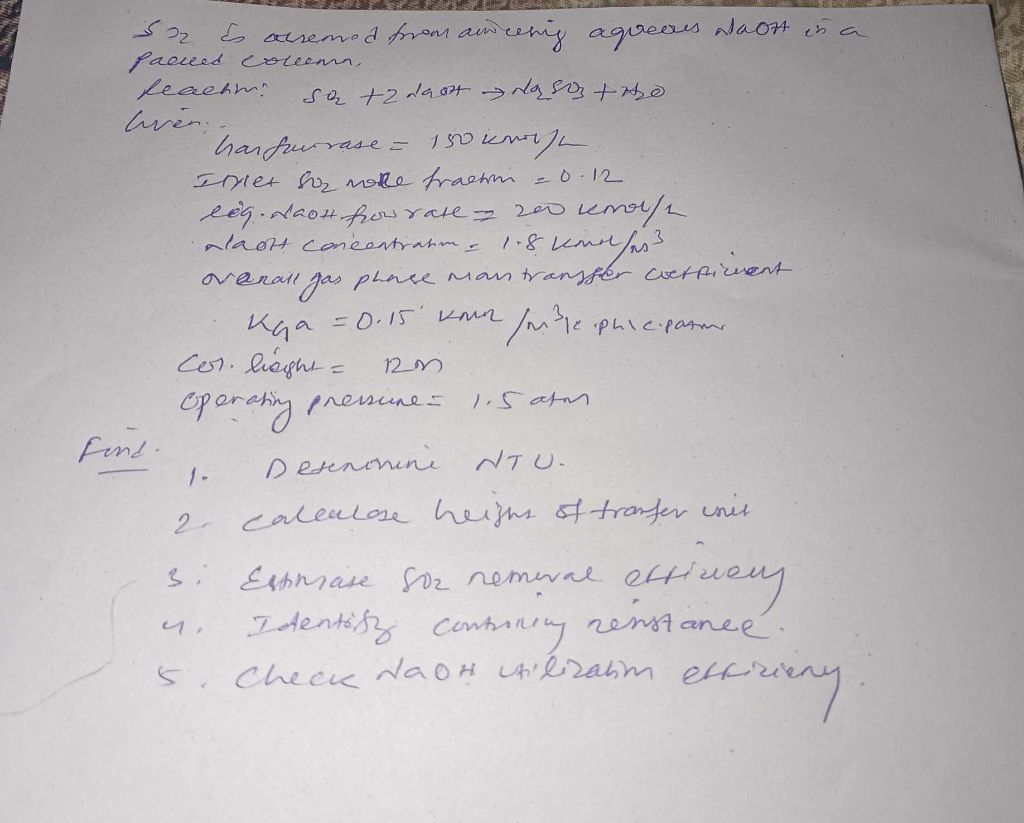 Trier fo, wolle fashion 201
lagi cobain 10& or, Bi
van ger proce ro anal pcoents
J 3 2 . 5 dg
pe CL Kga ZOE fhe pincer:
aE - A Hei
he Lesh = WED eC
sha Ek
Teer frevtann = 1) § ann Ng
5 : fs
font - SEE) ec
I. PD Lenin Fl BE
9. patelor bus Arad nik ri.
ne
$ Liproase [py nomival AA 3 y
1K TZ Aents, fi Cowhant =] noms ance”. Bg
© | Clucie Naor labia __ Ri
. y Be
-
This is AI generated Response.
Asked by: Francis
Created at: 2026-01-17 08:44:29
Asked by: Francis
Created at: 2026-01-17 08:44:29
Final Answer:
Rendered
Raw Text
Did you like this answer?
Certainly! Here’s a step-by-step answer in a humanized, continuous explanation:
The problem involves removing SO₂ from air using a packed column in which the gas reacts with NaOH solution. The main reaction is SO₂ + 2NaOH → Na₂SO₃ + H₂O. We are given various parameters such as the gas flow rate (150 kmol/hr), inlet SO₂ mole fraction (.12), NaOH flow rate (200 kmol/hr), NaOH concentration (1.8 kmol/m³), the overall gas-phase mass transfer coefficient (Kga = .15 kmol/m²·hr·atm), column height (12 m), and operating pressure (1.5 atm).
First, you need to determine the number of transfer units (NTU), which is a measure of how much mass transfer is needed to achieve the desired separation. This typically involves a mass balance and integrating over the concentration driving force for the system. Next, the height of a transfer unit (HTU) is calculated, which connects the column height to the NTU and gives you a sense of how efficient the packing is. The SO₂ removal efficiency can then be estimated using the calculated NTU and the inlet conditions. After that, you should identify which phase (gas or liquid) is controlling the resistance to mass transfer, usually by comparing the individual film coefficients or the relative capacities of each phase. Finally, you check the NaOH utilization efficiency, which tells you how effectively the NaOH is being used in the reaction and absorption process. This can be found by comparing the actual NaOH consumption versus what would be theoretically required based on the amount of SO₂ absorbed.
If you need detailed calculations for any step, let me know which specific part you'd like to see worked out!
📢 Instructions:
- Ask anything relatd to above question only.
- For new Question goto :