 VIPSolutions
FO SO SE REA AS saat Cet ge pa a na Sms anence | bee # Codie cc fl sx > ee ———— eT ao cei rds ce yg § meds mannzynt IRE | Co
Question:
 FO SO SE REA AS saat
Cet ge pa a na
Sms anence | bee
# Codie cc fl sx > ee
———— eT
ao cei rds ce yg
§ meds mannzynt IRE |
Co
This is AI generated Response.
Asked by: July kumari
Created at: 2025-07-26 10:38:39
Asked by: July kumari
Created at: 2025-07-26 10:38:39
Final Answer:
Rendered
Raw Text
Did you like this answer?
Let's analyze each part step by step:
---
## **First Comparison: Cases A and B**
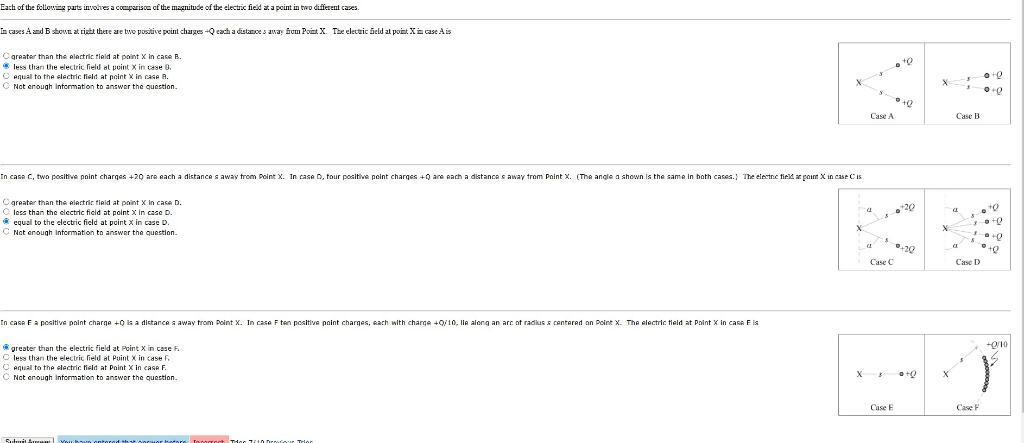
- **Case A:** Two positive charges (+Q) at a distance d from point X.
- **Case B:** One positive and one negative charge (+Q, -Q) at the same distance d from point X.
**Electric field at X:**
- In **Case A**, both electric fields add up since both are in the same direction.
- In **Case B**, the fields are in opposite directions and partially cancel out.
**Therefore, the electric field at point X in case A is:**
- **(A) greater than the electric field at point X in case B.**
---
## **Second Comparison: Cases C and D**
- **Case C:** Two positive charges (+2Q), each at distance d from X, at an angle α from the x-axis.
- **Case D:** Four positive charges (+Q), each at the same distance and angle.
**Electric field at X:**
- Each charge in case D is +Q, but there are 4 of them.
- In case C, there are 2 charges of +2Q.
- Both cases have the same total charge (4Q) and symmetry.
**The vector sum of the fields will be the same (since 2 × 2Q = 4 × Q) and the geometric configuration is symmetric.**
**Therefore, the electric field at point X in case C is:**
- **(C) equal to the electric field at point X in case D.**
---
## **Third Comparison: Cases E and F**
- **Case E:** Single charge +Q at distance a from X.
- **Case F:** Ten positive charges, each +Q/10, distributed evenly on a circle of radius a centered on X.
**Electric field at X:**
- In case F, symmetry causes the electric field contributions from each charge to cancel out, resulting in zero net field.
- In case E, there is a nonzero field from the single charge.
**Therefore, the electric field at point X in case E is:**
- **(A) greater than the electric field at point X in case F.**
---
### **Summary of Answers:**
1. **First question:** A
2. **Second question:** C
3. **Third question:** A
📢 Instructions:
- Ask anything relatd to above question only.
- For new Question goto :