 VIPSolutions
— = (FEE. Ci a =~ i — o Be = ler Gel ER RE = = Ee dil Ge ONE SOB WLR 8 1 fi d te 1 3 0.0 0 2||zs Flee i En ts 00 0 0]|z 0 mt TH i HOES Hit a UR i li gh Bi ii i i fia Hi Ti Fi fat LEER Sr — is a EEE i EE lh il bil HEE ; 1 ee HE ee go se A - SE Fay lie thi tpt to oblain Ho ncantioll Hr ees EE
Question:
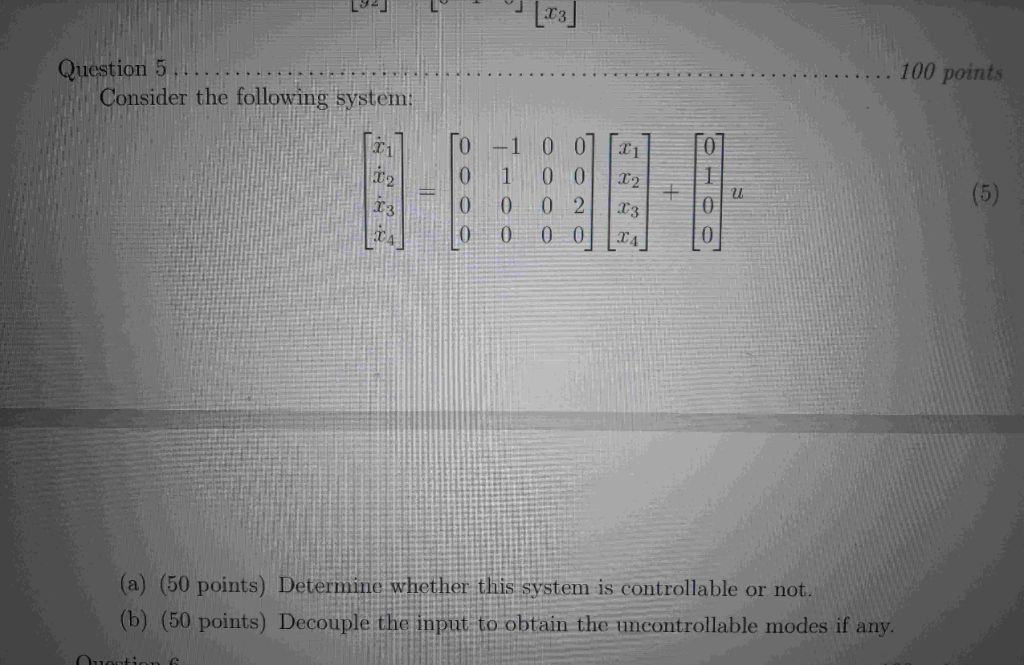 — = (FEE.
Ci a =~
i — o
Be =
ler Gel ER RE = =
Ee dil Ge ONE SOB WLR 8 1 fi
d te 1 3 0.0 0 2||zs Flee i
En ts 00 0 0]|z 0 mt
TH i HOES Hit
a UR
i li gh
Bi
ii i i fia
Hi Ti
Fi fat
LEER Sr
— is a
EEE i
EE lh
il bil HEE ; 1 ee
HE ee go
se A - SE
Fay
lie thi tpt to oblain Ho ncantioll
Hr ees EE
This is AI generated Response.
Asked by: rohit singh
Created at: 2025-11-10 20:28:35
Asked by: rohit singh
Created at: 2025-11-10 20:28:35
Final Answer:
Rendered
Raw Text
Did you like this answer?
# Solution to the State-Space Control System Problem
## System Description
The state-space system is given by:
\[
\begin{bmatrix}
\dot{x}_1 \\
\dot{x}_2 \\
\dot{x}_3 \\
\dot{x}_4
\end{bmatrix}
=
\begin{bmatrix}
& 1 & & \\
& & & \\
& & & 2 \\
& & &
\end{bmatrix}
\begin{bmatrix}
x_1 \\
x_2 \\
x_3 \\
x_4
\end{bmatrix}
+
\begin{bmatrix}
\\
1 \\
\\
\end{bmatrix}
u
\]
Let \( A \) and \( B \) be the system and input matrices, respectively.
---
## (a) **Controllability Analysis**
To determine controllability, construct the controllability matrix:
\[
\mathcal{C} = [B\ AB\ A^2B\ A^3B]
\]
Let's compute each term:
### \( B \):
\[
B = \begin{bmatrix} \\ 1 \\ \\ \end{bmatrix}
\]
### \( AB \):
\[
AB = A \cdot B =
\begin{bmatrix}
& 1 & & \\
& & & \\
& & & 2 \\
& & &
\end{bmatrix}
\begin{bmatrix} \\ 1 \\ \\ \end{bmatrix}
=
\begin{bmatrix}
1 \\
\\
\\
\end{bmatrix}
\]
### \( A^2B \):
\[
A^2B = A \cdot AB =
\begin{bmatrix}
& 1 & & \\
& & & \\
& & & 2 \\
& & &
\end{bmatrix}
\begin{bmatrix}
1 \\
\\
\\
\end{bmatrix}
=
\begin{bmatrix}
\\
\\
\\
\end{bmatrix}
\]
### \( A^3B \):
\[
A^3B = A \cdot A^2B = A \cdot \begin{bmatrix} \\ \\ \\ \end{bmatrix} = \begin{bmatrix} \\ \\ \\ \end{bmatrix}
\]
### **Controllability Matrix**
\[
\mathcal{C} = \left[ B\ AB\ A^2B\ A^3B \right] =
\begin{bmatrix}
& 1 & & \\
1 & & & \\
& & & \\
& & &
\end{bmatrix}
\]
#### **Rank of the Controllability Matrix**
The rank is 2 (since only the first 2 rows/columns are nonzero and linearly independent). The system is **not controllable** (it is a 4-state system, but the controllability matrix has rank 2).
---
## (b) **Input Decoupling for Uncontrollable Modes**
To decouple the input and obtain the uncontrollable modes:
- The controllable states are associated with the first two states (\(x_1, x_2\)).
- The uncontrollable modes are associated with the remaining states (\(x_3, x_4\)), which are not affected by the input.
### **Transformation to Decouple**
Let \( x = Tz \), where \(T\) is a transformation matrix that puts the system into controllable and uncontrollable canonical form.
One possible \(T\) is:
\[
T =
\begin{bmatrix}
& 1 & & \\
1 & & & \\
& & 1 & \\
& & & 1
\end{bmatrix}
\]
Rewriting the system in these new coordinates will separate the controllable and uncontrollable states. The uncontrollable subsystem is:
\[
\dot{x}_3 = \\
\dot{x}_4 = 2x_3
\]
This subsystem is unaffected by the input \(u\).
---
## **Final Answers**
### (a) **The system is not controllable.**
- **Rank of controllability matrix = 2 < 4.**
### (b) **The uncontrollable modes are \(x_3, x_4\).**
- **Input does not affect these modes.**
- **They evolve independently:**
\[
\dot{x}_3 = , \quad \dot{x}_4 = 2x_3
\]
---
Let me know if you need the explicit decoupling transformation!
📢 Instructions:
- Ask anything relatd to above question only.
- For new Question goto :