 VIPSolutions
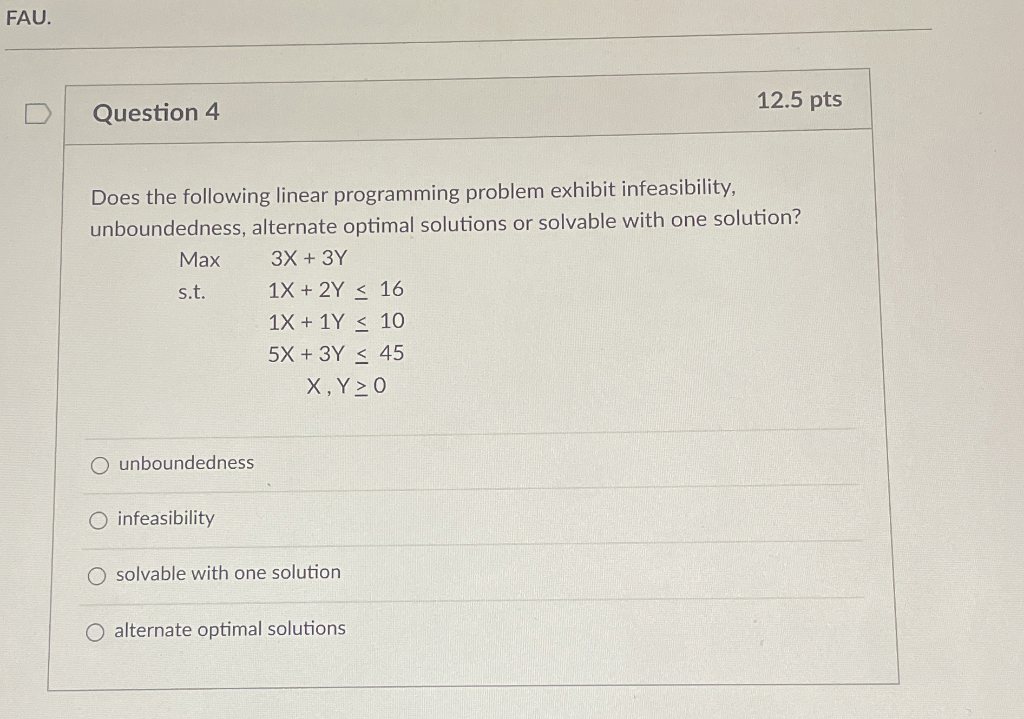
FAU. a [OD | Question 4 12.5 pts Does the following linear programming problem exhibit infeasibility, unboundedness, alternate optimal solutions or solvable with one solution? Max 3X + 3Y s.t. IX +2Y < 16 1X +1Y < 10 5X +3Y < 45 XENE>10) | © unboundedness | | © infeasibility | © solvable with one solution | © alternate optimal solutions FAU. a [OD | Question 4 12.5 pts Does the following linear programming problem exhibit infeasibility, unboundedness, alternate optimal solutions or solvable with one solution? Max 3X + 3Y s.t. IX +2Y < 16 1X +1Y < 10 5X +3Y < 45 XENE>10) | © unboundedness | | © infeasibility | © solvable with one solution | © alternate optimal solutions
Question:
 FAU.
a
[OD | Question 4 12.5 pts
Does the following linear programming problem exhibit infeasibility,
unboundedness, alternate optimal solutions or solvable with one solution?
Max 3X + 3Y
s.t. IX +2Y < 16
1X +1Y < 10
5X +3Y < 45
XENE>10)
| © unboundedness
|
| © infeasibility
| © solvable with one solution
| © alternate optimal solutions
FAU.
a
[OD | Question 4 12.5 pts
Does the following linear programming problem exhibit infeasibility,
unboundedness, alternate optimal solutions or solvable with one solution?
Max 3X + 3Y
s.t. IX +2Y < 16
1X +1Y < 10
5X +3Y < 45
XENE>10)
| © unboundedness
|
| © infeasibility
| © solvable with one solution
| © alternate optimal solutions
This is AI generated Response.
Asked by: Sunitha
Created at: 2025-07-24 14:33:35
Asked by: Sunitha
Created at: 2025-07-24 14:33:35
Final Answer:
Rendered
Raw Text
Did you like this answer?
Let's analyze the linear programming problem:
**Maximize:** 3X + 3Y
**Subject to:**
1. X + 2Y ≤ 16
2. X + Y ≤ 10
3. 5X + 3Y ≤ 45
4. X, Y ≥ 0
Let's check each option:
1. **Unboundedness:**
- This is not possible because all constraints are "≤", and X, Y are non-negative, so the feasible region is bounded.
2. **Infeasibility:**
- The constraints do not contradict each other, so there is a feasible region.
3. **Solvable with one solution:**
- Let's check if the optimal solution is unique.
- The objective function is 3X + 3Y, and the coefficients are the same for both variables.
- Let's find the intersection points of the constraints:
- X + 2Y = 16
- X + Y = 10 → X = 10 - Y
- Substituting in the first equation: (10 - Y) + 2Y = 16 → 10 + Y = 16 → Y = 6, X = 4
- At (4, 6):
- 5X + 3Y = 5*4 + 3*6 = 20 + 18 = 38 ≤ 45, so feasible
- Now, check if the optimal solution lies on more than one constraint (for alternate optimal solutions):
- The objective function is parallel to X + Y = constant lines.
- The two constraints X + Y ≤ 10 and X + 2Y ≤ 16 are not parallel to the objective, so the optimal solution will occur at a vertex.
- There is no indication that two vertices yield the same optimal value.
4. **Alternate optimal solutions:**
- This would occur if the objective function is parallel to a constraint at the optimal point, but here, that's not the case.
**Conclusion:**
The problem is **solvable with one solution**.
**Answer:**
☑️ solvable with one solution
Question:
os this correct answer
This is AI generated Response.
Asked by: Sunitha
Created at: 2025-07-24 14:34:17
Asked by: Sunitha
Created at: 2025-07-24 14:34:17
Final Answer:
Rendered
Raw Text
Did you like this answer?
Yes, your analysis is correct. The linear programming problem described is feasible, bounded, and has a unique optimal solution at a specific vertex of the feasible region. Since the objective function's coefficients are not parallel to any constraint at the optimum, there are no alternate optimal solutions. Therefore, the problem is solvable with one solution.
**Final answer:** **"solvable with one solution"**
📢 Instructions:
- Ask anything relatd to above question only.
- For new Question goto :