Extremum conditions
1. Helmholtz free energy for the ideal gas
166 Extremum Principles
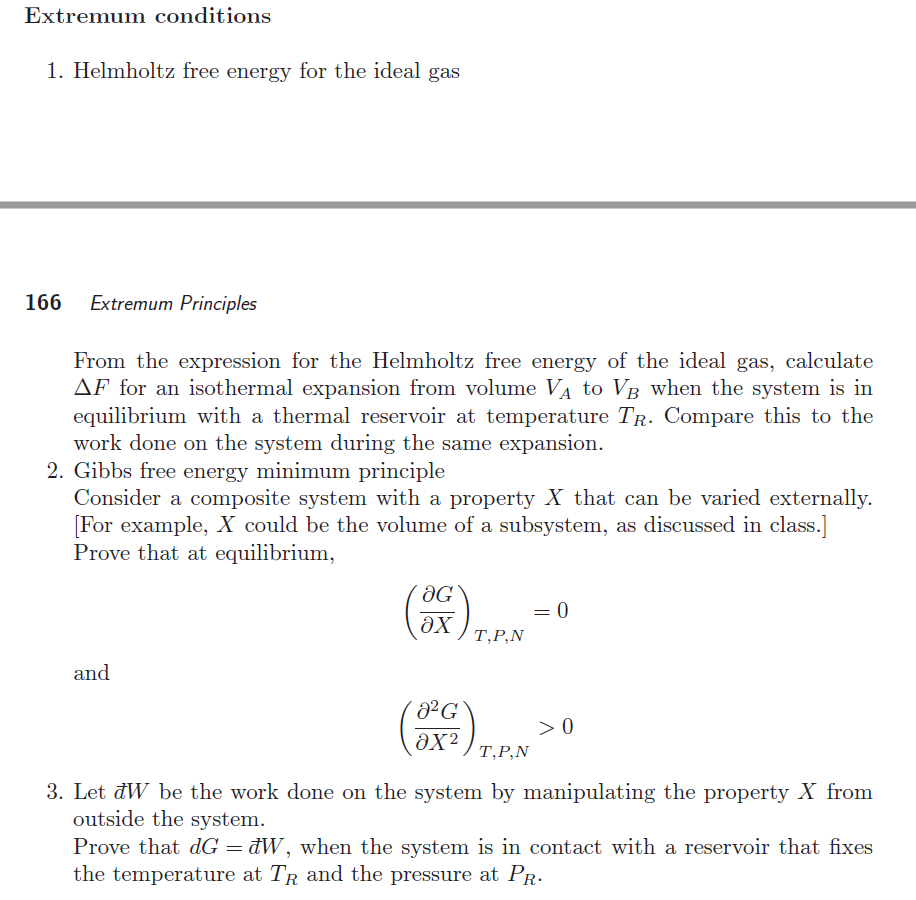
From the expression for the Helmholtz free energy of the ideal gas, calculate
AF for an isothermal expansion from volume Vj to Vp when the system is in
equilibrium with a thermal reservoir at temperature Tp. Compare this to the
work done on the system during the same expansion.
2. Gibbs free energy minimum principle
Consider a composite system with a property X that can be varied externally.
[For example, X could be the volume of a subsystem, as discussed in class.]
Prove that at equilibrium,
IG
(5%),
X) pn
and
le )
“v5 >0
(ax 2) ren
3. Let dW be the work done on the system by manipulating the property X from
outside the system.
Prove that dG = dW, when the system is in contact with a reservoir that fixes
the temperature at Tz and the pressure at Pp.
Question:
Extremum conditions
1. Helmholtz free energy for the ideal gas
166 Extremum Principles
From the expression for the Helmholtz free energy of the ideal gas, calculate
AF for an isothermal expansion from volume Vj to Vp when the system is in
equilibrium with a thermal reservoir at temperature Tp. Compare this to the
work done on the system during the same expansion.
2. Gibbs free energy minimum principle
Consider a composite system with a property X that can be varied externally.
[For example, X could be the volume of a subsystem, as discussed in class.]
Prove that at equilibrium,
IG
(5%),
X) pn
and
le )
“v5 >0
(ax 2) ren
3. Let dW be the work done on the system by manipulating the property X from
outside the system.
Prove that dG = dW, when the system is in contact with a reservoir that fixes
the temperature at Tz and the pressure at Pp.
This is AI generated Response.
Asked by: Adapaka Jagadeesh
Created at: 2025-07-29 13:45:15
Final Answer:
RenderedRaw Text
Did you like this answer?
Here’s a breakdown and explanation of the questions and tasks from the images:
---
### 1. **Helmholtz Free Energy for the Ideal Gas**
**Task:**
Using the expression for the Helmholtz free energy \( F \) of the ideal gas, calculate \( \Delta F \) for an isothermal expansion from volume \( V_A \) to \( V_B \) when the system is in equilibrium with a thermal reservoir at temperature \( T_R \). Compare this to the work done on the system during the same expansion.
**Hints for Solution:**
- The Helmholtz free energy for an ideal gas:
\[
F = U - TS
\]
- For an isothermal process (\(T = T_R\)),
\[
\Delta F = -k_B T_R \ln \left( \frac{V_B}{V_A} \right)
\]
for 1 mole (more generally, multiply by \( n \) for \( n \) moles).
- The work done by the gas (reversible isothermal expansion):
\[
W = nRT_R \ln \left( \frac{V_B}{V_A} \right)
\]
Note the sign convention: if you want the work *done on* the system, it will be negative.
- **Compare:** \( \Delta F \) equals the maximum work extractable in an isothermal process.
---
### 2. **Gibbs Free Energy Minimum Principle**
**Task:**
For a composite system with a variable property \( X \) (e.g., volume of a subsystem), prove that at equilibrium:
\[
\left( \frac{\partial G}{\partial X} \right)_{T,P,N} = 0
\]
and
\[
\left( \frac{\partial^2 G}{\partial X^2} \right)_{T,P,N} > 0
\]
**Hints for Solution:**
- At equilibrium, the Gibbs free energy is minimized (for constant \( T \), \( P \), \( N \)), so the first derivative with respect to \( X \) vanishes.
- The second derivative must be positive for a minimum (stability condition).
---
### 3. **Work Done via Manipulating Property \( X \)**
**Task:**
Let \( \delta \bar{W} \) be the work done on the system by manipulating property \( X \) externally. Prove:
\[
dG = \delta \bar{W}
\]
when the system is in contact with a reservoir at fixed \( T_R \) and \( P_R \).
**Hints for Solution:**
- The differential of the Gibbs free energy:
\[
dG = -S dT + V dP + \left( \frac{\partial G}{\partial X} \right)_{T,P,N} dX
\]
- At constant \( T \) and \( P \), \( dG = \left( \frac{\partial G}{\partial X} \right)_{T,P,N} dX \).
- Work done by varying \( X \) is \( \delta \bar{W} \), so \( dG = \delta \bar{W} \).
---
If you’d like detailed step-by-step solutions for any of these, let me know which one to start with!
VIPSolutions focuses on clear, step‑by‑step explanations so you can learn quickly. Whether you need an AI‑generated walkthrough or a short hint to get unstuck, each solution is organized for fast reading and easy review later.
Search similar questions, compare approaches, and bookmark the best answers for revision. Our goal is simple: quick, reliable study help that feels natural—not noisy.
 VIPSolutions
 Extremum conditions
1. Helmholtz free energy for the ideal gas
166 Extremum Principles
From the expression for the Helmholtz free energy of the ideal gas, calculate
AF for an isothermal expansion from volume Vj to Vp when the system is in
equilibrium with a thermal reservoir at temperature Tp. Compare this to the
work done on the system during the same expansion.
2. Gibbs free energy minimum principle
Consider a composite system with a property X that can be varied externally.
[For example, X could be the volume of a subsystem, as discussed in class.]
Prove that at equilibrium,
IG
(5%),
X) pn
and
le )
“v5 >0
(ax 2) ren
3. Let dW be the work done on the system by manipulating the property X from
outside the system.
Prove that dG = dW, when the system is in contact with a reservoir that fixes
the temperature at Tz and the pressure at Pp.