 VIPSolutions
Example 9.19: An ideal turbojet with afterburner operates at altitudes where the ambient pressure is 10 kPa. The inlet air temperature is -20 °C, and the pressure ratio is 7.5:1. The maximum turbine temperature allowable is 1500 °C. The airflow rate is 8.2 kg/s. (a) What exit velocity is obtained without the afterburner? (b) What is the rate of heat input , Qe (MJ/s)? (c) Fuel is consumed twice as quickly when the afterburner is used. What is the exit velocity with the afterburner on? Assume ideal air-standard conditions with constant specific heats evaluated at the mean temperature of the cycle. A . 0 T3=1500 °C rp=75 | C bine a Ty =-20°C 4 - ad P1=10kPa m=8.2 kg/s
Question:
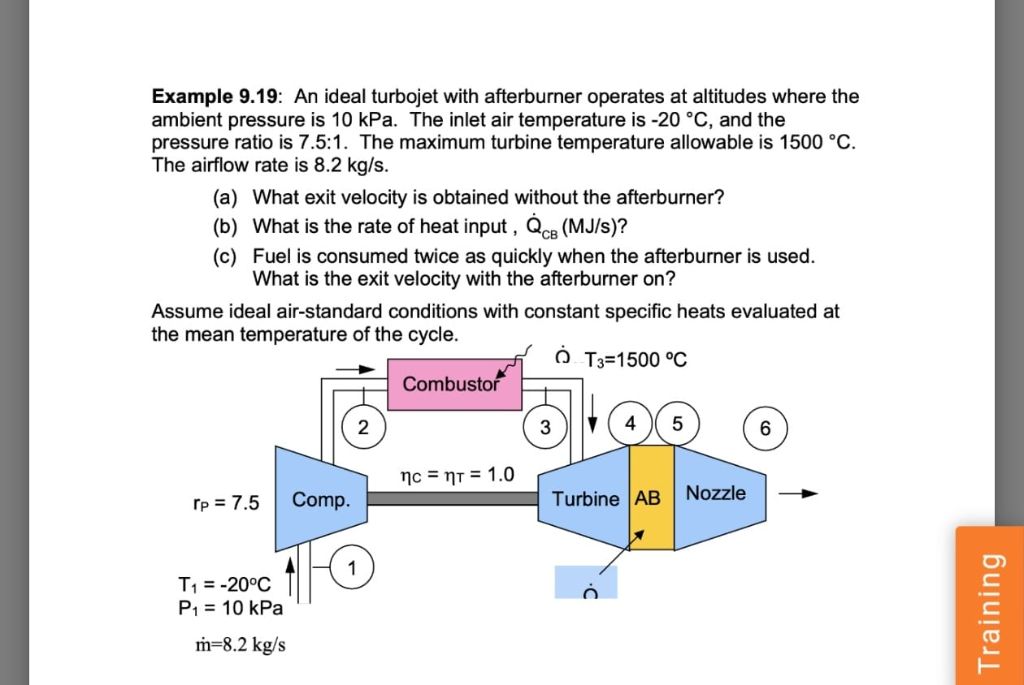 Example 9.19: An ideal turbojet with afterburner operates at altitudes where the
ambient pressure is 10 kPa. The inlet air temperature is -20 °C, and the
pressure ratio is 7.5:1. The maximum turbine temperature allowable is 1500 °C.
The airflow rate is 8.2 kg/s.
(a) What exit velocity is obtained without the afterburner?
(b) What is the rate of heat input , Qe (MJ/s)?
(c) Fuel is consumed twice as quickly when the afterburner is used.
What is the exit velocity with the afterburner on?
Assume ideal air-standard conditions with constant specific heats evaluated at
the mean temperature of the cycle. A
. 0 T3=1500 °C
rp=75 | C bine a
Ty =-20°C 4 - ad
P1=10kPa
m=8.2 kg/s
This is AI generated Response.
Asked by: Satish Reddy
Created at: 2025-06-26 10:58:40
Asked by: Satish Reddy
Created at: 2025-06-26 10:58:40
Final Answer:
Rendered
Raw Text
Did you like this answer?
This is a classic thermodynamics problem involving a turbojet engine with an afterburner under *ideal air-standard conditions*.
Let's break down the problem step by step:
---
### Given Data
- **Ambient pressure,** \( P_1 = 10\, \text{kPa} \)
- **Ambient temperature,** \( T_1 = -20^\circ\text{C} = 253.15\, \text{K} \)
- **Pressure ratio,** \( r_P = 7.5 \)
- **Maximum turbine temperature,** \( T_3 = 1500^\circ\text{C} = 1773.15\, \text{K} \)
- **Airflow rate,** \( \dot{m} = 8.2\, \text{kg/s} \)
- **Compressor and turbine efficiencies,** \( \eta_C = \eta_T = 1.0 \) (ideal)
- **Specific heat (assume air):** \( c_p \approx 1.005\, \text{kJ/kg}\cdot\text{K} \), \( \gamma = 1.4 \)
---
### (a) **Exit velocity without the afterburner**
#### Step 1: Compressor Outlet Temperature (\(T_2\))
\[
\frac{T_2}{T_1} = r_P^{(\gamma-1)/\gamma}
\]
\[
T_2 = T_1 \cdot r_P^{(\gamma-1)/\gamma}
\]
\[
T_2 = 253.15 \cdot 7.5^{(0.4/1.4)}
\]
\[
7.5^{0.286} \approx 1.817
\]
\[
T_2 = 253.15 \cdot 1.817 \approx 459.7\, \text{K}
\]
#### Step 2: Turbine Outlet Temperature (\(T_4\))
- For ideal cycle (neglecting afterburner), \(T_4\) is determined by energy balance:
\[
c_p (T_3 - T_4) = c_p (T_2 - T_1)
\]
\[
T_4 = T_3 - (T_2 - T_1)
\]
\[
T_4 = 1773.15 - (459.7 - 253.15)
\]
\[
T_4 = 1773.15 - 206.55 = 1566.6\, \text{K}
\]
#### Step 3: Exit Velocity (\(V_e\))
- Assuming expansion to ambient pressure and neglecting inlet velocity:
\[
V_e = \sqrt{2 c_p (T_4 - T_1)}
\]
\[
V_e = \sqrt{2 \cdot 1005 \cdot (1566.6 - 253.15)}
\]
\[
V_e = \sqrt{2 \cdot 1005 \cdot 1313.45}
\]
\[
V_e = \sqrt{2,640,061.25}
\]
\[
V_e \approx 1625\, \text{m/s}
\]
---
### (b) **Rate of Heat Input (\(\dot{Q}_{CB}\))**
\[
\dot{Q}_{CB} = \dot{m} c_p (T_3 - T_2)
\]
\[
\dot{Q}_{CB} = 8.2 \cdot 1005 \cdot (1773.15 - 459.7)
\]
\[
= 8.2 \cdot 1005 \cdot 1313.45
\]
\[
= 8.2 \cdot 1,320,017.25
\]
\[
= 10,824,141.45\, \text{W}
\]
\[
= 10.82\, \text{MW}
\]
---
### (c) **Exit Velocity with Afterburner On**
- **Fuel consumed twice as quickly:** This means **total heat input doubles**, so let \(\dot{Q}_{total} = 2 \dot{Q}_{CB}\).
- Let afterburner raise temperature to \(T_5\):
\[
\dot{Q}_{CB} + \dot{Q}_{AB} = \dot{m} c_p (T_5 - T_2) = 2 \cdot \dot{m} c_p (T_3 - T_2)
\]
\[
T_5 - T_2 = 2(T_3 - T_2)
\]
\[
T_5 = 2T_3 - T_2
\]
\[
T_5 = 2 \cdot 1773.15 - 459.7 = 3546.3 - 459.7 = 3086.6\, \text{K}
\]
- **Exit velocity:**
\[
V_{e,AB} = \sqrt{2c_p (T_5 - T_1)}
\]
\[
V_{e,AB} = \sqrt{2 \cdot 1005 \cdot (3086.6 - 253.15)}
\]
\[
= \sqrt{2 \cdot 1005 \cdot 2833.45}
\]
\[
= \sqrt{5,698,761.25}
\]
\[
V_{e,AB} \approx 2387\, \text{m/s}
\]
---
## **Summary**
**(a)** Exit velocity (no afterburner): **~1625 m/s**
**(b)** Heat input rate: **~10.82 MW**
**(c)** Exit velocity (afterburner on, double fuel): **~2387 m/s**
---
Let me know if you need any clarifications or more detailed steps!
📢 Instructions:
- Ask anything relatd to above question only.
- For new Question goto :