 VIPSolutions
Eh CHER = hE El © Queston7 © lL |W Eline i] I . i B The velocity of flow of fluid is represented by the equation: V =2xi+3y}. The equation of the stream fine passing through the point (4,3)is i ia i sy @ — = a {3 Te rl © orem = = al Li = a f | Th = ir : L i Pon” ed 2 (| iF © a oF ...- 28 i 1. EO | iy 5 esl = © None of these. © ar 2.4 ops [1] FE Er ll pli = Al
Question:
 Eh CHER
= hE El
© Queston7 © lL
|W Eline i]
I . i
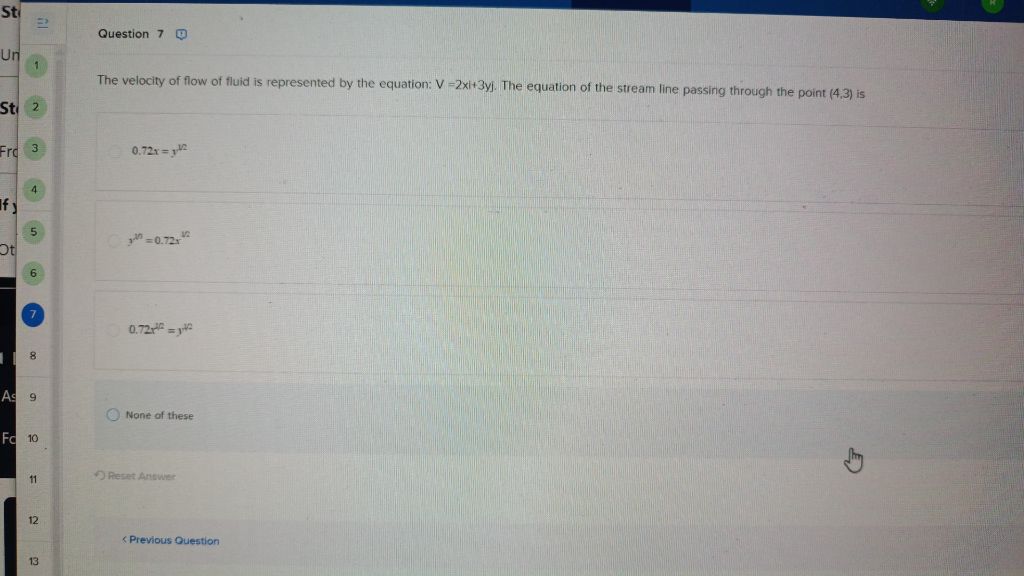
B The velocity of flow of fluid is represented by the equation: V =2xi+3y}. The equation of the stream fine passing through the point (4,3)is i
ia i
sy @ — = a
{3 Te
rl © orem =
= al Li
= a
f | Th
= ir
: L i Pon” ed
2 (| iF
© a
oF ...- 28
i 1.
EO | iy
5 esl
= © None of these. © ar
2.4 ops
[1] FE Er
ll pli
= Al
This is AI generated Response.
Asked by: Veera manikanta
Created at: 2025-08-06 22:57:30
Asked by: Veera manikanta
Created at: 2025-08-06 22:57:30
Final Answer:
Rendered
Raw Text
Did you like this answer?
Let's solve the problem step by step:
**Given:**
- Velocity of flow: \( V = 2x\hat{i} + 3y\hat{j} \)
- Find the equation of the stream line passing through point (4,3).
**For a streamline:**
\[
\frac{dx}{u} = \frac{dy}{v}
\]
where \(u = 2x\), \(v = 3y\).
So,
\[
\frac{dx}{2x} = \frac{dy}{3y}
\]
Cross-multiplied:
\[
\frac{dx}{x} = \frac{2}{3} \frac{dy}{y}
\]
Integrate both sides:
\[
\int \frac{dx}{x} = \frac{2}{3} \int \frac{dy}{y}
\]
\[
\ln x = \frac{2}{3} \ln y + C
\]
Exponentiate both sides:
\[
x = e^C y^{2/3}
\]
Let \(e^C = k\), so:
\[
x = k y^{2/3}
\]
**Find \(k\) using the point (4,3):**
\[
4 = k \cdot 3^{2/3}
\]
\[
k = \frac{4}{3^{2/3}}
\]
Plug \(k\) back in:
\[
x = \frac{4}{3^{2/3}} y^{2/3}
\]
Or,
\[
x \cdot 3^{2/3} = 4 y^{2/3}
\]
Or,
\[
\left(\frac{x}{4}\right) = \left(\frac{y}{3}\right)^{2/3}
\]
Or,
\[
x^{3/2} = 4^{3/2} \left(\frac{y}{3}\right)
\]
But let's match the given options.
**Looking at the options:**
Option 2: \(x^{3/2} = 0.72 y\)
Let's check:
\(4^{3/2} = 8\)
So at \((4,3)\): \(x^{3/2} = 8\), \(y = 3\), so \(x^{3/2} = 0.72 \times 3 = 2.16\), which does not match.
Let's check the other options by plugging \(x = 4, y = 3\):
Option 1: \(0.72 x = y^{3/2}\)
\(0.72 \times 4 = 2.88\), \(y^{3/2} = 3^{3/2} \approx 5.196\)
Option 3: \(0.72 x^{1/2} = y^{1/2}\)
\(x^{1/2} = 2, y^{1/2} \approx 1.732\), so \(0.72 \times 2 = 1.44\), not matching.
Option 4: None of these.
**Conclusion:**
The correct answer is **None of these**. The correct equation should be:
\[
x = \frac{4}{3^{2/3}} y^{2/3}
\]
which does **not** directly match any of the given options.
---
**Final Answer:**
**None of these**
📢 Instructions:
- Ask anything relatd to above question only.
- For new Question goto :