 VIPSolutions
( - | egg —_— 01:28:39 . A —— f i e | " , u
Question:
 ( -
| egg —_— 01:28:39
. A ——
f i
e
| "
, u
This is AI generated Response.
Asked by: Veera manikanta
Created at: 2025-08-31 10:14:36
Asked by: Veera manikanta
Created at: 2025-08-31 10:14:36
Final Answer:
Rendered
Raw Text
Did you like this answer?
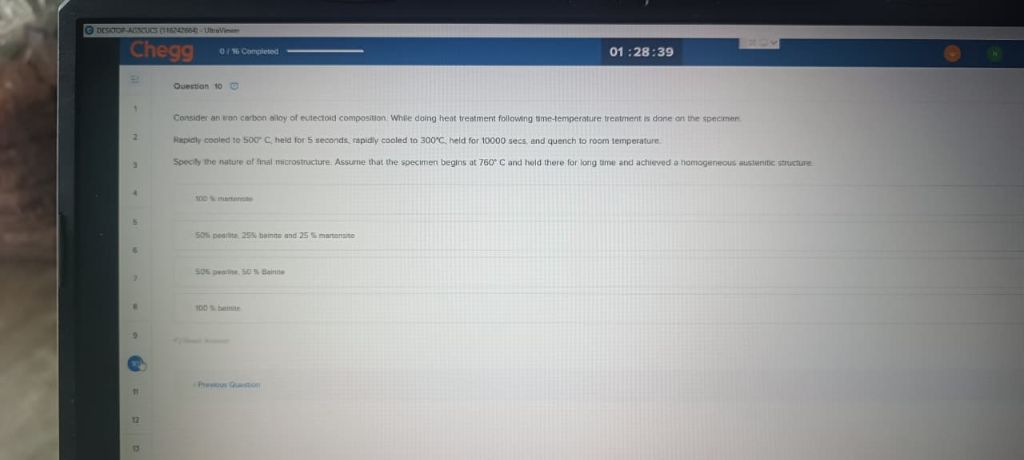
Let's analyze the question step by step:
### **Given:**
- **Iron-carbon alloy of eutectoid composition** (0.76 wt% C)
- **Heat treatment:**
1. Rapidly cooled to 500°C, held for 5 seconds
2. Rapidly cooled to 300°C, held for 10,000 seconds
3. Quenched to room temperature
- **Initial condition:** Specimen begins at 760°C (homogeneous austenitic structure)
---
### **Steps for Solution:**
#### **1. At 760°C**
- The alloy is entirely **austenite** (γ-phase).
#### **2. Cooling to 500°C (hold for 5 s)**
- At 500°C, we are just above the temperature where **bainite formation** starts (on a TTT diagram).
- Holding for only 5 seconds is **not enough time** for significant transformation (neither pearlite nor bainite forms significantly at this short time).
#### **3. Cooling to 300°C (hold for 10,000 s)**
- At 300°C, **bainite** formation is favored (as per the TTT diagram for eutectoid steel).
- Holding for 10,000 s is **more than enough** to complete the transformation of austenite to bainite.
#### **4. Quenched to room temperature**
- Any remaining austenite would transform to martensite, but since most, if not all, austenite has already transformed to bainite during the long hold at 300°C, there will be almost no martensite.
---
### **Final Microstructure:**
- **100% Bainite**
(since the austenite completely transforms to bainite during the long hold at 300°C).
---
### **Correct Answer:**
> **100% is bainite.**
**(Option 4)**
---
If you need an explanation or the TTT diagram for this process, let me know!
📢 Instructions:
- Ask anything relatd to above question only.
- For new Question goto :