 VIPSolutions
EE EEE———— ein | tos ST | I——— \ EE —— ES
Question:
 EE EEE————
ein |
tos ST |
I———
\
EE —— ES
This is AI generated Response.
Asked by: Prahlad Kumar
Created at: 2025-09-16 21:50:16
Asked by: Prahlad Kumar
Created at: 2025-09-16 21:50:16
Final Answer:
Rendered
Raw Text
Did you like this answer?
# Diffusion of Methane Through Helium
## Problem Statement (Paraphrased)
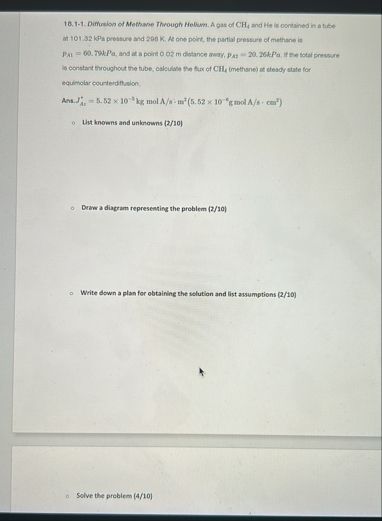
A gas of CH₄ and He is contained in a tube at 101.32 kPa and 298 K. At one point, the partial pressure of methane, \( P_{A1} = 20.1 \) kPa, and at a point 0.02 m away, \( P_{A2} = 20.7 \) kPa. The total pressure is constant. Calculate the flux of CH₄ (methane) at steady state for equimolar counterdiffusion.
Given:
- Diffusion coefficient: \( D_{AB} = 6.52 \times 10^{-5} \) m²/s
---
## 1. List Knowns and Unknowns (2/10)
### **Knowns:**
- \( P = 101.32 \) kPa (total pressure)
- \( T = 298 \) K
- \( P_{A1} = 20.1 \) kPa (partial pressure of CH₄ at point 1)
- \( P_{A2} = 20.7 \) kPa (partial pressure of CH₄ at point 2)
- \( x_2 - x_1 = 0.02 \) m (distance between points)
- \( D_{AB} = 6.52 \times 10^{-5} \) m²/s (diffusion coefficient for CH₄ in He)
- Steady-state, equimolar counterdiffusion
### **Unknowns:**
- Flux of CH₄ (\( N_A \)), in mol/(m²·s)
---
## 2. Draw a Diagram Representing the Problem (2/10)
```
|--------------------- Tube ---------------------|
Point 1 (x1) Point 2 (x2)
P_A1 = 20.1 kPa P_A2 = 20.7 kPa
|---------------------------------------------|
Distance = 0.02 m
```
*(Hand-drawn diagram recommended for submission)*
---
## 3. Plan and List Assumptions (2/10)
### **Plan:**
- Use Fick's law for equimolar counterdiffusion:
\[
N_A = -D_{AB} \frac{C}{x_2 - x_1} (y_{A2} - y_{A1})
\]
Or, in terms of partial pressures:
\[
N_A = -\frac{D_{AB} P}{R T (x_2 - x_1)} (y_{A2} - y_{A1})
\]
where \( y_{A} = \frac{P_A}{P} \).
### **Assumptions:**
- Steady-state diffusion
- Isothermal process
- Total pressure is constant
- Ideal gas behavior
- No chemical reaction
---
## 4. Solve the Problem (4/10)
### **Step 1: Calculate mole fractions**
\[
y_{A1} = \frac{P_{A1}}{P} = \frac{20.1}{101.32} = 0.1985
\]
\[
y_{A2} = \frac{20.7}{101.32} = 0.2043
\]
### **Step 2: Substitute into Fick's Law**
\[
N_A = - \frac{D_{AB} P}{R T (x_2 - x_1)} (y_{A2} - y_{A1})
\]
- \( D_{AB} = 6.52 \times 10^{-5} \) m²/s
- \( P = 101320 \) Pa
- \( R = 8.314 \) J/(mol·K)
- \( T = 298 \) K
- \( x_2 - x_1 = 0.02 \) m
- \( y_{A2} - y_{A1} = 0.2043 - 0.1985 = 0.0058 \)
\[
N_A = - \frac{6.52 \times 10^{-5} \times 101320}{8.314 \times 298 \times 0.02} \times 0.0058
\]
Calculate denominator:
\[
8.314 \times 298 \times 0.02 = 49.54
\]
Calculate numerator:
\[
6.52 \times 10^{-5} \times 101320 = 6.6078
\]
Plug in values:
\[
N_A = - \frac{6.6078}{49.54} \times 0.0058
\]
\[
N_A = -0.1335 \times 0.0058 = -0.000774 \text{ mol/(m}^2\text{·s)}
\]
### **Final Answer:**
\[
\boxed{N_A = -7.74 \times 10^{-4} \ \text{mol/(m}^2\cdot \text{s)}}
\]
(The negative sign indicates the direction of flux; you may report the magnitude if only the flux amount is needed.)
---
**If you need a clean hand-drawn diagram or a step-by-step explanation for each part, let me know!**
Question:
step by step please
This is AI generated Response.
Asked by: Prahlad Kumar
Created at: 2025-09-16 21:51:22
Asked by: Prahlad Kumar
Created at: 2025-09-16 21:51:22
Final Answer:
Rendered
Raw Text
Did you like this answer?
# Step-by-Step Explanation of the Problem
## Problem Overview
We need to calculate the flux of methane (CH₄) in a tube where it is diffusing through helium (He). The setup involves different partial pressures of CH₄ at two points separated by a distance.
## Step 1: Understanding Inputs and Outputs
### **Known Values**
- **Total Pressure (P)**: \( 101.32 \) kPa
- **Temperature (T)**: \( 298 \) K
- **Partial Pressure at Point 1 (P_{A1})**: \( 20.1 \) kPa
- **Partial Pressure at Point 2 (P_{A2})**: \( 20.7 \) kPa
- **Distance (x₂ - x₁)**: \( 0.02 \) m
- **Diffusion Coefficient (D_{AB})**: \( 6.52 \times 10^{-5} \) m²/s
### **Unknown Value**
- **Flux of CH₄ (N_A)**: To be calculated in mol/(m²·s)
---
## Step 2: Calculate Mole Fractions
**Mole Fraction at Point 1 (y_{A1})**:
\[
y_{A1} = \frac{P_{A1}}{P} = \frac{20.1 \, \text{kPa}}{101.32 \, \text{kPa}} \approx 0.1985
\]
**Mole Fraction at Point 2 (y_{A2})**:
\[
y_{A2} = \frac{P_{A2}}{P} = \frac{20.7 \, \text{kPa}}{101.32 \, \text{kPa}} \approx 0.2043
\]
---
## Step 3: Use Fick's Law for Flux Calculation
### **Fick's Law for Equimolar Counterdiffusion**
The formula for the flux \( N_A \) is given by:
\[
N_A = -\frac{D_{AB} P}{R T (x_2 - x_1)} (y_{A2} - y_{A1})
\]
### **Substituting Known Values**
- **Constants**:
- \( D_{AB} = 6.52 \times 10^{-5} \) m²/s
- \( P = 101320 \) Pa
- \( R = 8.314 \) J/(mol·K)
- \( T = 298 \) K
- \( x_2 - x_1 = 0.02 \) m
- \( y_{A2} - y_{A1} = 0.2043 - 0.1985 = 0.0058 \)
### **Calculate Denominator**
\[
R T (x_2 - x_1) = 8.314 \times 298 \times 0.02 \approx 49.54
\]
### **Calculate Numerator**
\[
D_{AB} P = 6.52 \times 10^{-5} \times 101320 \approx 6.6078
\]
### **Plug Values into the Flux Equation**
\[
N_A = -\frac{6.6078}{49.54} \times 0.0058
\]
### **Perform Final Calculation**
1. Calculate the fraction:
\[
\frac{6.6078}{49.54} \approx 0.1335
\]
2. Multiply by the mole fraction difference:
\[
N_A = -0.1335 \times 0.0058 \approx -0.000774 \text{ mol/(m}^2\text{·s)}
\]
---
## Step 4: Final Result
### **Flux of Methane**
The calculated flux of CH₄ is:
\[
\boxed{N_A = -7.74 \times 10^{-4} \ \text{mol/(m}^2\cdot \text{s)}}
\]
### **Interpretation**
- The negative sign indicates the direction of flux (from higher to lower concentration).
- The magnitude of the flux is \( 7.74 \times 10^{-4} \) mol/(m²·s).
If you have any further questions or need clarification on any part, feel free to ask!
📢 Instructions:
- Ask anything relatd to above question only.
- For new Question goto :