Duration Calculation Homework Assignment #3
All bonds are semi-annual. All yield measures are stated as annual percentage rates.
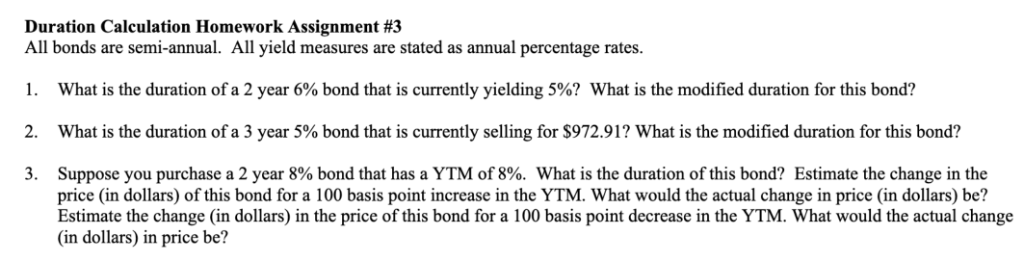
1. What is the duration of a 2 year 6% bond that is currently yielding 5%? What is the modified duration for this bond?
2. Whats the duration of a 3 year 5% bond that is currently selling for $972.91? What is the modified duration for this bond?
3. Suppose you purchase a 2 year 8% bond that has a YTM of 8%. What is the duration of this bond? Estimate the change in the
price (in dollars) of this bond for a 100 basis point increase in the YTM. What would the actual change in price (in dollars) be?
Estimate the change (in dollars) in the price of this bond for a 100 basis point decrease in the YTM. What would the actual change
(in dollars) in price be?
Question:
Duration Calculation Homework Assignment #3
All bonds are semi-annual. All yield measures are stated as annual percentage rates.
1. What is the duration of a 2 year 6% bond that is currently yielding 5%? What is the modified duration for this bond?
2. Whats the duration of a 3 year 5% bond that is currently selling for $972.91? What is the modified duration for this bond?
3. Suppose you purchase a 2 year 8% bond that has a YTM of 8%. What is the duration of this bond? Estimate the change in the
price (in dollars) of this bond for a 100 basis point increase in the YTM. What would the actual change in price (in dollars) be?
Estimate the change (in dollars) in the price of this bond for a 100 basis point decrease in the YTM. What would the actual change
(in dollars) in price be?
This is AI generated Response.
Asked by: Sahab Sharan
Created at: 2025-09-16 09:12:51
Final Answer:
RenderedRaw Text
Did you like this answer?
# Duration Calculation Homework Assignment #3 Solutions
**Assumptions:**
- All bonds pay coupons semi-annually.
- Face value (FV) = $1,000 unless otherwise specified.
---
## 1. **Duration and Modified Duration of a 2-Year 6% Bond (Yield = 5%)**
### **Step 1: Calculate the Bond Price**
- Coupon (C) = 6% of $1,000 = $60/year = $30 per 6 months
- Number of periods (n) = 4 (2 years × 2)
- Periodic yield (y) = 5% / 2 = 2.5% = 0.025
\[
P = \sum_{t=1}^4 \frac{30}{(1 + 0.025)^t} + \frac{1000}{(1 + 0.025)^4}
\]
Let’s compute:
- \( (1+0.025)^1 = 1.025 \)
- \( (1+0.025)^2 = 1.050625 \)
- \( (1+0.025)^3 = 1.076890625 \)
- \( (1+0.025)^4 = 1.1038128906 \)
\[
P = \frac{30}{1.025} + \frac{30}{1.050625} + \frac{30}{1.076890625} + \frac{30}{1.1038128906} + \frac{1000}{1.1038128906}
\]
\[
P = 29.27 + 28.57 + 27.86 + 27.19 + 906.73 = \$1,019.62
\]
---
### **Step 2: Calculate Macaulay Duration**
\[
\text{Macaulay Duration} = \frac{1}{P} \sum_{t=1}^n \frac{t \cdot CF_t}{(1+y)^t}
\]
Where \( t \) is the period in half-years.
\[
\text{Macaulay Duration} = \frac{1}{1019.62}[1 \times 29.27 + 2 \times 28.57 + 3 \times 27.86 + 4 \times (27.19+906.73)]
\]
\[
= \frac{1}{1019.62}[29.27 + 57.14 + 83.58 + 3735.68] = \frac{1}{1019.62}[3905.67] = 3.83 \text{ half-years}
\]
Convert to years:
\[
3.83/2 = 1.92 \text{ years}
\]
---
### **Step 3: Modified Duration**
\[
\text{Modified Duration} = \frac{\text{Macaulay Duration}}{1 + \text{periodic yield}}
\]
\[
= \frac{1.92}{1 + 0.025} = \frac{1.92}{1.025} = 1.87 \text{ years}
\]
---
## 2. **Duration and Modified Duration of a 3-Year 5% Bond (Price = $972.91)**
### **Step 1: Find Yield to Maturity (YTM)**
- Coupon = $25 every 6 months, n = 6
- Price = $972.91
Solve for \( y \):
\[
972.91 = \sum_{t=1}^6 \frac{25}{(1+y)^t} + \frac{1000}{(1+y)^6}
\]
This requires trial and error or a financial calculator. Let’s estimate \( y \):
Trying \( y = 0.0275 \) (annual 5.5%):
\[
\text{PV of coupons: } 25 \times \left[ \frac{1 - (1+0.0275)^{-6}}{0.0275} \right] = 25 \times 5.659 = 141.48
\]
\[
\text{PV of principal: } \frac{1000}{(1.0275)^6} = 849.67
\]
\[
\text{Total PV} = 991.15 \text{ (Too high)}
\]
Try \( y = 0.03 \) (annual 6%):
\[
\text{PV of coupons: } 25 \times 5.417 = 135.43
\]
\[
\text{PV of principal: } \frac{1000}{(1.03)^6} = 837.48
\]
\[
\text{Total PV} = 972.91
\]
So, YTM (annualized) = 6%.
---
### **Step 2: Calculate Macaulay Duration**
\[
\text{Macaulay Duration} = \frac{1}{972.91}[1 \times 24.27 + 2 \times 23.57 + 3 \times 22.89 + 4 \times 22.22 + 5 \times 21.57 + 6 \times (20.92+746.06)]
\]
\[
\text{Dollar weights: }
\]
- \( t = 1: \frac{25}{1.03} = 24.27 \)
- \( t = 2: \frac{25}{(1.03)^2} = 23.57 \)
- \( t = 3: \frac{25}{(1.03)^3} = 22.89 \)
- \( t = 4: \frac{25}{(1.03)^4} = 22.22 \)
- \( t = 5: \frac{25}{(1.03)^5} = 21.57 \)
- \( t = 6: \frac{25}{(1.03)^6} + \frac{1000}{(1.03)^6} = 20.92 + 837.48 = 858.40 \)
\[
\text{Numerator} = 1 \times 24.27 + 2 \times 23.57 + 3 \times 22.89 + 4 \times 22.22 + 5 \times 21.57 + 6 \times 858.40
\]
\[
= 24.27 + 47.14 + 68.67 + 88.88 + 107.85 + 5150.40 = 5487.21
\]
\[
\text{Macaulay Duration (in periods)} = \frac{5487.21}{972.91} = 5.64 \text{ periods}
\]
Convert to years: \( 5.64/2 = 2.82 \) years
---
### **Step 3: Modified Duration**
\[
\text{Modified Duration} = \frac{2.82}{1 + 0.03} = \frac{2.82}{1.03} = 2.74 \text{ years}
\]
---
## 3. **2-Year 8% Bond, YTM = 8%**
### **Step 1: Duration**
- Coupon = $40 every 6 months, n = 4, y = 8%/2 = 4% = 0.04
\[
P = \sum_{t=1}^{4} \frac{40}{(1.04)^t} + \frac{1000}{(1.04)^4}
\]
Values:
- (1.04)^1 = 1.04
- (1.04)^2 = 1.0816
- (1.04)^3 = 1.124864
- (1.04)^4 = 1.169858
\[
P = \frac{40}{1.04} + \frac{40}{1.0816} + \frac{40}{1.124864} + \frac{40}{1.169858} + \frac{1000}{1.169858}
\]
\[
= 38.46 + 36.99 + 35.56 + 34.20 + 855.13 = \$1,000.34
\]
(Pretty much at par.)
\[
\text{Macaulay Duration} = \frac{1}{1000.34}[1 \times 38.46 + 2 \times 36.99 + 3 \times 35.56 + 4 \times (34.20 + 855.13)]
\]
\[
= \frac{1}{1000.34}[38.46 + 73.98 + 106.68 + 3555.32] = \frac{1}{1000.34}[3774.44] = 3.77 \text{ half-years}
\]
Convert to years: \( 3.77/2 = 1.89 \) years
---
### **Step 2: Modified Duration**
\[
\text{Modified Duration} = \frac{1.89}{1.04} = 1.82 \text{ years}
\]
---
### **Step 3: Price Change for 100 Basis Point Change in YTM**
- 100 basis points = 1% = 0.01
\[
\Delta P \approx -\text{Modified Duration} \times \Delta y \times P
\]
\[
\Delta P \approx -1.82 \times 0.01 \times 1000 = -\$18.20
\]
#### **Actual Price Change (for +1% YTM, i.e., y = 9%)**
- New periodic yield = 9% / 2 = 4.5% = 0.045
\[
P_{new} = \sum_{t=1}^{4} \frac{40}{(1.045)^t} + \frac{1000}{(1.045)^4}
\]
- (1.045)^1 = 1.045
- (1.045)^2 = 1.092025
- (1.045)^3 = 1.141166
- (1.045)^4 = 1.192519
\[
P_{new} = 38.28 + 36.64 + 35.18 + 33.77 + 838.98 = \$982.85
\]
\[
\Delta P = 982.85 - 1000.34 = -\$17.49
\]
#### **For -1% YTM (y = 7%)**
- New periodic yield = 7% / 2 = 3.5% = 0.035
\[
P_{new} = \sum_{t=1}^{4} \frac{40}{(1.035)^t} + \frac{1000}{(1.035)^4}
\]
- (1.035)^1 = 1.035
- (1.035)^2 = 1.071225
- (1.035)^3 = 1.108718
- (1.035)^4 = 1.147523
\[
P_{new} = 38.65 + 37.28 + 35.89 + 34.59 + 871.42 = \$1,017.83
\]
\[
\Delta P = 1017.83 - 1000.34 = +\$17.49
\]
---
### **Summary Table**
| Scenario | Approx. Change (\$) | Actual Change (\$) |
|----------------------------|--------------------|--------------------|
| +100 bps (YTM to 9%) | -18.20 | -17.49 |
| -100 bps (YTM to 7%) | +18.20 | +17.49 |
---
## **Conclusion**
- **Duration** is a measure of interest rate sensitivity.
- **Modified duration** gives the approximate percentage change in price for a 1% change in yield.
- Actual price changes are slightly less (in absolute value) than estimated by modified duration due to bond convexity.
---
If you need detailed formulas, steps, or clarification, just ask!
VIPSolutions focuses on clear, step‑by‑step explanations so you can learn quickly. Whether you need an AI‑generated walkthrough or a short hint to get unstuck, each solution is organized for fast reading and easy review later.
Search similar questions, compare approaches, and bookmark the best answers for revision. Our goal is simple: quick, reliable study help that feels natural—not noisy.
 VIPSolutions
 Duration Calculation Homework Assignment #3
All bonds are semi-annual. All yield measures are stated as annual percentage rates.
1. What is the duration of a 2 year 6% bond that is currently yielding 5%? What is the modified duration for this bond?
2. Whats the duration of a 3 year 5% bond that is currently selling for $972.91? What is the modified duration for this bond?
3. Suppose you purchase a 2 year 8% bond that has a YTM of 8%. What is the duration of this bond? Estimate the change in the
price (in dollars) of this bond for a 100 basis point increase in the YTM. What would the actual change in price (in dollars) be?
Estimate the change (in dollars) in the price of this bond for a 100 basis point decrease in the YTM. What would the actual change
(in dollars) in price be?